Best Crypto Exchanges in Chile for 2026
Most Chileans buying crypto in 2026 want a clear answer to one question: Can I move pesos out of BancoEstado, Santander, BCI, Banco de Chile, or Itaú into an exchange, buy what I want, and get the money back into my account without the bank pausing the transfer for review?
We tested every major platform in Chile, and Bybit came out on top. The platform supports CLP funding through P2P, card, Apple Pay, and Google Pay, offers instant KYC verification, and a flat 0.1% spot fee that no competitor on this list matches at the same asset count.
Below are the six best crypto platforms that accept CLP deposits, offer Spanish user interfaces and local customer support, provide top-tier security, and have low investment fees.
Our Top Picks: Best Platforms for 2026

Top Crypto Exchange in Chile - Bybit
Bybit is our top pick in Chile for 2026. It offers a full Spanish interface, CLP funding through P2P, card, Apple Pay, and Google Pay against the major Chilean banks, and a flat 0.1% spot fee.
Available Markets
2,700+ Cryptocurrencies
CLP Deposit Methods
P2P, Cards, Apple Pay, Google Pay
Trading Fees
0.1% Spot Trading Fees
Compare Top Chilean Crypto Exchanges
1. Bybit
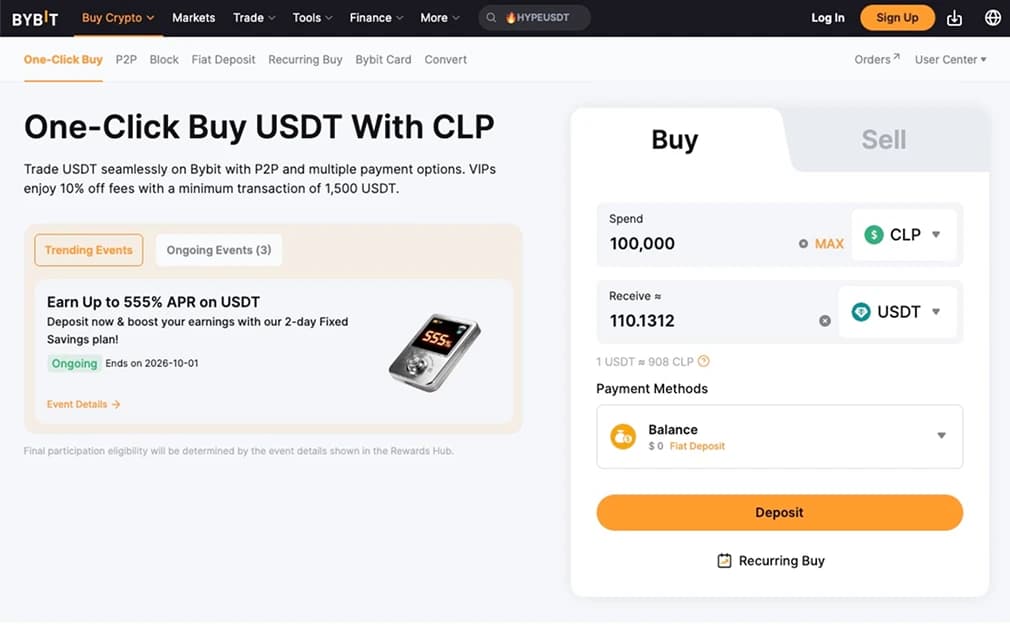
Bybit is the exchange we point Chilean users to first in 2026. The platform supports CLP funding via card, Khipu, and Apple Pay or Google Pay, with a genuinely deep CLP P2P order book against pesos from BCI, Banco Santander, BancoEstado, Banco de Chile, and Itaú.
The interface is fully translated, and customer support handles Spanish-language queries during Chilean business hours. What you get is a complete trading venue. There are over 2,700 spot pairs, perpetual futures, options, copy trading, the Bybit Card, trading bots, and Earn products.
Proof of Reserves is published regularly and audited by Hacken, with reserves above 100% for major assets. The constraint Chilean users need to be aware of is that Bybit does not hold CMF authorization under the Ley Fintec, so it operates as a cross-border platform.
Pros
- Flat 0.10% spot fees with VIP tier reductions, one of the lowest rates available to Chilean users on any exchange with this many listed assets.
- Spanish-language interface, mobile app rated highly across Android and iOS, and a P2P order book deep enough that pricing against CLP stays within roughly 1% of the spot rate on majors during business hours.
- 2,700+ cryptocurrencies, comprehensive product stack covering spot, perpetual futures, options, copy trading, the Bybit Card, and Earn.
Cons
- No CMF authorization under the Ley Fintec, so Bybit operates in Chile as a cross-border platform rather than a locally authorized one.
- No direct integration with Chilean banks at the platform level. Funding via local bank transfer happens through the P2P marketplace rather than a sponsored CLP account, which adds a counterparty step.
- The interface, while powerful, can feel dense for a first-time buyer. The default screen is a full trading terminal rather than a one-click buy button.
2. Gate
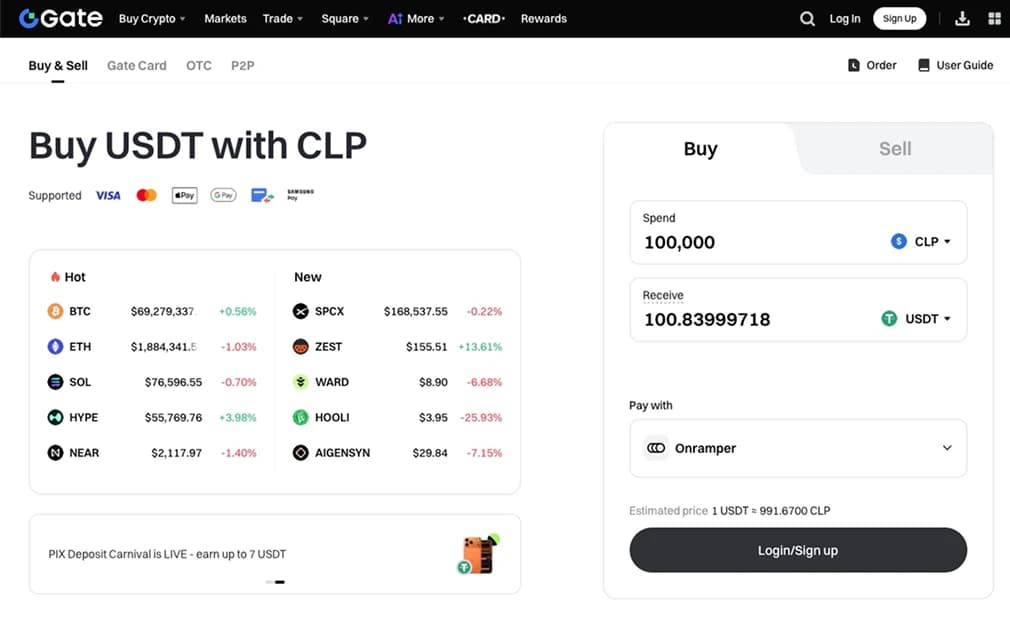
Gate is on this list for Chilean users who want access to the long tail of crypto: newly launched tokens, niche altcoins, and assets that take 6 to 12 months to appear on Bybit or Kraken. The platform lists over 4,600 cryptocurrencies, which is the widest selection of any exchange in Chile.
The product stack covers spot, perpetual futures with up to 100x leverage, leveraged ETFs, copy trading, automated bots, Simple Earn, crypto loans, and the Gate Card. Spot fees run at 0.20%, and security sits on a 126% total reserve ratio verified on-chain via Proof of Reserves.
CLP funding runs through the P2P marketplace against the major Chilean banks, card, and bank transfers routed through third-party providers. The P2P book is meaningfully deep on USDT/CLP, and the platform supports a Spanish interface with Chilean customer support.
Pros
- By far the largest asset selection on this list at 4,600+ cryptocurrencies, including newly launched tokens that take weeks or months to appear on Bybit, Kraken, or Coinbase.
- 126% on-chain verified reserve ratio, regularly published Proof of Reserves, and a comprehensive trading toolkit with copy trading, bots, leveraged tokens, perpetual futures, the Gate Card, and Simple Earn.
- Active P2P book against CLP with the major Chilean banks, a Spanish-language interface, and 0.20% spot fees with further VIP tier discounts for high-volume accounts.
Cons
- No CMF authorization under the Ley Fintec, so Gate operates in Chile as a cross-border platform with no Chilean dispute resolution scheme.
- The massive asset selection includes many low-liquidity tokens with elevated pump-and-dump risk, which require real due diligence before buying.
- CLP funding routes through P2P or card rather than a direct local bank transfer rail, which adds either a counterparty step or a card-network fee of 3% to 4%.
3. Kraken
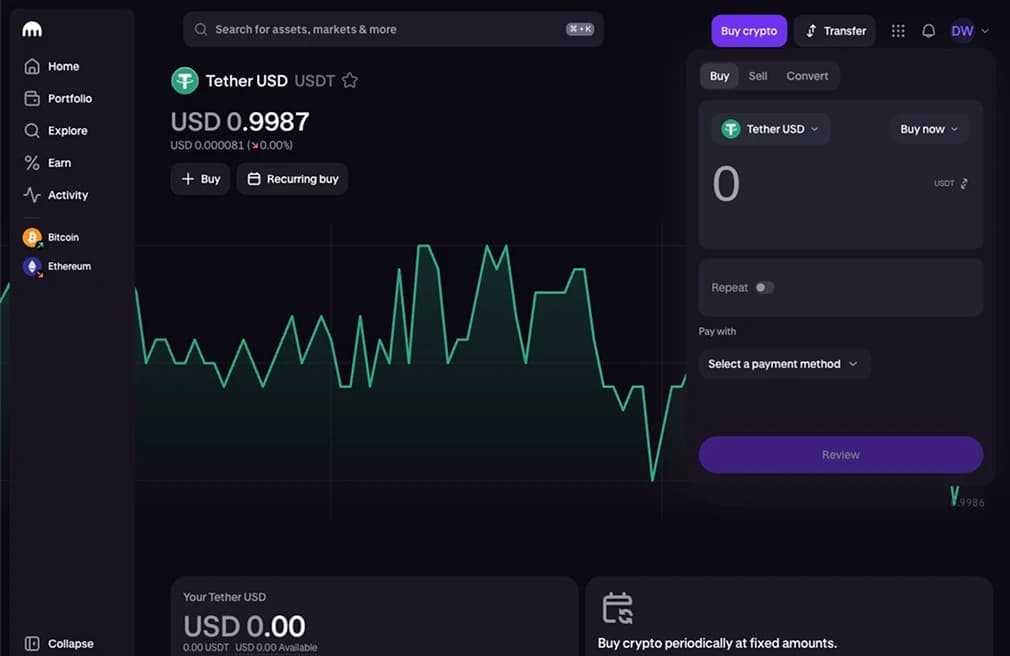
Kraken is the strongest choice for institutional users, family offices, and serious retail traders in Chile. The platform has been operating since 2011 with no security incidents, publishes audited Proof of Reserves regularly, and runs an OTC desk and a dedicated institutional services team.
For Chilean accounts, the product depth is the genuine selling point. Kraken Pro provides a full order book with limit, stop, take-profit, and conditional orders. Margin is available up to 5x, staking pays out weekly on most proof-of-stake assets, and futures are accessible for certain users.
The catch for Chile specifically is the funding mechanics. Kraken does not support direct CLP deposits. Funding happens via international wire in USD or EUR, which adds 1 to 5 business days for settlement and incurs 30 to 60 USD in correspondent bank charges, depending on your bank.
Pros
- Kraken Pro offers the deepest order book available to Chilean accounts on regulated venues, with margin up to 5x, staking, futures subject to eligibility, an OTC desk above 100,000 USD, and a dedicated institutional services team.
- Proof of Reserves has been published and audited regularly since well before it became an industry standard, with a security track record dating back to 2011 and no breaches.
- Tight spreads on majors, reliable stablecoin rails for moving in and out of positions, and an API that supports algorithmic execution at institutional latency.
Cons
- No direct CLP deposit rail. Funding happens via international wire in USD or EUR, which adds 1 to 5 business days of settlement and meaningful correspondent bank charges from any Chilean bank.
- No CMF authorization under the Ley Fintec, so the platform operates in Chile as a cross-border venue rather than a locally registered one.
- The Instant Buy interface starts at a 1% fee, which is steep, so Chilean users have to be willing to use Kraken Pro to get the proper fee schedule.
4. BingX
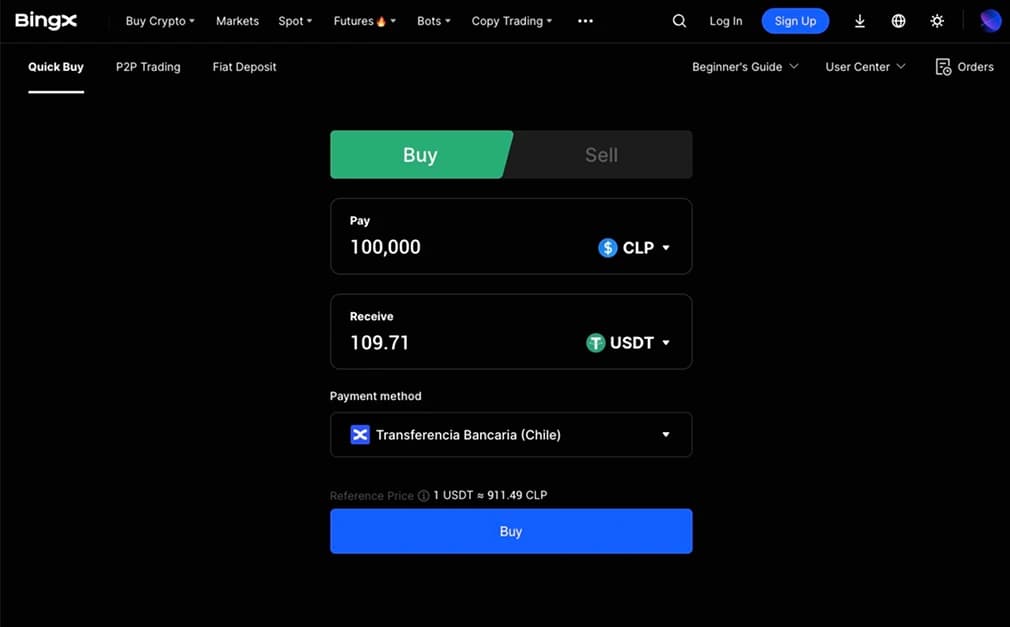
BingX is the platform we point Chilean users to when funding flexibility matters more than asset count. The exchange has been operating since 2018, serves over 40 million users globally, and has been pushing hard into Latin America with localized payment integrations across the region.
The P2P book covers direct bank transfer from BancoEstado, BCI, Banco de Chile, Santander, Itaú, and Scotiabank, plus the local fintech rails most Chileans actually use: MACH, Tenpo, Mercado Pago, and Khipu-routed bank payments.
Spot trading runs at 0.10% maker and taker, copy trading is well executed with transparent leaderboards, and the product stack covers spot, perpetual futures, grid bots, and a Spanish interface throughout. The asset list runs to around 1,000 cryptocurrencies.
Pros
- The widest range of CLP payment options on this list via P2P, covering direct bank transfers from all major Chilean banks, plus MACH, Tenpo, Mercado Pago, and Khipu, making it the most flexible funding rail for Chilean users.
- 0.10% spot fees, a well-built copy trading product with transparent leaderboards, and a Spanish interface with local support during business hours.
- Strong LATAM brand presence with the Chelsea FC partnership and regional marketing investment, plus a mobile app rated competitively on both Android and iOS.
Cons
- No CMF authorization under the Ley Fintec, no Chilean dispute resolution scheme, and Proof of Reserves cadence is less mature than what Bybit, Kraken, or Bitget publish.
- Asset selection of around 1,000 cryptocurrencies is well below Gate or MEXC, so the long tail of newly launched tokens is thinner.
- P2P pricing against CLP can drift further from the global spot rate during off-hours than what you see on Bybit, since the local liquidity pool is shallower.
5. MEXC
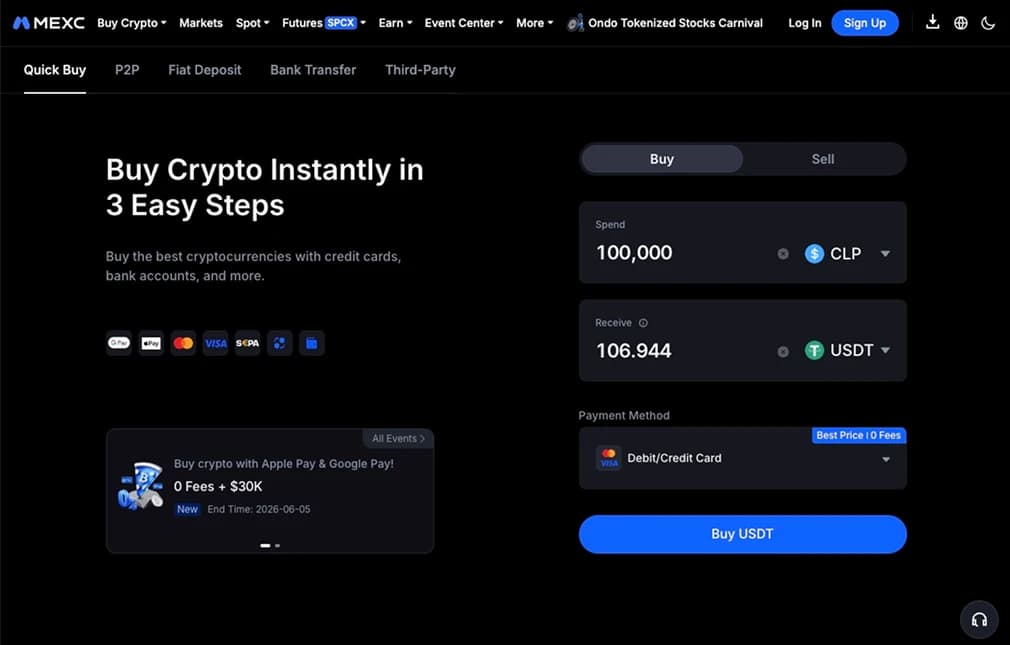
MEXC is on this list for Chilean traders who prioritize execution quality on majors over everything else. The platform ranks among the deepest order books globally for BTC/USDT and ETH/USDT, with tight spreads, and that matters once you start trading large positions.
Spot trading runs at 0% maker and 0.05% taker, which is the lowest on this list. Futures are 0.02% maker and 0.06% taker. The asset selection runs to over 2,900 spot pairs and 1,100 perpetual contracts, with new listings appearing among the fastest in the industry.
For Chile, the funding rail is exclusively P2P. There is no card processor, no direct bank transfer, and no Apple Pay or Google Pay. The CLP P2P book covers the major Chilean banks but is meaningfully thinner than Bybit or BingX, so larger first-time deposits can take longer.
Pros
- The deepest BTC and ETH order books on this list, with 0% maker and 0.05% taker spot fees and 0.02% maker and 0.06% taker futures fees, which is the lowest fee structure available to Chilean users at this liquidity level.
- 2,900+ spot pairs and 1,100+ perpetual futures contracts, with one of the fastest new-listing cadences in the industry and access to leveraged ETFs for short-term volatility plays.
- Reserve ratio is published regularly, and a Futures Insurance Fund provides a self-insurance layer for derivatives positions, plus a Spanish-language interface.
Cons
- CLP funding is limited to P2P only, with no direct bank transfer, card, or fintech rail at the platform level. The P2P CLP book is meaningfully thinner than Bybit or BingX, especially outside business hours.
- No CMF authorization under the Ley Fintec, no Chilean dispute resolution scheme, and a regulatory posture that has been challenged in several jurisdictions outside Chile.
- The product breadth is heavy on derivatives and altcoins, with less of the consumer-friendly tooling (recurring buys, simple onboarding flows) that Bybit or BingX provide.
6. Bitget
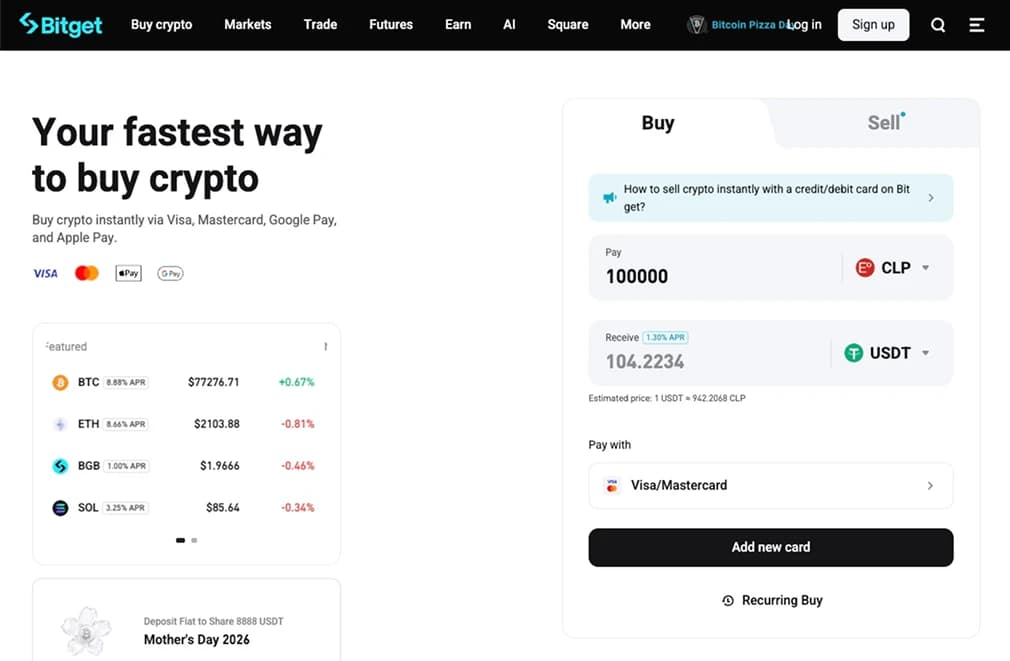
Bitget earns its place on this list for Chilean users interested in copy trading. The platform runs a 300 million USD on-chain Protection Fund and publishes Proof of Reserves regularly. Bitget offers spot, futures, automated bots, leveraged tokens, crypto loans, Simple Earn, and the Bitget Card.
Copy trading is the standout feature, and it is well executed. The leaderboards show transparent risk scores, profit-and-loss histories, win rates, and asset allocations for elite traders you can mirror, and it offers one of the largest pools of verified strategies among the major exchanges.
For Chile, funding runs through card and a P2P marketplace against pesos with the major Chilean banks. The P2P book is meaningfully thinner than Bybit on CLP pairs, and card deposits absorb 3 to 4% in all-in cost. The platform supports Spanish, and the mobile app is well-built.
Pros
- Copy trading is one of the most mature implementations on this list, with transparent leaderboards, risk scores, and a deep pool of elite traders to mirror, making it the easiest way for Chilean users to access active strategies without running them themselves.
- 1,300+ cryptocurrencies, 0.10% flat spot fees with BGB-holder discounts down to as low as 0.02%, and a 300 million USD on-chain Protection Fund providing a self-insurance layer.
- Comprehensive product stack including spot, perpetual futures, automated bots, leveraged tokens, crypto loans, Simple Earn, and the Bitget Card, all accessible from a single Chilean account.
Cons
- No CMF authorization under the Ley Fintec, no direct CLP bank transfer rail, and funding limited to card at 3 to 4% all-in cost or a P2P marketplace that is meaningfully thinner than Bybit on CLP pairs.
- Copy trading performance depends entirely on the traders you follow, and past performance is not a reliable guide to future returns.
- The 1,300+ asset catalog includes many low-liquidity tokens with elevated pump-and-dump risk that require thorough due diligence before buying.
Crypto and Bitcoin Regulation in Chile
Chile is one of the most clearly regulated crypto markets in Latin America in 2026. The framework rests on three pillars: the Ley Fintec, the AML/CFT regime supervised by the Unidad de Análisis Financiero, and the tax compliance layer administered by the Servicio de Impuestos Internos.
The first pillar is the Ley Fintec (Ley N° 21.521), established on 4 January 2023. The law defines crypto assets as digital representations of units of value, goods, or services that are distinct from money, and places cryptoasset exchanges under the supervision of the Comisión para el Mercado Financiero (CMF).
The CMF issued Norma de Carácter General N° 502 in January 2024, establishing the registration and authorization requirements for financial service providers. Entities providing the regulated services on a professional basis in or from Chile must file for inscription in the Registro de Prestadores de Servicios Financieros (RPSF).
The second pillar is AML/CFT supervision through the Unidad de Análisis Financiero (UAF). Crypto exchanges and other obliged entities must run KYC, monitor transactions, report suspicious operations, and maintain records.
The third pillar is tax. The SII treats crypto as an asset for income tax purposes, not as currency or foreign exchange. We cover the tax rules in the next section.
How Does the SII Tax Crypto?
The Servicio de Impuestos Internos treats crypto as a digital or virtual asset, not as legal tender or foreign currency. There is no separate crypto-specific tax regime in Chile, and crypto-related income is taxed under the standard income tax framework.
Here are the main taxes that apply to crypto for individuals in Chile:
- Impuesto Global Complementario: Profits from selling, swapping, or spending crypto are taxable income under the Global Complementario for resident individuals. The 2026 brackets are progressive, running from a 0% exempt tier to a top rate of 40% on the highest tier.
- Crypto-to-crypto swaps: Swapping BTC for ETH or for USDT is a disposal of the BTC at its fair market value in CLP, which means the gain or loss is realized at that moment, even if you have not converted back to pesos. This is the rule that catches most Chilean traders out.
- No Value Added Tax (VAT): The SII has confirmed in Oficio 963 and subsequent rulings that the sale of crypto assets is not subject to the 19% IVA, on the basis that crypto is an intangible asset.
- Losses are deductible against gains: Crypto disposal losses can be offset against other crypto gains in the same tax year, calculated on a per-transaction basis using the SII's preferred valuation method.
- Mining, staking, and airdrops: Treated as ordinary income at the CLP value on the date received, declared under the appropriate tax category. Mining-related expenses such as electricity and hardware may be deductible if the activity rises to the level of a habitual or business activity.
- Records must be kept for every transaction: Date, amount, CLP value at the time of the transaction, counterparty information where available, and any fees.
For most retail investors in Chile, the practical position is the Global Complementario applied at your marginal rate on the net annual crypto gain, declared in the Formulario 22 each April, with IVA exempt at the asset level but not necessarily at the service-fee level.
Cryptocurrency Adoption in Chile
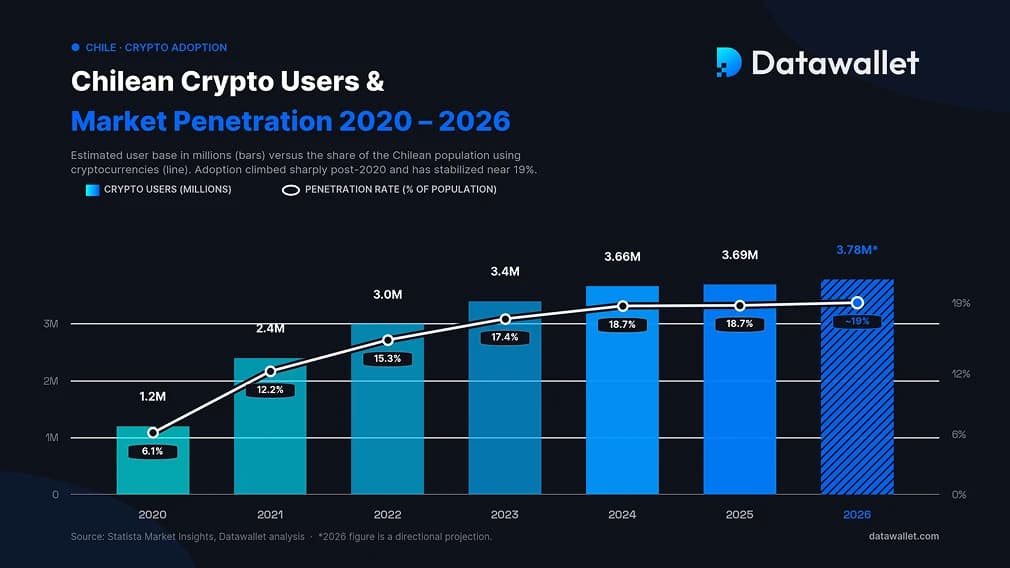
Crypto adoption in Chile in 2026 ranks in the upper-middle range of Latin America. The country has not produced a Bukele-style moment of national adoption like El Salvador, and Bitcoin is not legal tender. What has happened is a steady accumulation of retail ownership.
According to Statista Market Insights, the Chilean crypto user base was projected to reach 3.75 to 3.85 million people by the end of 2026, representing around 19% of the population, with annual revenue from crypto activity estimated at roughly US$232 to US$245 million by year-end.
The Chainalysis 2025 Cryptocurrency Report places Latin America at 1.5 trillion USD in crypto value received over the year through June 2025, with Brazil dominating the regional total. Chile sits behind Brazil and Argentina on absolute volume, but performs competitively on grassroots adoption.
Given the wide variation among Statista's 3.7 million user estimate, on-chain-derived estimates, and exchange-reported active user figures, these numbers should be treated as directional rather than precise.
How to Buy Bitcoin in Chile
For most Chilean users in 2026, the best setup is a platform with clean CLP funding from your local bank account or fintech wallet, fair trading fees, and a withdrawal path that actually works back to your cuenta corriente.
This is the process we use in Chile:
- Choose the right exchange: If price and product depth matter most, Bybit, Gate, or MEXC will give you the best execution. If funding flexibility matters more, BingX has the widest range of CLP P2P payment methods.
- Complete KYC verification: Finish identity verification before sending any funds. Chilean platforms typically need your cédula de identidad, a selfie or liveness scan, and a proof-of-address document from the last three months.
- Fund the account: For most Chileans on global platforms, the realistic option is P2P against USDT/CLP with a counterparty from your preferred bank, or a card-funded buy if you accept the 3 to 4% all-in cost.
- Buy Bitcoin on the spot market: If price matters, skip the one-click buy screen and use the BTC/USDT spot pair directly. A limit order just below the current ask usually gives you a cleaner execution than the instant quote.
- Move to self-custody for long-term holdings: If you are buying Bitcoin to hold for more than a few months, transfer it from the exchange to a hardware wallet such as a Ledger or Trezor.
That process gives Chilean users the cleanest path from a peso balance to Bitcoin in self-custody, while keeping exposure to platform risk and bank-side friction as low as practical in the current environment.
Final Thoughts
For most people in Chile right now, the right approach is straightforward: pick a platform that fits your priority on cost, asset depth, or funding flexibility, fund via P2P rather than card where possible, and test the exit path with a small withdrawal early.
Bybit is our top overall pick because it combines the lowest fees on this list at scale with a Spanish-language interface, deep CLP P2P liquidity against the major Chilean banks, and a comprehensive product stack covering spot, futures, copy trading, and Earn.
Whichever you pick, complete KYC before funding, start with a small test deposit and withdrawal to confirm everything works, and stay on top of your SII obligations through the annual Formulario 22 cycle.
Our Methodology
We evaluated over 12 crypto exchanges available to Chilean users by creating accounts, funding in CLP via P2P, card, and bank-routed payment rails, executing spot trades, and withdrawing back to Chilean bank accounts. Each platform was scored across six criteria:
- Trust Score: Our proprietary rating (out of 5) weights CMF authorization status under the Ley Fintec, UAF AML/CFT supervision, security history, proof of reserves transparency, platform longevity, and audit coverage. Exchanges with mature Proof of Reserves and clean security track records scored higher.
- CLP Funding Methods: Confirmed P2P, card, bank transfer, and payment rails from local banks, plus MACH, Tenpo, Mercado Pago, and Khipu. We tested settlement speed, P2P book depth, deposit limits, and the all-in cost from a Chilean peso balance into a tradeable position.
- Chilean Regulatory Standing: Verified each platform's RPSF status via the CMF registry, cross-checked against the CMF's published list of unregistered entities, and confirmed AML/CFT posture against the UAF Circular N° 62 framework that entered into force on 1 June 2025.
- Security Track Record: Reviewed breach history, custody setup, proof of reserves cadence, segregation of client assets, and account-level protections, including 2FA, withdrawal whitelists, and anti-phishing codes.
- Assets and Liquidity: Tested execution by placing market and limit orders on BTC/USDT, ETH/USDT, and at least one mid-cap pair to measure spread, depth, and fill quality.
- Fee Structure: Compared maker and taker fees, deposit and withdrawal charges, P2P spreads, card-funded buy costs, and the all-in cost of a full peso-to-crypto-to-peso round trip rather than relying on headline fee tables.
We excluded platforms that have suspended services for Chilean users, platforms appearing on the CMF's public list of unregistered or unauthorized entities under enforcement action, and providers with no clear AML/CFT posture relevant to Chile. Testing ran from February to May 2026.
Frequently asked questions

.webp)