
6 Best Crypto Exchanges in Mexico
Mexico allows anyone to buy crypto while keeping its banks entirely out of the business. The Fintech Law of 2018 defined virtual assets, and then Banxico's Circular 4/2019 barred banks and licensed fintechs from offering them to clients. Individuals now trade freely on platforms the financial system itself cannot touch.
What makes Mexico workable is SPEI. Banxico's interbank transfer system settles in seconds, runs around the clock, and several exchanges plug into it directly through a CLABE, so pesos reach a trading account faster than most countries manage with cards. Cash users have a second door: OXXO's 23,000 convenience stores take peso deposits straight into Bitso.
We ran every platform through a Mexican user's full cycle: KYC with an INE credential, SPEI transfers from BBVA and Banorte accounts, P2P orders settled by bank transfer, and a peso withdrawal back to a CLABE.
Our Top Picks: Best Platforms for 2026

Top Crypto Exchange in Mexico - Bybit
Bybit is the best exchange in Mexico because it combines zero-fee SPEI peso deposits, 2,800+ assets at 0.1% spot fees, a full Spanish interface, P2P backup funding, copy trading, and monthly Proof-of-Reserves.
Available Assets
2,800+ Cryptocurrencies
Fees
0.1% Spot Trading Fees
MXN Deposit Methods
SPEI, Cards, P2P (Mercado Pago, Bank Transfer)
Compare Top Mexican Crypto Exchanges
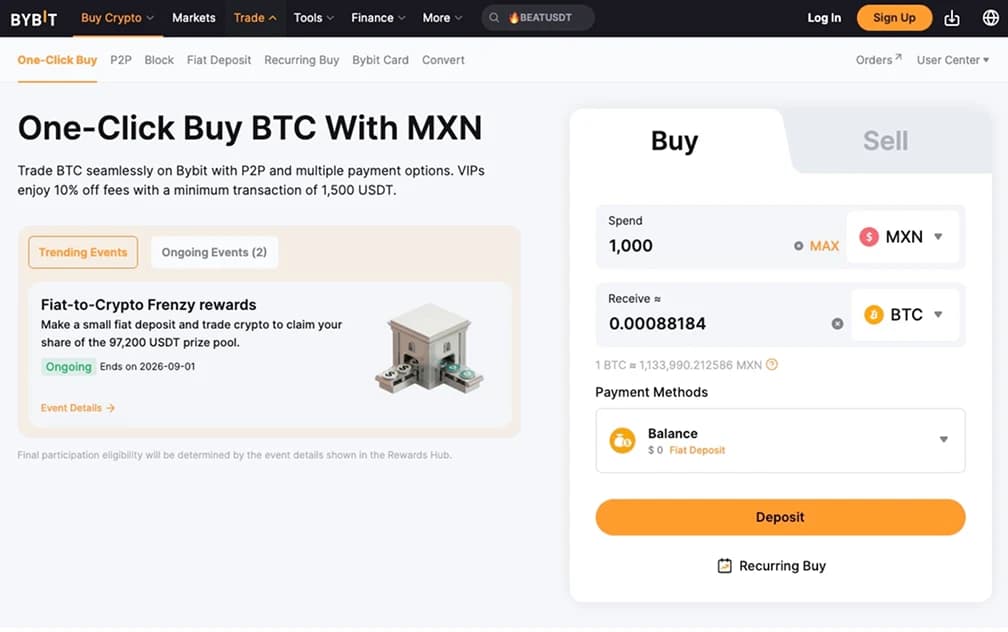
1. Bybit
Bybit ranks first because no other global platform treats the peso as a first-class currency. MXN deposits and withdrawals run over SPEI at no charge, the entire app operates in Spanish, and a Mastercard-backed Bybit Card lets balances be spent directly. Our SPEI test from a BBVA account landed as tradable MXN in under five minutes, and the withdrawal back cleared just as quickly.
Once funded, the product range outclasses everything else accessible from Mexico. Spot covers 2,800+ assets at a flat 0.1% fee, with perpetuals, options, grid bots, copy trading, demo trading, crypto loans and Bybit Earn stacked on top. A P2P desk is also available, accepting MXN for USDT, BTC, and ETH, with merchants taking Mercado Pago and standard bank transfers.
Two cautions apply. Bybit holds no Mexican authorization of any kind, so a dispute leaves you with the platform's own support and nothing else. And because every swap on the exchange counts as a disposal under SAT rules, exporting trade history monthly beats reconstructing a year of activity each April. The full platform breakdown sits in our Bybit review.
Pros
- Zero-fee SPEI peso deposits and withdrawals, plus card and P2P alternatives.
- 2,800+ assets across spot, derivatives, copy trading, and Earn at 0.1% spot fees.
- Fully Spanish interface, support chat, and a Bybit Card for spending in Mexico.
Cons
- No Mexican regulator stands behind the platform if something goes wrong.
- Derivatives sit one tap away from the spot screen, tempting new users to take on leverage.
- Card top-ups carry a processor markup that SPEI avoids entirely.
2. Kraken
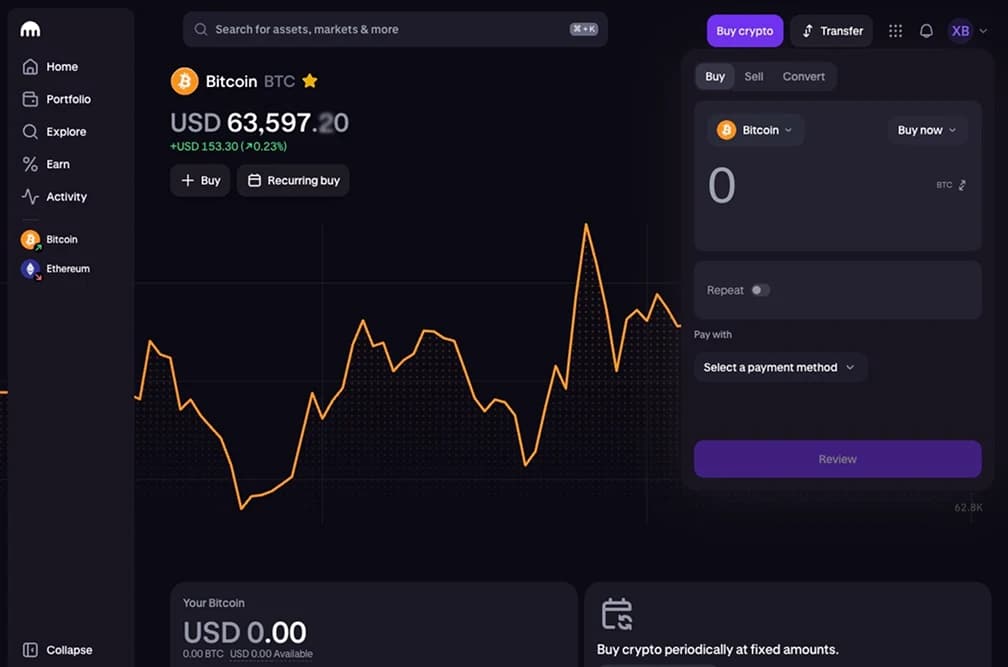
Kraken earns second place on a security record that matters more in Mexico than coin counts do. Fifteen years of operation without a major breach, 1:1 Proof-of-Reserves audits, and the bulk of client assets in cold storage make it the venue we point peso savers toward when they plan to hold a balance on an exchange rather than in self-custody.
Funding works through SPEI, with one mechanic worth understanding before you send anything. Pesos convert to US dollars on arrival, since Kraken holds no MXN balances. Withdrawals reverse the conversion back to pesos. That forced USD conversion cuts both ways. This means forex fees in both directions, yet many Mexican users treat the dollar balance as a feature.
Kraken Pro prices start at 0.4% maker and 0.8% taker at base volume across 475+ assets, with staking, futures, and an OTC desk for size. Our Kraken review covers the full product suite. Kraken’s user interface can also be used in Spanish on both mobile apps and desktop, simplifying access for local traders.
Pros
- Cleanest security history of any exchange serving Mexico, with audited 1:1 reserves.
- Direct SPEI deposits and withdrawals tied to your CURP or RFC, which keeps the SAT paper trail tidy.
- A professional trading stack with staking, futures, and OTC for larger orders.
Cons
- Deposited pesos convert to USD automatically, adding FX cost in both directions.
- A conservative listing policy means fewer altcoins than every rival here.
- Instant buys outside Kraken Pro carry a spread that punishes casual orders.
3. OKX
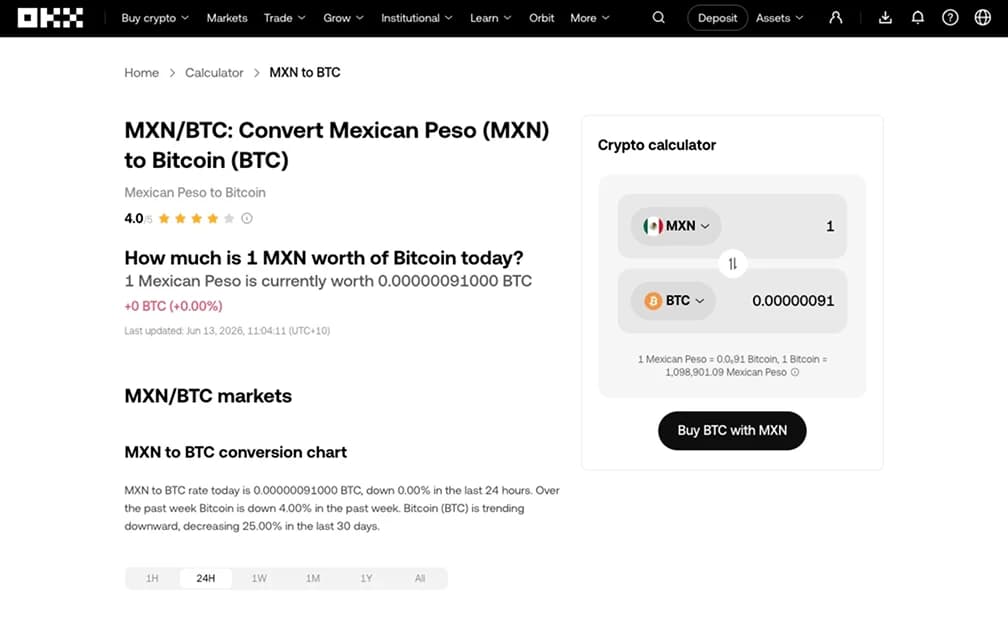
OKX wins when it comes to overall costs. Spot fees of 0.08% maker and 0.10% taker undercut every major exchange available in Mexico, and the app bundles a Web3 wallet that opens DeFi, DEX trading, and on-chain tokens without a separate install. For the crowd moving past simple holding into on-chain activity, that single-app setup saves real friction.
The peso enters through cards or the P2P marketplace, where merchants settle by SPEI or ordinary bank transfer into escrow. Our P2P test order, paid via transfer from a Banorte account, was released in about 8 minutes at a spread of under 2% of the mid-market USDT price. The exchange publishes monthly Proof-of-Reserves attestations and lists around 350+ spot assets.
Two facts should be considered. There is no direct SPEI integration, so funding always involves either a card markup or a P2P counterparty. And in February 2025, OKX settled with US authorities for over $500 million across anti-money-laundering failures, a compliance mark the cleaner records here do not carry. More details can be found in our OKX review.
Pros
- 0.08% maker and 0.10% taker fees, the cheapest order-book pricing on this list.
- Integrated Web3 wallet for DeFi and DEX access from one app.
- Monthly Proof-of-Reserves with a consistent publication history.
Cons
- No direct SPEI channel, leaving cards and P2P as the only peso entry points.
- The 2025 US settlement weighs on an otherwise solid record.
- Web3 depth adds complexity a first-time buyer never needs.
4. Binance
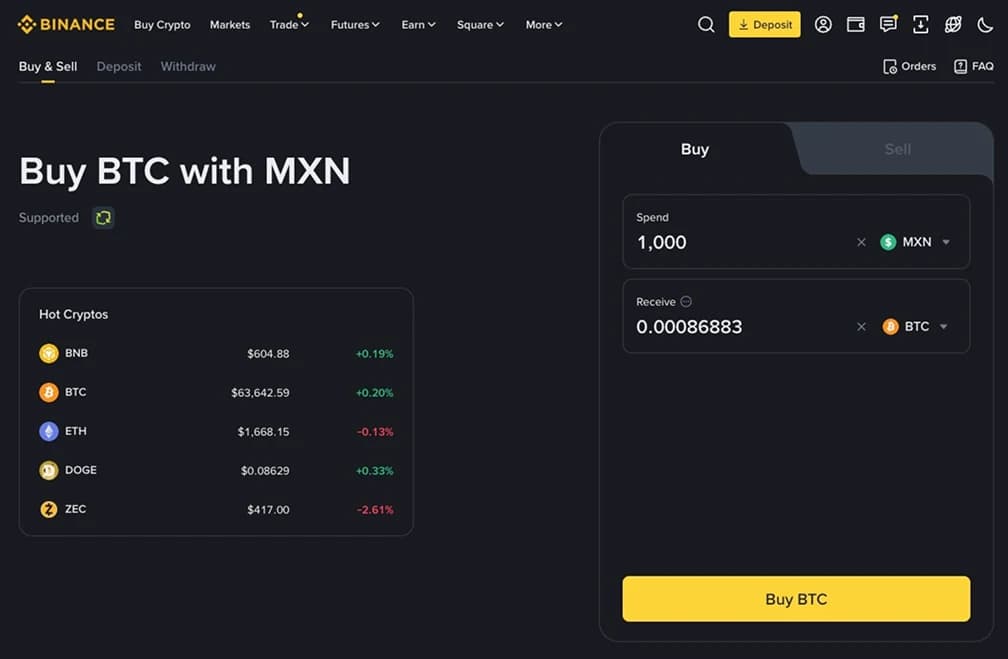
Binance brings the deepest order books in the industry to Mexico, and it has done more local groundwork than most offshore platforms. Peso deposits and withdrawals are processed via SPEI through Medá, an institution licensed by the CNBV, while the operating entity holds a Vulnerable Activity registration with the SAT under Mexico's AML framework. Few global exchanges can show that much local paperwork.
Liquidity remains the core case. On BTC and ETH pairs, fills barely move the price at sizes that would visibly shift thinner books, and 500+ assets trade at 0.1% spot fees before BNB discounts. Earn, Launchpool, Auto-Invest, Copy Trading, and one of the busiest MXN P2P marketplaces round out the package, with merchants accepting SPEI and bank transfers.
Set against that is history. The 2023 US settlement still colors the compliance picture globally, and unlike Bitso's free peso rails, Binance applies a fee on MXN withdrawals, so model the round-trip cost before parking serious size. Fee tiers and products are unpacked in our Binance review.
Pros
- SPEI peso rails through a CNBV-licensed payments partner, with a SAT registration behind the local entity.
- The deepest spot liquidity of any platform that a Mexican user can reach.
- Broad Earn suite, Launchpool access, and a long-running SAFU insurance fund.
Cons
- MXN withdrawals carry a fee that Bitso and Bybit avoid.
- The 2023 US settlement remains the industry's heaviest compliance scar.
- Feature sprawl makes the app slow to learn for a first purchase.
5. Gate
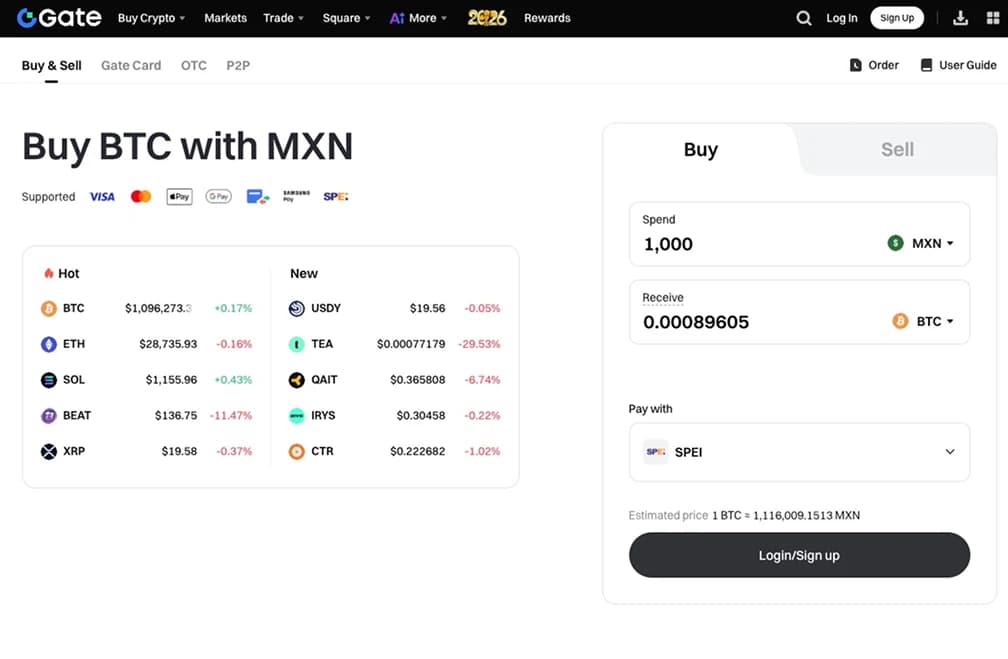
Gate is on this list for one reason: catalog depth nobody else matches. With 4,800+ listed assets, it regularly carries small-cap and newly launched tokens months before they appear on Bybit or Binance, which makes it the venue Mexican altcoin hunters end up opening sooner or later. Traders can find anything from altcoins and memecoins to DeFi tokens and stablecoins.
Peso support is the weak point. MXN P2P liquidity is thin, so the practical approach is to buy USDT on Bybit, Binance, or Bitso first and move it across via a TRC20 transfer, which costs about a dollar and settles in minutes. Direct MXN card purchases work as a fallback at a processor markup ranging from 1.99% to 3.99%.
Once funded, spot pricing runs 0.09% maker and 0.10% taker, alongside copy trading, bots, a Launchpad, and one of the higher published reserve ratios among major exchanges. Our Gate review goes deeper. Treat it as a second account rather than a first stop. The long tail of listings includes plenty of thin, speculative tokens, and a market that punishes careless position sizing.
Pros
- 4,800+ assets, the widest selection reachable from Mexico by a wide margin.
- Competitive 0.09% maker and 0.10% taker spot fees with copy trading and bots.
- A high published reserve ratio relative to major-exchange peers.
Cons
- Almost no peso on-ramp, so funding means a stablecoin transfer from elsewhere.
- Long-tail listings carry real liquidity and quality risk.
- Less local brand presence and Spanish-language polish than the venues above.
6. Bitso
Bitso is the exchange built for Mexico rather than adapted to it. Founded in Mexico City in 2014 and now serving roughly 9 million users across Latin America, it offers free SPEI deposits and withdrawals, and the only cash on-ramp on this list: handing pesos over an OXXO counter credits your account for a fee of 2.6% plus IVA. Our OXXO test deposit appeared in the app before we left the store.
The security record is genuinely strong. No hack in over a decade, monthly solvency proofs published using zero-knowledge technology, ISO 27001 certification, and insurance on custodial holdings. Bitso also issues MXNB, a peso-pegged stablecoin backed 1:1 and attested quarterly, and its business arm moved $6.5 billion of US-Mexico remittances in 2024, north of a tenth of the corridor.
Costs need to be read carefully. The simple app shows 0% commission but prices through a spread, so active traders belong on Bitso Alpha, the order-book product with tiered maker and taker fees. And while Bitso registers under Mexico's AML framework and holds a Gibraltar DLT license, no Mexican license for client-facing crypto services exists for anyone to hold, a gap covered in the regulation section below.
Pros
- Free SPEI peso rails plus OXXO cash deposits, the most complete MXN funding in the market.
- A decade-plus security record with monthly zk solvency proofs and ISO 27001 certification.
- MXNB peso stablecoin and remittance infrastructure no foreign venue replicates.
Cons
- Spread pricing in the simple app makes the 0% fee headline misleading for larger orders.
- 200+ assets trail every global platform on this list.
- Yield products advertise variable rates that deserve a close read before committing funds.
.webp)
How to Choose a Crypto Exchange in Mexico
Picking a platform here is mostly a question of how your pesos get in, what evidence you keep, and where your holdings end up. Four checks we apply:
- Test SPEI before anything else. Direct SPEI support distinguishes the convenient venues (Bybit, Bitso, Kraken, Binance) from those that require cards or P2P (OKX, Gate). Send a small transfer first, since bank-side handling varies: accounts at BBVA, Banorte, Santander, and Banamex all cleared our test deposits.
- Keep your RFC and CURP consistent everywhere. Kraken requires them at deposit, and the SAT can match exchange reports against your declarations. Mismatched names or third-party accounts are the fastest way to a frozen transfer.
- Save proof of every acquisition. Your cost basis, adjusted for inflation, is what stands between paying ISR on your gain and arguing with the SAT about the whole sale amount. Download statements monthly instead of trusting an app to still exist at filing time.
- Match the venue to the job. Active traders fit Bybit or OKX, long-term holders fit Kraken plus a hardware wallet, altcoin specialists fit Gate, cash-based and remittance users fit Bitso, and anyone buying stablecoins specifically should read our guide to buying USDT in Mexico.
Crypto and Bitcoin Regulation in Mexico
Mexico's framework pairs clear definitions and broad personal freedom with a financial system ordered to stay away. Here is a quick summary:
- The Fintech Law (2018): Article 30 of the Ley para Regular las Instituciones de Tecnología Financiera defines virtual assets as electronically registered representations of value that are not legal tender. Buying, selling, holding, and mining remain legal for individuals and ordinary companies.
- Banxico's Circular 4/2019: The central bank prohibited banks and licensed fintech institutions (ITFs) from offering virtual asset services to clients, permitting only limited internal uses with prior authorization. A joint 2021 statement from Banxico, the SHCP, and the CNBV repeated the warning, which is why no Mexican bank app sells Bitcoin.
- No exchange license exists: Client-facing crypto services sit outside what regulated entities may offer, so platforms serve Mexicans without a CNBV crypto license. None exists to obtain, and their local obligation runs through AML law instead.
- The Ley Antilavado (LFPIORPI): Virtual asset operations are designated as a Vulnerable Activity. Platforms and businesses dealing in them must register with the SAT and report operations above roughly 645 UMA, around MX$75,700 in 2026, to the Financial Intelligence Unit (UIF) by the 17th of the following month.
Banxico shows no sign of softening. In December 2025, it warned that stablecoins pose financial stability risks and reiterated its preference for maintaining distance between banks and virtual assets, even as Fintech Law reform talks continue into 2026.
How is Crypto Taxed in Mexico?
The Servicio de Administración Tributaria (SAT) applies general tax law to crypto rather than a dedicated regime, treating virtual assets as intangible movable property. The obligations that matter:
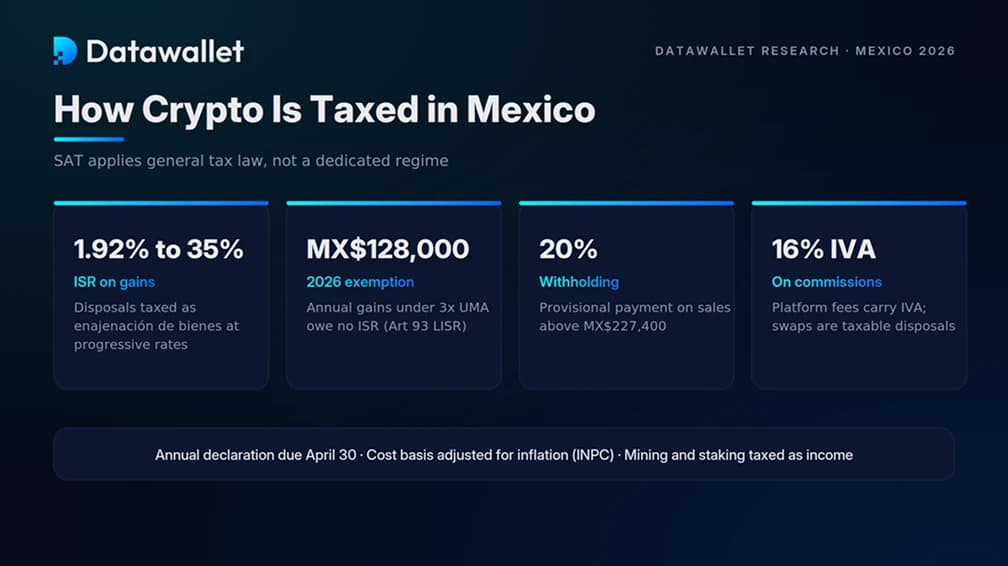
- ISR on disposals: Selling, swapping, or spending crypto is an enajenación de bienes. The gain, calculated as the sale price minus the acquisition cost, adjusted for inflation using the INPC, accrues to your annual income and is taxed at progressive rates ranging from 1.92% to 35%.
- A useful exemption: Article 93 of the income tax law exempts individuals whose total annual gains from disposals of movable property stay under three times the annual UMA, roughly MX$128,000 for 2026. Below that line, you owe no ISR on the gains, though records proving it are still required.
- The 20% withholding rule: For individual sales above MX$227,400, tax guidance from PRODECON indicates the buyer must withhold 20% of the transaction as a provisional payment. This mechanism mostly bites in direct OTC and P2P deals rather than on exchanges.
- IVA and other income: Platform commissions are subject to 16% IVA. Mining and staking rewards are taxed as ordinary income at their peso value when received. The annual declaration for individuals is due April 30, and omitting tax draws a fine of 55% to 75% plus surcharges.
Compared with the regimes in our best low-tax crypto countries guide, Mexico lands mid-table: no flat punitive rate, a real exemption for small gains, but full progressive taxation above it. Confirm your position with a Mexican contador, since this is general information rather than tax advice.
Cryptocurrency Adoption in Mexico
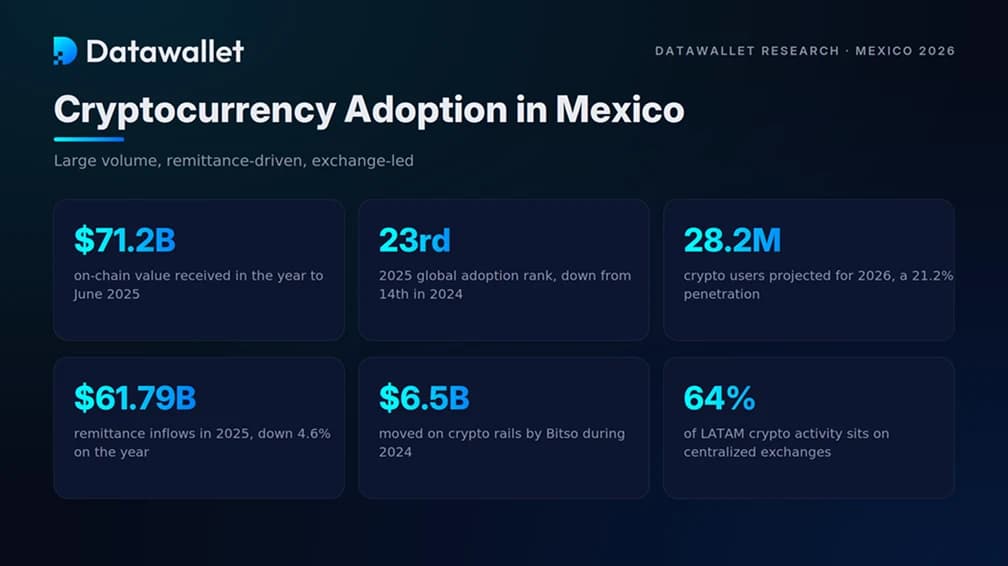
Mexico's adoption profile contradicts itself. On-chain volume ranks among the world's largest, yet the country keeps sliding down per-capita indices. The headline numbers:
- On-chain value received: $71.2 billion in the year to June 2025 per Chainalysis, third in Latin America behind Brazil and Argentina.
- Global adoption rank: 23rd on the Chainalysis 2025 Global Crypto Adoption Index, down from 14th in 2024.
- User base: 28.2 million crypto users projected for 2026, a 21.2% penetration rate, per Statista Market Insights.
- Remittance inflows: $61.79 billion in 2025 per Banxico data, down 4.6% year on year.
- Crypto-rail remittances: $6.5 billion moved by Bitso Business in 2024, over a tenth of the US corridor.
- Exchange concentration: 64% of Latin American crypto activity runs through centralized exchanges per Chainalysis, second only to MENA.
Mexican crypto is concentrated in high-value remittance and business transfers rather than mass retail speculation.
Chainalysis weights its index by population and purchasing power, so a market where payment companies push billions through stablecoin corridors while the median household holds nothing scores lower than its raw throughput suggests. To see how Mexico sits globally, check our crypto adoption statistics page.
How to Buy Bitcoin in Mexico
Buying Bitcoin in Mexico requires using a regulated crypto exchange. The clean sequence pairs SPEI funding with records that the SAT will accept later:
- Open the account that matches your money: Bank-account users should start with Bybit or Bitso for free SPEI rails, cash earners with Bitso for OXXO deposits, and security-first holders with Kraken, accepting the USD conversion step.
- Clear KYC with Mexican documents: An INE credential or passport plus a selfie verified within hours everywhere we tested. Have your CURP and RFC ready, since several platforms now request them during onboarding or at first deposit.
- Send pesos by SPEI: Copy the CLABE from the deposit screen and transfer from your own bank app. Start small to confirm your bank passes the payment without friction, then scale. Keep the SPEI receipt, as it documents your acquisition cost.
- Buy BTC with a limit order: Use the order book interface and place a limit order on BTC/MXN or BTC/USDT. Instant-buy screens price through spreads of 1% or more that a limit order sidesteps.
- Move long-term holdings off the exchange: Anything you are not actively trading belongs in self-custody. Our best crypto wallets guide covers hardware and software options.
Exiting reverses the path: sell into MXN, withdraw by SPEI to your own CLABE, and file the gain or the exemption evidence with your annual declaration.
Final Thoughts
Mexico offers something rare in emerging markets: instant, nearly free fiat rails into crypto, full legal freedom for individuals, and a tax regime with a genuine small-gains exemption, all under a regulator that simply refuses to let banks join in.
Bybit takes the overall title on peso rails plus product depth, Kraken is the custody-safety pick once you accept the forced USD conversion, OKX wins on fees, Binance on liquidity, Gate on diversity, and Bitso remains the platform Mexico actually built, with the only cash door in the market.
For the regional picture, our guide to the best crypto exchanges in Argentina covers Latin America's other heavyweight market.
Our Methodology
We evaluated each platform by repeating the steps a user in Mexico would take: registering with an INE credential, supplying CURP and RFC where requested, funding via SPEI, cards, OXXO, and P2P merchants, executing spot trades, and withdrawing pesos to a CLABE. Six criteria set the rankings:
- Trust Score: A 5-point rating weighing security history, reserve transparency, local registrations, and years of operation.
- MXN Funding Access: Speed, cost, and reliability of moving pesos in and out, tested across SPEI, cards from major Mexican banks, OXXO cash, and P2P settlement.
- Fees: Headline maker and taker rates plus the full round-trip cost including spreads, card markups, and withdrawal charges.
- Asset Range: Coverage from majors and stablecoins through long-tail tokens, derivatives, and adjacent products like stocks.
- Tax Practicality: Whether statements and receipts from the platform hold up as cost-basis evidence under SAT rules.
- Local Usability: Spanish-language quality, KYC friction with Mexican documents, app performance, and the peso exit path.
Funding quality carried the most weight, because in a market with rails as good as SPEI, an exchange that cannot use them properly gives up its main local advantage. Testing ran from March to June 2026.
Frequently asked questions


.webp)
.webp)
