




Compare Top Decentralized Exchanges
1. Hyperliquid
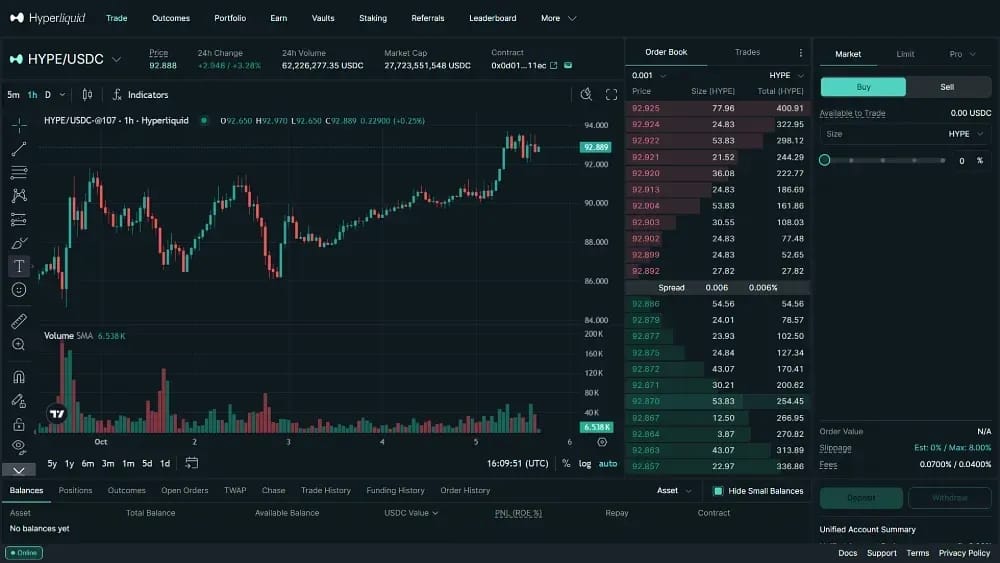
Hyperliquid holds first place in 2026 because a single self-custodial account reaches crypto spot, crypto perpetuals, and non-crypto perpetuals built through HIP-3. Without moving collateral, traders can switch among Bitcoin, the licensed S&P 500 contract, gold, crude oil, single stocks, and pre-IPO markets. HIP-4 adds outcome contracts to the same environment.
That range is backed by substantial depth. The Block reported open interest above $14 billion in September 2026, with HIP-3 markets accounting for about a quarter. Maximum leverage varies by asset from 3x to 40x. Traders can use market, limit, scale, and time-weighted average price orders to manage entries and slippage.
Costs remain competitive with centralized venues. Base fees are 0.045% taker and 0.015% maker for perps, compared with 0.070% and 0.040% on spot. Spot volume receives double weight toward 14-day fee tiers. Trading is gasless, HYPE stakers can earn additional discounts, and Coinbase began routing Base App orders into Hyperliquid liquidity in August 2026.
Pros
- Crypto spot, perps, stocks, metals, oil, indices, and outcome markets.
- Deepest onchain perp liquidity, with open interest above $14 billion.
- Gasless trading with scale, TWAP, and reduce-only order controls.
- Spot volume receives double weight in fee-tier calculations.
Cons
- Non-crypto markets are perpetual contracts, not the underlying assets.
- HIP-3 markets rely on deployer-managed oracles and carry higher fees.
- The main interface remains restricted for US traders.
- Leverage up to 40x raises liquidation risk during sharp moves.
2. Uniswap
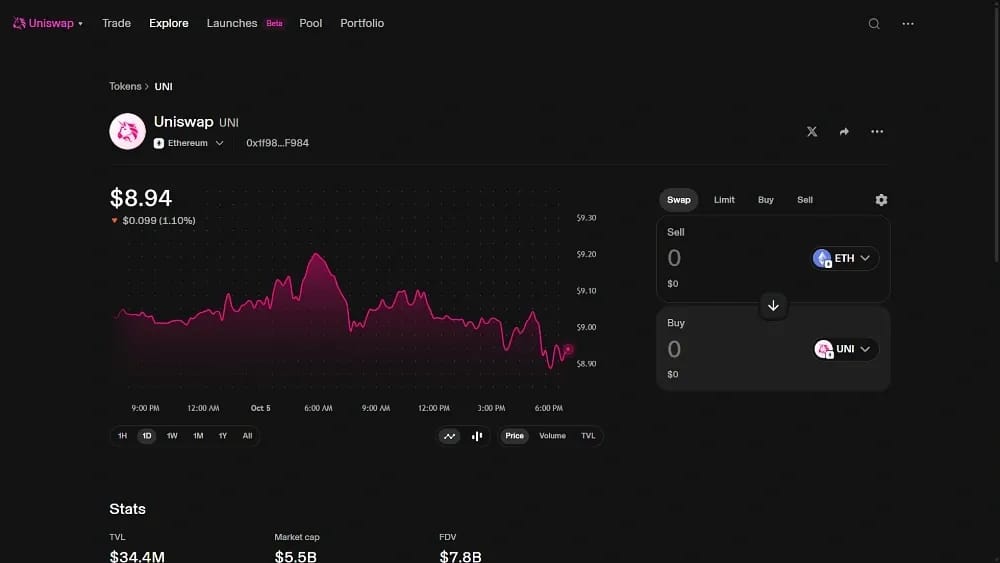
Uniswap remains our choice for EVM-chain spot swaps, but the center of its activity shifted during 2026. Uniswap v4 overtook v3 in monthly volume. Within weeks of its July launch, Robinhood Chain became the protocol's busiest network. September also brought a deployment on Circle's Arc alongside Ethereum, Base, Arbitrum, and Unichain.
Execution can draw from v2, v3, and v4 liquidity, including pools that use custom hooks. For eligible orders, UniswapX adds competition between third-party fillers. Permissioned Pools arrived on v4 in August, allowing issuers of tokenized funds and stocks to enforce access rules on each swap without giving up automated market maker liquidity.
Trader pricing is straightforward. Uniswap Labs applies a 0% interface fee, leaving swappers to pay pool fees and gas. Following the UNIfication vote, part of the pool fees on Ethereum and major rollups now funds UNI burns. That change slightly reduces liquidity-provider income in affected pools.
Pros
- Broad EVM coverage across 18+ networks, plus Solana swaps.
- Routing spans v2, v3, v4 hooks, and UniswapX fillers.
- Primary public AMM for stock tokens on Robinhood Chain.
- 0% Uniswap Labs interface fee on web and wallet swaps.
Cons
- The official interface blocks certain countries and flagged tokens.
- Protocol fees reduce liquidity-provider earnings on fee-switch pools.
- Permissioned pools require eligibility checks that exclude many wallets.
- Gas costs still depend on the selected network and congestion.
3. PancakeSwap
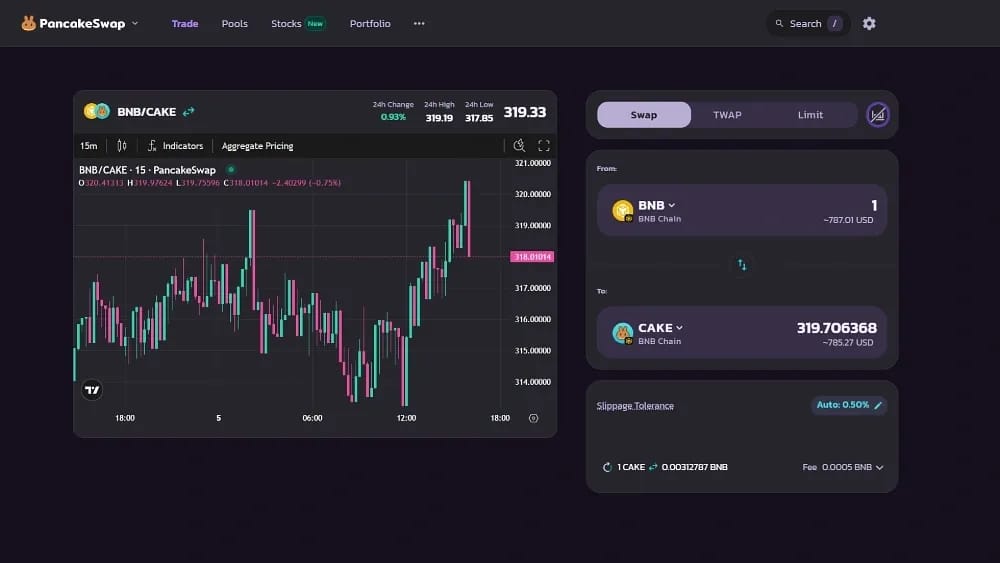
PancakeSwap is well suited to traders who want swaps, bridging, limit orders, time-weighted average price orders, and perpetual futures under the same brand. Its mid-year recap reports $4.2 trillion in cumulative volume across more than ten chains. BNB Chain, Base, and Arbitrum lead that activity, while newer Infinity pools have exceeded $150 billion.
The perpetuals product was rebuilt in 2026. Its new engine uses Aster's order-book infrastructure instead of the previous pool model, introducing a full book and leverage of up to 200x. A one-tap Simple Mode targets beginners. Execution remains onchain and non-custodial, while the portfolio page brings tokens, perp positions, and liquidity history into one view.
Spot trading extends well beyond basic swaps. Infinity supports hooks, custom fee logic, and liquidity bins. Fee-earning limit orders place one-sided liquidity near a chosen target price. PancakeSwap X routes tokenized stocks from Ondo, xStocks, and Robinhood, while MEV Guard protects eligible BNB Chain swaps from front-running and sandwich attacks.
Pros
- Swaps, bridge, limit orders, TWAP, and perps sit together.
- Infinity pools support hooks, dynamic fees, and liquidity bins.
- Order-book perps offer leverage up to 200x on majors.
- MEV Guard protects eligible BNB Chain swaps from sandwich attacks.
Cons
- Perps execution depends on Aster's separate order-book infrastructure.
- MEV Guard protection applies only to eligible BNB Chain swaps.
- Fee-earning limit orders cover limited pairs with a $50 minimum.
- 200x leverage can liquidate positions on very small moves.
4. Jupiter
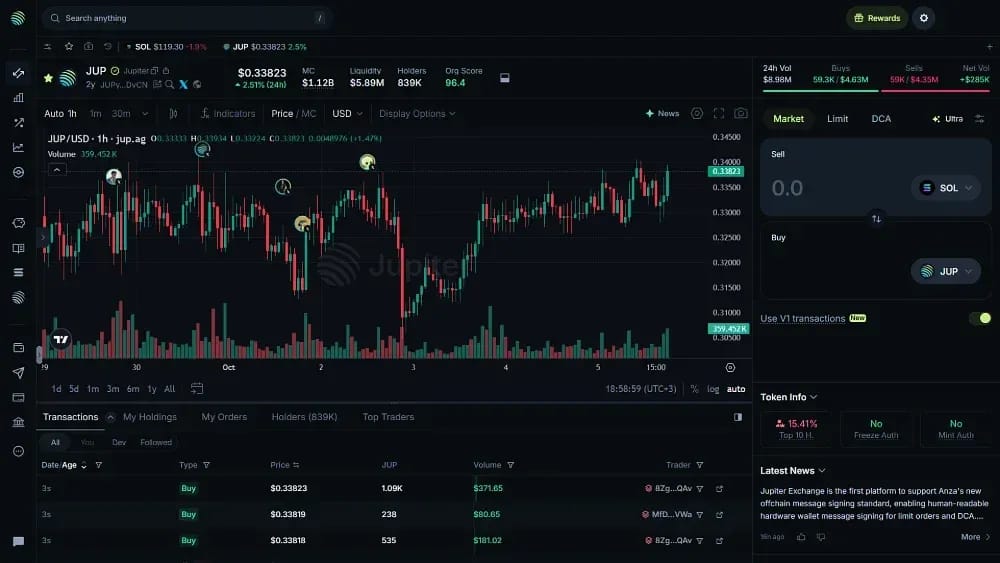
Jupiter earns its ranking through Solana's dominant aggregator and a derivatives business that continues to expand. Ultra routes across Solana pools, proprietary market makers, and request-for-quote desks. DefiLlama records roughly $1.29 trillion in lifetime aggregator volume and more than $500 billion in perpetuals volume.
Its order layer gives traders meaningful control over execution. Limit orders support buy-below and buy-above triggers, partial fills, plus take-profit and stop-loss exits. Recurring orders divide purchases into scheduled suborders and can include optional price ranges. Ultra also keeps transactions private until settlement and may cover network fees when a wallet holds little SOL.
Perpetuals expanded further in September 2026. Alongside SOL, ETH, and wBTC trading against the JLP pool, a new order book called GUM listed HYPE, ZEC, JUP, and tokenized SpaceX, SanDisk, and SK Hynix contracts with leverage up to 20x. Jupiter Lend also passed $2.4 billion in deposits, creating another use for idle collateral.
Pros
- Aggregates Solana pools, prop AMMs, and market-maker quotes.
- Limit orders include take-profit and stop-loss logic.
- Perps now span nine markets, including tokenized equities.
- Lend, JupUSD, and recurring orders sit in one app.
Cons
- New GUM perp markets are in beta with gated access.
- Stop-loss execution is not guaranteed under slippage limits.
- Ultra applies dynamic fees instead of fully free swaps.
- Solana focus limits direct coverage of EVM-chain assets.
5. Raydium
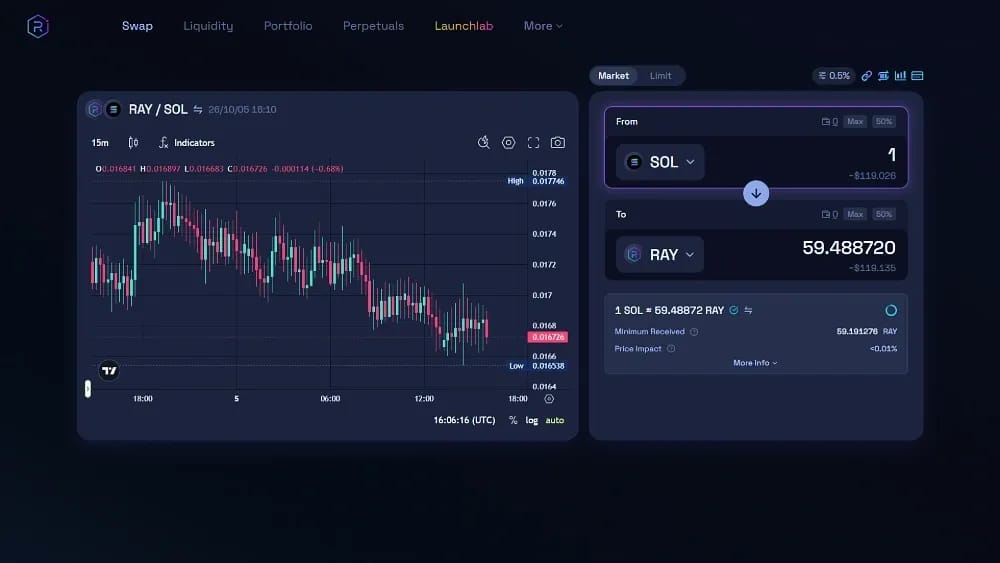
Raydium is Solana's most complete native DEX, bringing instant swaps, liquidity provision, token launches, and perpetuals into a single platform. DefiLlama tracks about $734 billion in lifetime spot volume across its pool programs. Our Raydium explainer details how its constant-product, concentrated-liquidity, and legacy pools work for traders and liquidity providers.
The trading interface does more than route a swap. It draws from onchain pools, displays price impact before confirmation, and charges standard-tier fees ranging from 0.01% to 1%, with most of each fee going to liquidity providers. Concentrated pools now support limit orders. Permissioned pools are also used for compliance-gated real-world assets available to eligible wallets.
LaunchLab has become the main 2026 development. A September upgrade allows new tokens to pair against any quote asset, including tokenized stocks and ETFs. Every launch now graduates into a constant-product pool with creator liquidity locked. Raydium Perpetuals, powered through Orderly, adds gasless order-book trading with a 0.045% taker fee and zero maker fees.
Pros
- Solana-native swaps, perps, pools, farms, and launches in one app.
- LaunchLab supports any quote asset, including tokenized stocks.
- CLMM pools can reduce price impact for active ranges.
- Perps charge zero maker fees on a gasless order book.
Cons
- Perps are unavailable in several restricted jurisdictions.
- CLMM positions require active monitoring and range management.
- LaunchLab tokens can carry extreme volatility and liquidity risk.
- Prop AMMs now win much of Solana's blue-chip order flow.
6. Aerodrome
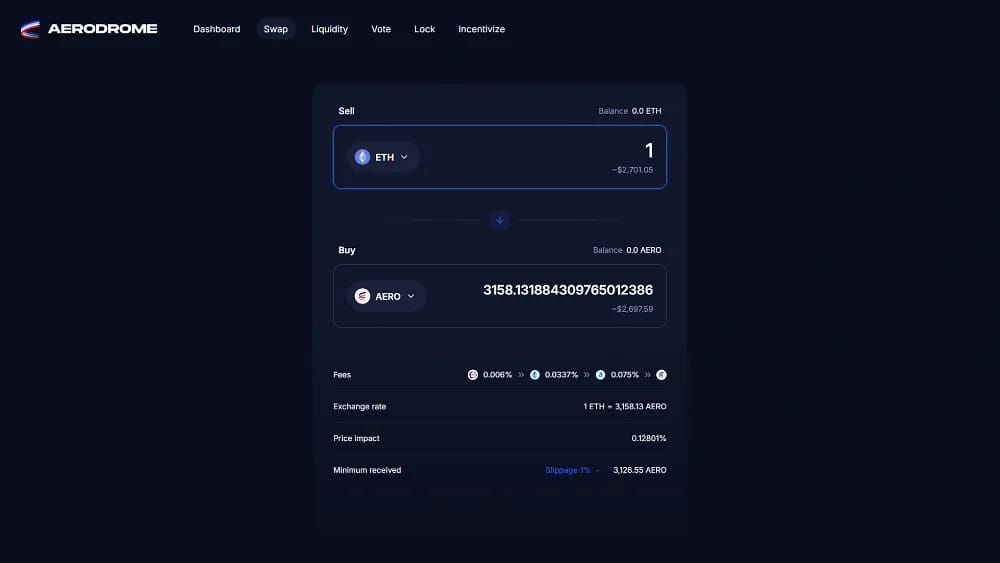
Aerodrome is Base's liquidity hub, processing roughly half of the network's DEX volume and around $439 billion in lifetime swaps, according to DefiLlama. Its mix of stable and volatile pools with Slipstream concentrated liquidity gives majors, stablecoins, cbBTC, and tokenized stocks on Base tight spreads.
Its economics differ from the standard exchange model. Aerodrome sends 100% of trading fees and incentives to voters who lock AERO. Those voters decide each week where token emissions should be directed. Protocols can compete for those votes by offering incentives, helping sustain unusually deep liquidity across important Base pairs.
A more substantial change arrives on October 21, 2026. Aerodrome and Optimism's Velodrome will merge into Aero, creating one exchange across Base, Ethereum, OP Mainnet, Arbitrum, Arc, Ink, and Robinhood Chain. The roadmap includes one AERO token, crosschain swaps, and built-in MEV auctions. Current liquidity providers should review migration guidance before the transition.
Pros
- Deepest liquidity on Base for majors, stablecoins, and cbBTC.
- 100% of fees and incentives flow to AERO lockers.
- Slipstream concentrated pools tighten spreads on high-volume pairs.
- Aero merger extends the model to seven EVM chains.
Cons
- Full benefits require locking AERO for up to four years.
- No native perps or advanced order types for traders.
- The Aero migration adds short-term contract and transition risk.
- Emissions-driven rewards can dilute holders who do not lock.
7. Pump
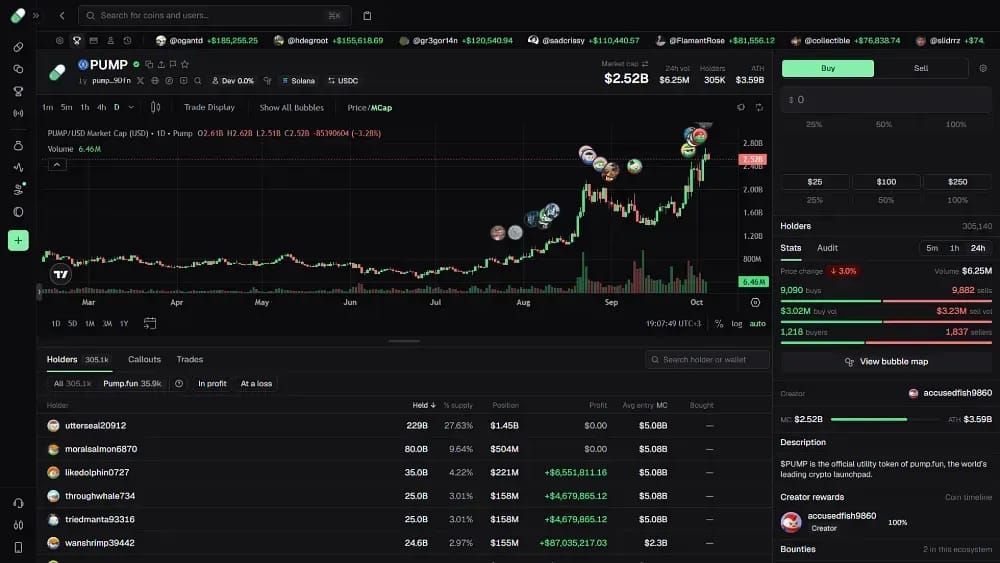
Pump is the starting point for most Solana memecoins, making it the DEX to know for early-stage tokens, as our Pump.fun guide explains. Tokens can be created for free on its bonding curve. Once a curve fills, the token graduates into PumpSwap, Pump's automated market maker, which has roughly $284 billion in lifetime volume.
The fee schedule changes as a token matures. Trades on the curve cost 1.25%, divided between the creator and protocol. Graduation carries a flat 0.015 SOL charge taken from pool liquidity. PumpSwap fees then range from 1.25% down to 0.30% as market cap increases, while creators continue receiving part of trading fees.
Pump has expanded into a broader trading stack. Terminal provides a professional interface for faster execution, and the mobile app passed 100,000 daily users with social feeds and in-chat trading. Half of net revenue is used to buy and burn PUMP. Most launched coins still fail quickly, making position sizing especially important on this platform.
Pros
- Free token creation with automatic graduation into PumpSwap.
- Earliest access to new Solana memecoins and narratives.
- Terminal and mobile app support fast, social trading.
- Half of net revenue funds PUMP buybacks and burns.
Cons
- Most launched tokens lose nearly all value within days.
- Curve and early-pool fees reach 1.25% per trade.
- Bundled wallets and snipers often front-run retail buyers.
- The site is blocked in several countries.
What is a Decentralized Exchange?
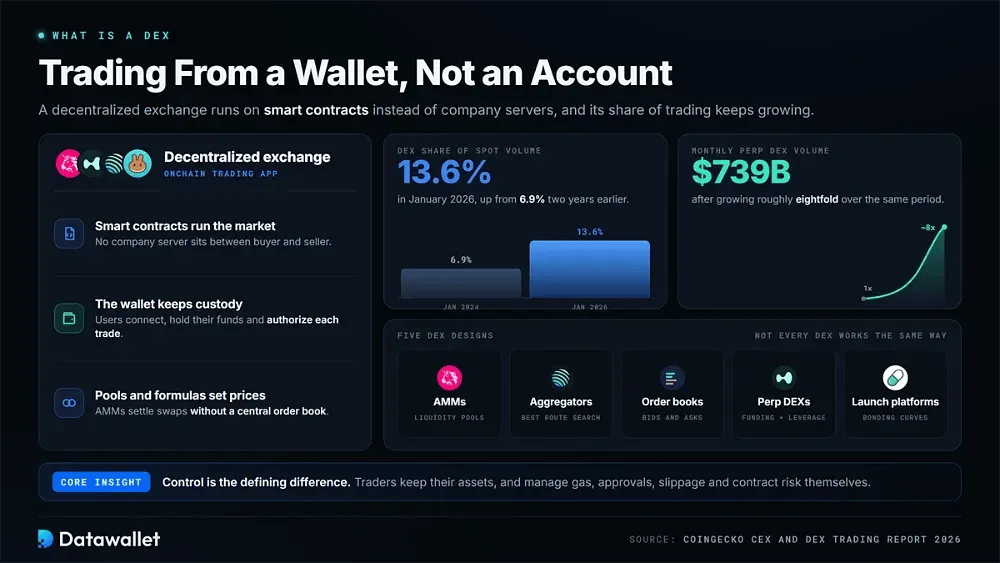
A decentralized exchange is a crypto trading application that runs through smart contracts rather than a company's servers. Users connect their wallets, retain custody of funds, and authorize trades onchain. Automated market makers use token pools and formulas to price swaps, allowing trades to settle without a centralized order book.
Not every DEX uses the same design. AMMs such as Uniswap handle most spot swaps through liquidity pools, while aggregators search across pools for better routes. Order-book DEXs match bids and asks. Perpetual DEXs add funding rates, leverage, collateral rules, and liquidations. Launch platforms instead use bonding curves to price newly issued tokens.
Onchain usage is already substantial and continues to shift. CoinGecko's CEX and DEX trading report found that the DEX share of spot volume rose from 6.9% in January 2024 to 13.6% in January 2026. Over the same period, monthly perp DEX volume grew roughly eightfold to $739 billion.
Control remains the defining difference. DEX traders keep assets in their own wallets and can often access new tokens earlier, but they must also manage gas, approvals, slippage, failed transactions, and contract risk themselves. The strongest DEXs make those responsibilities easier to understand without taking custody of user assets.
Benefits of Using a Decentralized Exchange
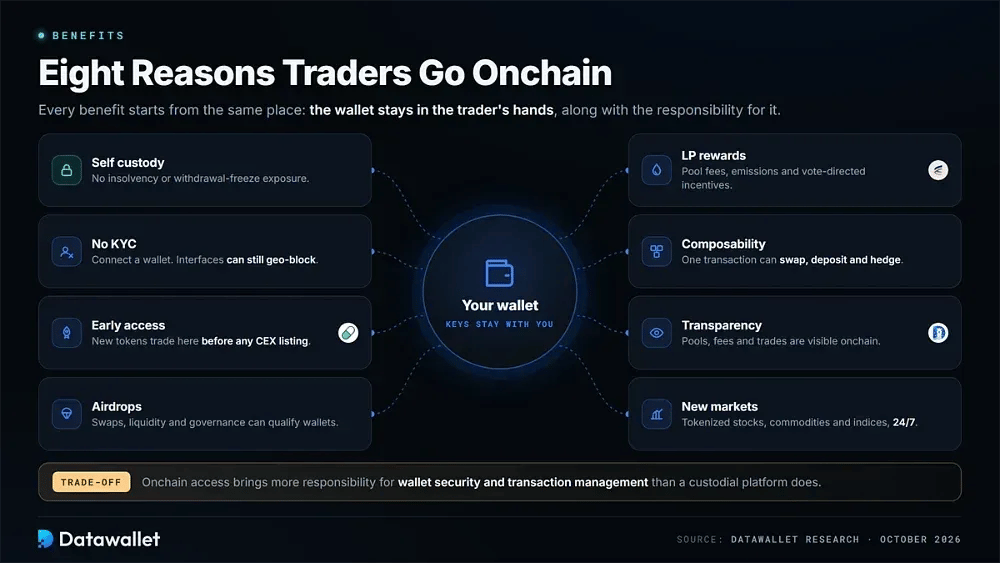
Decentralized exchanges give traders direct control over their assets and how orders are executed. They can also expand market access, but the trade-off is greater responsibility for wallet security and transaction management than a custodial platform normally places on the user.
The main benefits traders weigh before choosing a DEX:
- Self Custody: Users trade from their own crypto wallets, so assets never sit inside exchange-controlled accounts between transactions, removing the insolvency and withdrawal-freeze risks seen at failed custodians.
- No KYC: Most DEXs let users connect a wallet and trade without identity documents, although interfaces can still geo-block regions, as our no-KYC exchange guide explains in detail.
- Early Access: New tokens usually appear on DEXs and launch platforms before any centralized listing, giving traders earlier exposure to emerging assets, narratives, and memecoins at higher risk.
- Airdrops: Onchain activity can qualify wallets for ecosystem rewards when protocols incentivize swaps, liquidity, or governance, and our airdrop tracker lists the campaigns currently worth following.
- LP Rewards: Liquidity providers can earn pool fees, token emissions, and vote-directed incentives on venues like Aerodrome, although impermanent loss and smart-contract risk remain part of every position.
- Composability: DEX trades connect directly with lending markets, bridges, vaults, wallets, and analytics tools, so one transaction can swap, deposit, and hedge across the wider DeFi stack.
- Transparency: Pools, fees, trades, and liquidity changes are visible onchain and on dashboards like DefiLlama, giving users far more verifiable data than closed exchange order flow.
- New Markets: Onchain venues now list tokenized stocks, commodities, indices, and pre-IPO contracts around the clock, covered in our tokenized stock exchange guide, without needing a brokerage account.
Centralized Exchanges vs Decentralized Exchanges
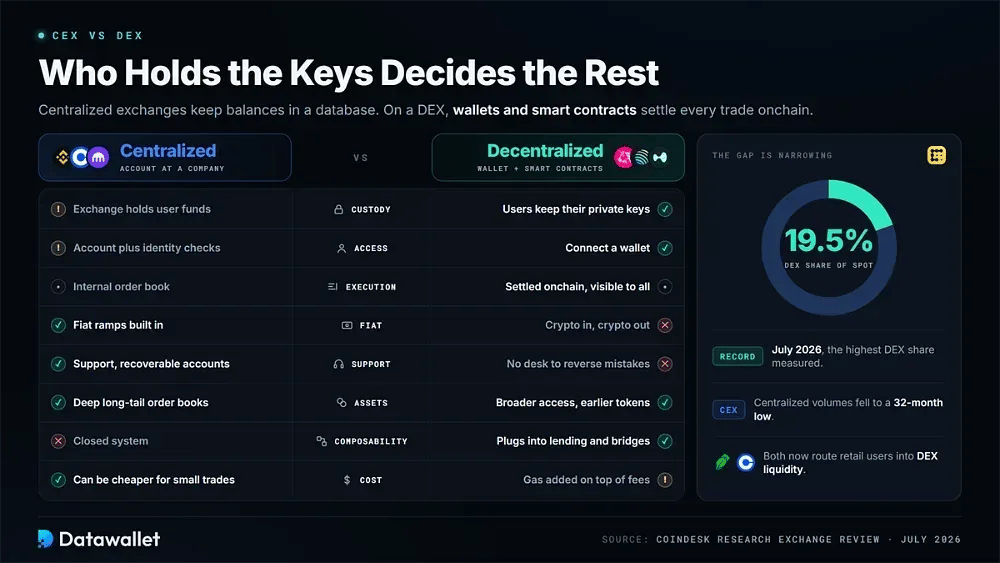
Centralized exchanges hold user funds, operate internal order books, and generally require an account plus identity verification. On a DEX, execution happens through wallets and smart contracts. Users keep their private keys, approve transactions themselves, and settle onchain instead of relying on balances maintained in an exchange database.
CEXs retain clear advantages in fiat ramps, customer support, recoverable accounts, and depth across long-tail order books. DEXs offer broader asset access, self-custody, transparent settlement, and direct composability with lending markets and bridges. Cost-conscious traders should compare both approaches because the lowest-fee centralized exchanges can be cheaper for small trades after gas is included.
That gap continues to narrow. CoinDesk Research measured a record 19.5% DEX share of spot trading in July 2026 while centralized volumes fell to a 32-month low. Distribution is changing as well: Robinhood and Coinbase now route retail users into DEX liquidity through their own applications.
Biggest DEX Trends in 2026
DEX competition in 2026 is increasingly determined by distribution, regulated assets, and execution quality rather than the sheer number of listed tokens. Across the exchanges reviewed for this ranking, two developments have had an especially visible effect.
Tokenized Stocks Arrive on AMMs
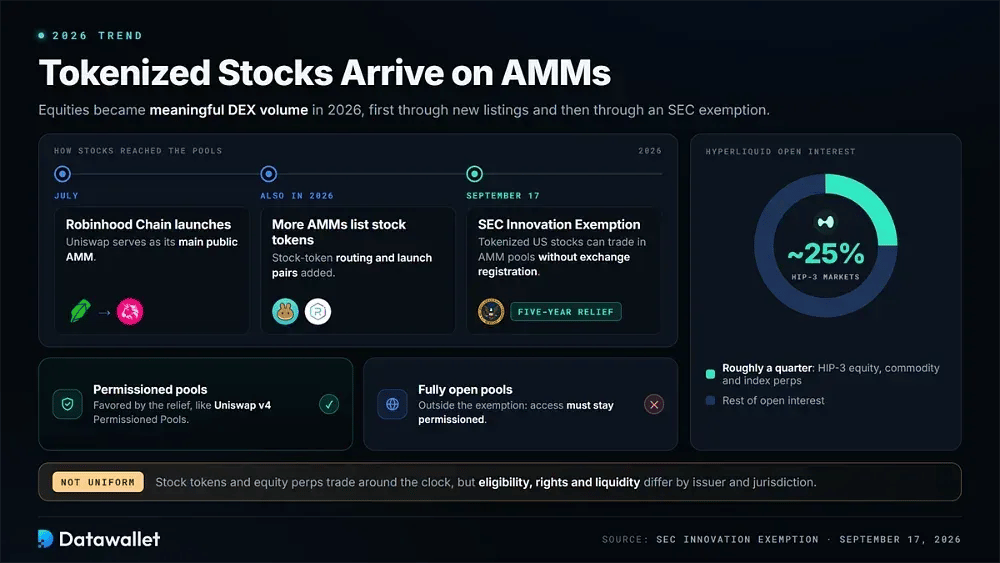
Tokenized equities became meaningful DEX volume in 2026. Robinhood Chain launched in July with Uniswap serving as its main public AMM. PancakeSwap and Raydium added stock-token routing and launch pairs. On Hyperliquid, HIP-3 equity, commodity, and index perpetuals grew to roughly a quarter of total open interest.
Regulation also moved in that direction. On September 17, 2026, the SEC issued a five-year Innovation Exemption allowing tokenized US-listed stocks to trade through permissioned AMM pools without exchange registration. Because access must remain permissioned, the relief favors models such as Uniswap v4's Permissioned Pools rather than fully open public pools.
For traders, the expansion creates more choice but not uniform products. Stock tokens and equity perps can trade around the clock from self-custodial wallets, yet eligibility, rights, and liquidity differ by issuer and jurisdiction. Our tokenization statistics and RWA project rankings show which issuers and products are attracting real capital.
Structural Shifts Changing How DEXs Compete
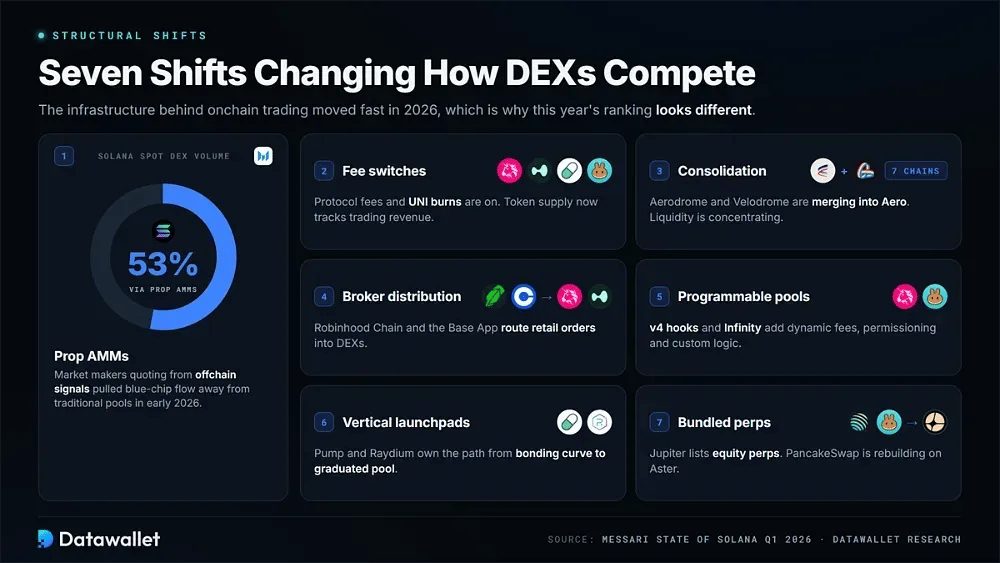
The infrastructure behind onchain trading also changed quickly in 2026. Several of those shifts help explain why this year's ranking differs from the one published a year earlier.
Seven structural changes worth understanding before picking a venue:
- Prop AMMs: Proprietary market makers quoting from offchain signals handled 53% of Solana spot DEX volume in early 2026, according to Messari, pulling blue-chip flow away from traditional pools.
- Fee Switches: Uniswap's UNIfication vote turned on protocol fees and UNI burns, joining Hyperliquid, Pump, and PancakeSwap in tying token supply directly to trading revenue rather than emissions alone.
- Consolidation: Aerodrome and Velodrome are merging into Aero across seven chains, a sign that liquidity is concentrating in fewer, larger protocols instead of fragmenting across isolated rollup deployments.
- Broker Distribution: Robinhood Chain and Coinbase's Base App now route retail orders into Uniswap and Hyperliquid, so DEX growth increasingly depends on partnerships rather than winning users wallet by wallet.
- Programmable Pools: Uniswap v4 hooks and PancakeSwap Infinity let developers add dynamic fees, permissioning, and custom logic to pools, turning exchanges into platforms that other teams build on.
- Vertical Launchpads: Pump and Raydium now own the full path from bonding curve to graduated pool, keeping launch fees and trading volume in-house instead of handing tokens to rival exchanges.
- Bundled Perps: Spot venues keep adding derivatives, with Jupiter listing equity perps on a new order book and PancakeSwap rebuilding on Aster, blurring the line with dedicated perp exchanges.
What the 2026 DEX Market Rewards
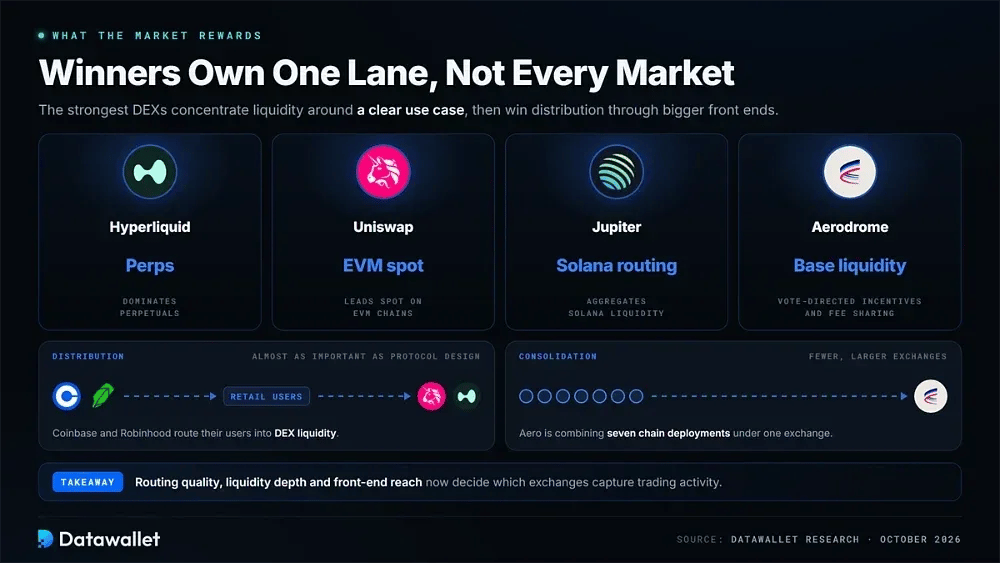
Across this ranking, the strongest DEXs tend to concentrate liquidity around a clear use case rather than trying to lead every market. Hyperliquid dominates perps, Uniswap leads EVM spot, Jupiter aggregates Solana liquidity, and Aerodrome deepens Base markets through vote-directed incentives and fee sharing.
Distribution now matters almost as much as protocol design. Coinbase and Robinhood are routing users into DEX liquidity, while Aero is combining seven chain deployments under one exchange. Routing quality, liquidity depth, and front-end reach therefore play a growing role in determining which venues capture trading activity.
How to Choose a DEX in 2026
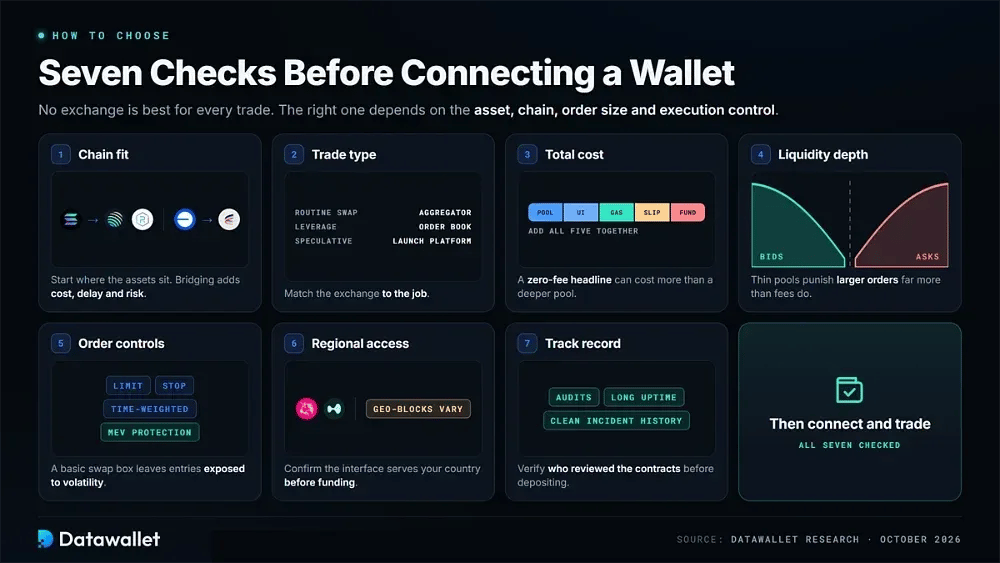
There is no single best exchange for every transaction. The right choice depends on the asset being traded, its chain, the size of the order, and how much control the trader needs over execution.
Work through these checks before connecting a wallet and trading:
- Chain Fit: Start with where your assets sit, since Jupiter and Raydium only serve Solana, Aerodrome centers on Base, and bridging elsewhere adds cost, delay, and extra contract risk.
- Trade Type: Match the venue to the job, using aggregators for routine swaps, order books for leverage, and launch platforms for speculative positions, since spot and perpetual trading behave differently.
- Total Cost: Add pool fees, interface fees, gas, slippage, and funding together, because a zero-fee headline can cost more than a deeper pool charging a visible maker or taker fee.
- Liquidity Depth: Check pool size and recent volume for your exact pair, and compare total value locked across venues, since thin liquidity punishes larger orders far more than fees do.
- Order Controls: Prefer platforms offering limit, stop, and time-weighted orders plus MEV protection when trading size, because a basic swap box leaves entries and exits exposed to volatility.
- Regional Access: Confirm the interface serves your country before funding a wallet, since geo-blocks vary widely between platforms, as our guides to Uniswap and Hyperliquid availability show.
- Track Record: Favor exchanges with audits, long uptime, and clean incident histories, and verify who reviewed the contracts using our list of smart contract auditors before depositing meaningful funds.
Are DEXs Regulated?
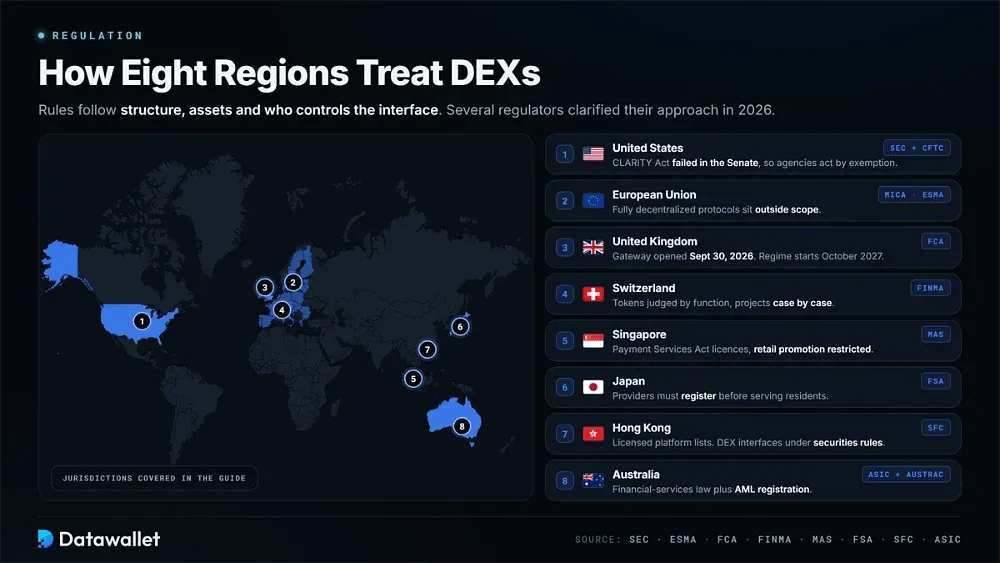
How a DEX is regulated depends on its structure, location, listed assets, degree of interface control, and whether an identifiable operator performs brokerage, custody, derivatives, or promotional functions. Several major jurisdictions clarified parts of their approach during 2026.
How regulators currently approach decentralized trading in each region:
- United States: The CLARITY Act failed a Senate vote in September 2026, so the SEC and CFTC are acting through exemptions and rulemaking, including relief for permissioned tokenized-stock pools.
- European Union: MiCA, coordinated by ESMA, regulates crypto-asset service providers but leaves fully decentralized protocols outside scope, so front-end operators and MiCA-licensed exchanges carry most obligations.
- United Kingdom: The FCA opened its authorisation gateway on September 30, 2026, ahead of a regime starting October 2027 that captures DeFi activity with an identifiable controlling person.
- Switzerland: FINMA applies existing financial-market law to tokens by function and licenses DLT trading facilities, so decentralized projects are assessed case by case on who actually controls them.
- Singapore: MAS licenses digital payment token services under the Payment Services Act, enforces anti-money-laundering controls, and restricts public promotion of crypto services to retail users.
- Japan: The FSA requires crypto-asset exchange service providers to register before serving residents, and unregistered offshore platforms have received public warnings about soliciting Japanese users.
- Hong Kong: The SFC licenses virtual asset trading platforms and publishes lists of licensed, applicant, and suspicious platforms, while decentralized interfaces serving locals are assessed under existing securities rules.
- Australia: ASIC applies financial-services law when digital assets behave like financial products, while AUSTRAC registers virtual asset service providers for anti-money-laundering and counter-terrorism financing purposes.
Is Trading on Decentralized Crypto Exchanges Taxed?
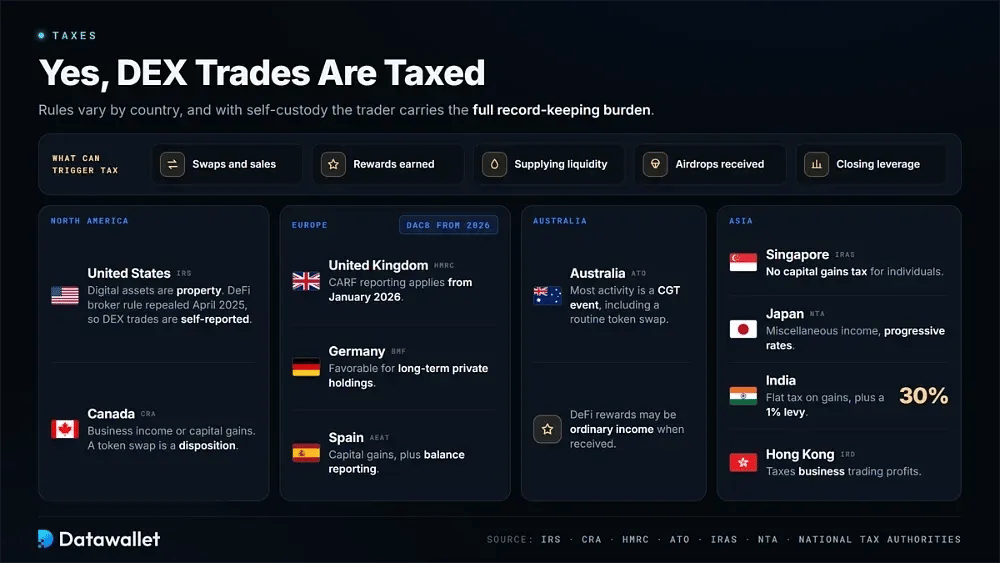
Yes. DEX transactions can create tax obligations when users swap or sell assets, earn rewards, supply liquidity, receive airdrops, or close leveraged positions. The exact rules vary by country. Because assets are self-custodied, traders usually carry the full record-keeping burden themselves.
1. North America
In the United States, the IRS treats digital assets as property. Swaps, sales, and rewards can therefore create capital gains or income. Custodial brokers now issue Form 1099-DA, but Congress repealed the DeFi broker rule in April 2025. DEX and self-custody transactions still have to be tracked and self-reported.
Canada takes a different classification approach. The CRA expects users to report crypto profits or losses as business income or capital gains depending on their activity. A token-for-token swap is a disposition, while paying with crypto is treated as barter, so records remain necessary even when fiat never enters the transaction.
2. Europe
In the United Kingdom, HMRC maintains a Cryptoassets Manual covering DeFi activity, disposals, and income. Swaps, sales, and rewards generally require records because tax treatment depends on the transaction. Cryptoasset Reporting Framework rules began applying to UK service providers from January 2026.
Germany's Federal Ministry of Finance has published guidance on private sales, staking, lending, and airdrops, with favorable treatment for long-term private holdings. Spain's Agencia Tributaria treats virtual currencies as assets that can generate capital gains and requires separate reporting for certain balances. The EU's DAC8 directive extends exchange reporting from 2026.
3. Australia
In Australia, the ATO says most crypto activity results in a capital gains tax event. A disposal can include selling an asset, swapping it for another token, gifting it, or spending it on goods and services. A routine DEX token swap is therefore taxable even when no Australian dollars are involved.
Users also need records covering transaction dates, Australian-dollar values, fees, and wallet movements. The ATO distinguishes investors from people trading as a business. DeFi rewards, staking returns, and liquidity incentives may be ordinary income when received, making a portfolio tracker useful for active wallets.
4. Asia
In Singapore, IRAS distinguishes payment tokens from other digital tokens and publishes guidance covering income tax and GST. Individuals do not pay capital gains tax, although profits may still be taxable when the activity amounts to a business. That distinction is one reason Singapore appears among low-tax crypto countries.
Japan's NTA generally treats crypto gains as miscellaneous income taxed at progressive rates. India's Income Tax Department applies a flat 30% tax to virtual digital asset gains plus a 1% transaction levy. In Hong Kong, the IRD taxes profits from trading carried on as a business.
Practical Trade-Offs Between DEX Models
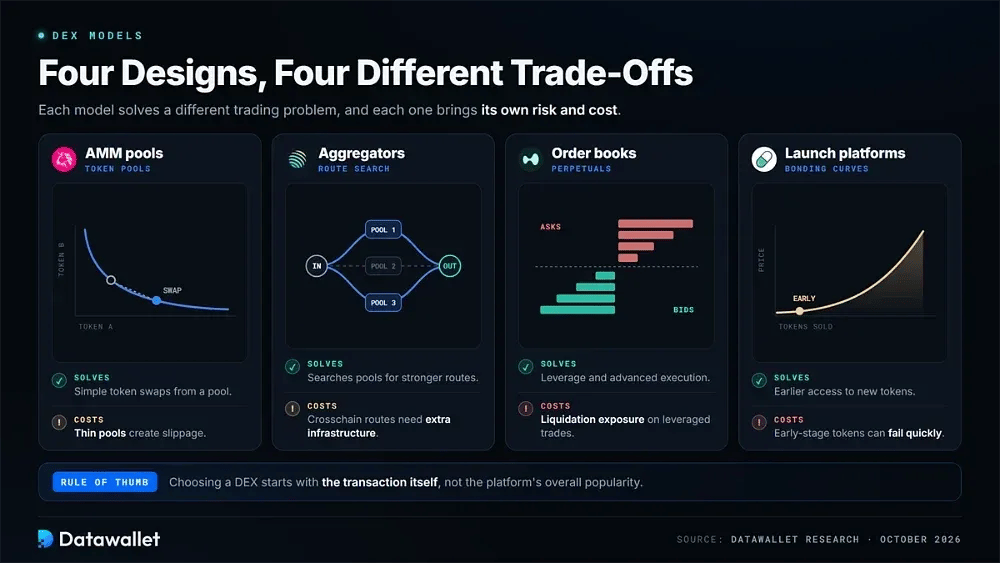
AMMs, aggregators, order books, and launch platforms solve different trading problems. Pools simplify token swaps, aggregators search for stronger routes, perpetual venues add leverage and advanced execution, while launch platforms give traders earlier access to newly issued assets through mechanisms such as bonding curves.
Those advantages come with different risks and costs. Thin pools create slippage, leveraged markets introduce liquidation exposure, crosschain routes depend on additional infrastructure, and early-stage tokens can fail quickly. Choosing a DEX therefore starts with the transaction itself rather than the platform's overall popularity.
Risks of Using a Decentralized Exchange
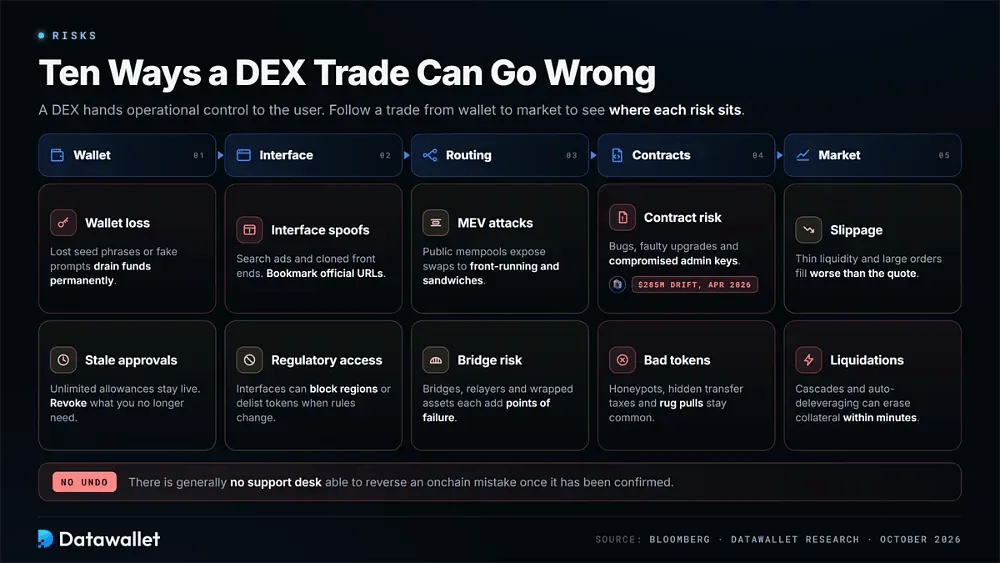
DEXs transfer operational control to the user. Every transaction depends on wallet security, contract quality, pricing, liquidity, and network conditions, and there is generally no support desk able to reverse an onchain mistake after it has been confirmed.
The main risks to check before using any decentralized exchange:
- Wallet Loss: Lost seed phrases, compromised devices, malicious browser extensions, or fake wallet prompts can drain funds permanently, because no exchange support team can freeze or reverse onchain transfers.
- Contract Risk: Smart contract bugs, faulty upgrades, and compromised admin keys can expose pools and vaults, as the $285 million Drift exploit in April 2026 demonstrated on Solana.
- Bad Tokens: Anyone can create tokens on most DEXs, so honeypots, hidden transfer taxes, bundled launches, and rug pulls remain common, especially on bonding-curve platforms with thousands of daily listings.
- Slippage: Thin liquidity, volatile prices, and large orders can produce worse execution than the quote shown, and some swaps fail outright with insufficient liquidity errors during fast markets.
- MEV Attacks: Public mempools expose swaps to front-running and sandwich attacks, so traders should favor private routing, tight slippage limits, or protection tools where the chain supports them.
- Bridge Risk: Crosschain swaps often depend on bridges, relayers, wrapped assets, or messaging systems, each of which adds its own security assumptions, liquidity limits, and potential points of failure.
- Liquidations: Perpetual DEXs add leverage, funding, and margin rules, and events like the October 2025 crash showed how cascades and auto-deleveraging can erase collateral within minutes.
- Stale Approvals: Unlimited token allowances granted to routers stay active after trading stops, so users should periodically revoke permissions they no longer need to limit damage from later exploits.
- Interface Spoofs: Search ads, lookalike domains, cloned front ends, and phishing signatures can trick users into approving malicious transactions, so bookmarking official URLs remains a basic but essential habit.
- Regulatory Access: Interfaces can block jurisdictions, delist tokens, or restrict products when rules change, leaving users to rely on alternative front ends or direct contract interaction they may not understand.
Final Thoughts
DEXs are most useful when the exchange matches the job. Hyperliquid is suited to active multi-market traders, while Uniswap leads EVM spot and tokenized-stock swaps. PancakeSwap covers BNB Chain. Jupiter and Raydium anchor Solana, Aerodrome dominates Base liquidity, and Pump remains the entry point for many new Solana tokens and memecoins.
The best choice still depends on asset coverage, chain support, liquidity, fees, available order controls, and the trader's risk tolerance. A straightforward token swap calls for different tools than leveraged perpetuals, liquidity provision, or a bonding-curve launch. In 2026, broker integrations also mean many traders will access DEX liquidity through applications they already use.
We would begin with careful self-custody practices, small test transactions, contract verification, and complete tax records. DEXs provide more control than centralized platforms, but that control extends to execution, wallet security, slippage, and reporting. Those habits matter more than which exchange happens to lead the volume rankings at a given moment.
Our Methodology
We evaluated 25 decentralized exchanges spanning AMMs, aggregators, perpetual venues, launch platforms, Solana-native exchanges, and multichain swap applications. The review used documentation, onchain dashboards, and hands-on testing in accordance with our editorial methodology.
Here is how we evaluated and scored each decentralized exchange:
- Market Access: We checked supported chains, spot markets, perpetual contracts, tokenized assets, launch tools, and crosschain swaps, and whether users could reach several trading modes from a single interface.
- Liquidity: We reviewed total value locked, pool depth, recent spot volume, and perpetual open interest using official dashboards and DefiLlama data captured during early October 2026.
- Execution: We tested order types, routing logic, slippage controls, MEV protection, limit and time-weighted orders, and whether each app explained the expected outcome clearly before confirmation.
- Costs: We compared swap fees, interface fees, protocol fees, perpetual trading fees, funding, and gas, separating protocol charges from network costs wherever the documentation made that possible.
- Product Depth: We scored platforms higher for useful tools beyond basic swaps, including perpetuals, advanced orders, liquidity strategies, launch infrastructure, lending integrations, and access to tokenized real-world assets.
- Risk Model: We reviewed self-custody design, contract exposure, oracle and bridge dependence, liquidation mechanics, and whether pending migrations or upgrades introduced additional short-term risk for users and liquidity providers.
- Transparency: We prioritized exchanges with detailed documentation, public analytics, clear fee pages, visible pool data, and verifiable onchain revenue over platforms relying on vague marketing claims.
- Usability: We assessed wallet connection, token search, charting, transaction previews, mobile support, and fee visibility, focusing on how easily a new user could avoid common and costly mistakes.
- Track Record: We considered launch history, market share, incident history, audits, governance maturity, and whether usage stayed meaningful after incentives faded or short-lived token narratives moved elsewhere.