






Which Countries Does BloFin Restrict?
Residents of these locations cannot open or keep a BloFin account. Section 6 of the BloFin Terms of Use, last revised on 3 July 2026, identifies 43 Restricted Locations and includes a catch-all clause for Russian-controlled areas of Ukraine.
Both residency and domicile trigger the restriction. A passport from a listed country therefore fails verification even when the holder lives elsewhere.
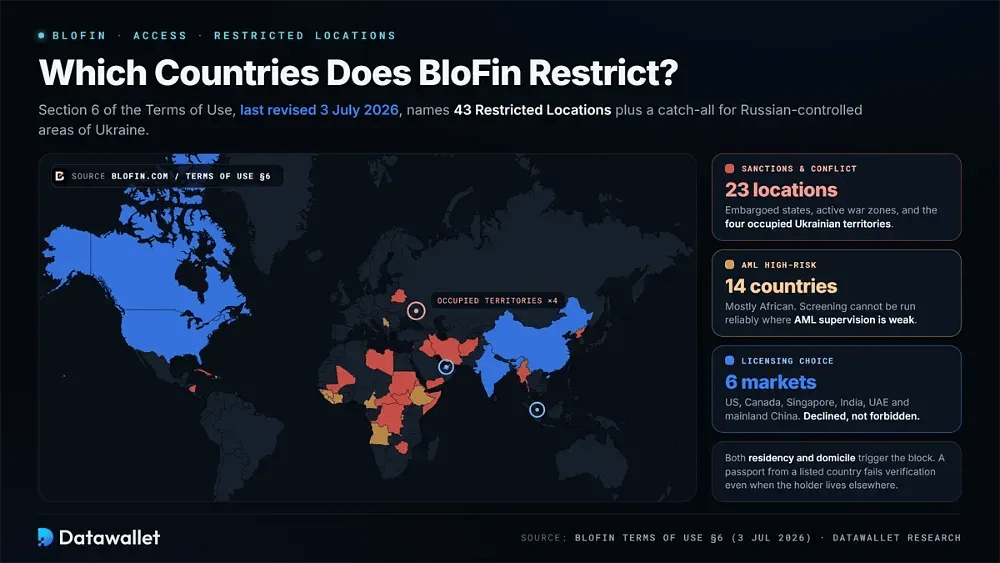
BloFin Restricted Countries List
The table groups every named jurisdiction by region, directly reflecting the current Terms of Use:
A VPN will not protect you. BloFin can freeze accounts, claw back profits and report users to law enforcement. Attempting to bypass the geoblock therefore puts your balance at risk once documents or withdrawal patterns reveal the restriction.
Why Does BloFin Restrict These Countries?
The reason behind a country's restriction can indicate whether the block might eventually be lifted. Some locations are covered by sanctions that exchanges cannot lawfully ignore. Others remain unavailable because BloFin has chosen not to bear the associated licensing costs.
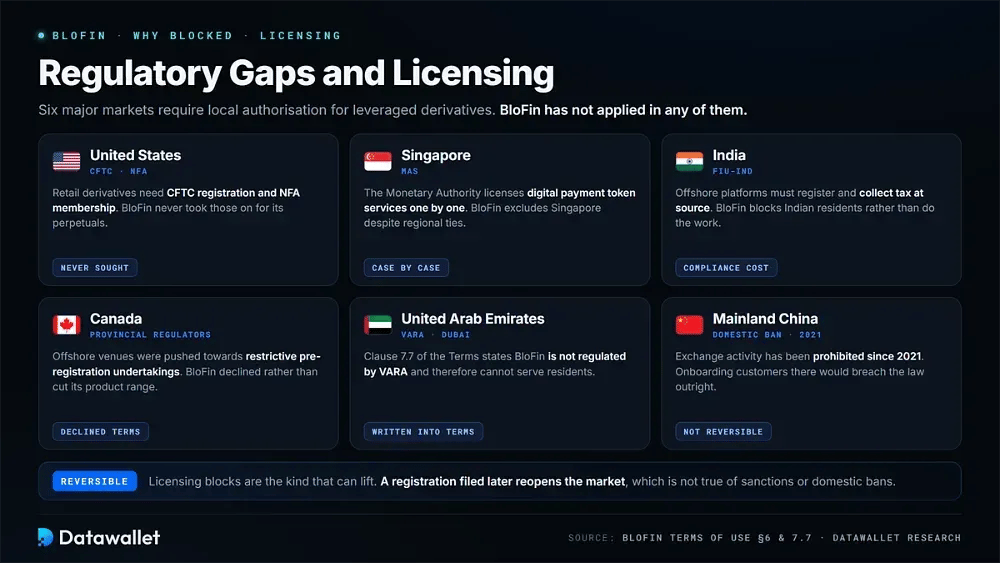
Regulatory Gaps and Licensing
Several governments require local authorisation before a platform may offer leveraged derivatives. BloFin has not applied for those permissions.
Licensing barriers that keep BloFin out of major markets:
- United States: Retail derivatives require registration with the CFTC and membership of the NFA. BloFin has never taken on those obligations for its perpetual contracts.
- Singapore: The Monetary Authority licenses digital payment token services individually. BloFin excludes Singapore despite maintaining corporate ties across the region.
- India: Offshore platforms must register with the Financial Intelligence Unit and collect tax at source. BloFin avoids that compliance work by blocking Indian residents outright.
- Canada: Provincial securities regulators pushed offshore derivatives venues towards restrictive pre-registration undertakings. Rather than limit its product range, BloFin declined that path.
- United Arab Emirates: Clause 7.7 of the Terms states that BloFin is not regulated by Dubai's Virtual Assets Regulatory Authority and therefore cannot serve residents.
- Mainland China: Exchange activity has been prohibited since 2021. Onboarding customers there would directly breach the domestic law BloFin says it respects.
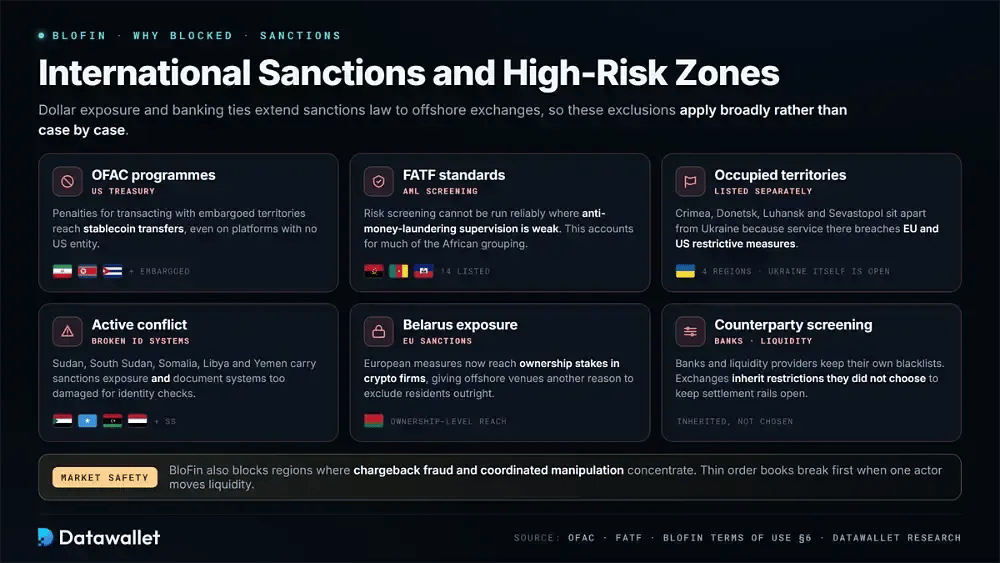
International Sanctions and High-Risk Zones
Dollar exposure and banking relationships extend sanctions law to offshore exchanges. As a result, these exclusions tend to apply broadly rather than case by case.
Sanctions frameworks driving the largest share of the list:
- OFAC programmes: The US Treasury's Office of Foreign Assets Control penalises firms that transact with embargoed territories. Those penalties can reach stablecoin transfers even on platforms with no American entity.
- FATF standards: Financial Action Task Force guidance requires risk screening that cannot be performed reliably in states with weak anti-money-laundering supervision. This accounts for much of the African grouping.
- Occupied territories: Crimea, Donetsk, Luhansk and Sevastopol are listed separately from Ukraine because providing financial services to those areas breaches European and American restrictive measures.
- Active conflict: Sudan, South Sudan, Somalia, Libya and Yemen face sanctions exposure while also having document systems too damaged to support meaningful identity verification.
- Belarus exposure: European sanctions now extend to ownership stakes in crypto firms, adding another reason for offshore venues to exclude Belarusian residents entirely.
- Counterparty screening: Banks and liquidity providers maintain their own blacklists. Exchanges can inherit restrictions they did not choose if they want to keep settlement rails open.
Fraud Prevention and Market Safety
BloFin also blocks regions where chargeback fraud and coordinated manipulation are concentrated. The rationale is to protect the order book for remaining traders, particularly because thin markets are most vulnerable when one actor manipulates liquidity.
Counterparty risk is also priced into agreements with market makers and payment processors. An exchange serving flagged jurisdictions consequently pays more for the same liquidity.
BloFin Supported Countries
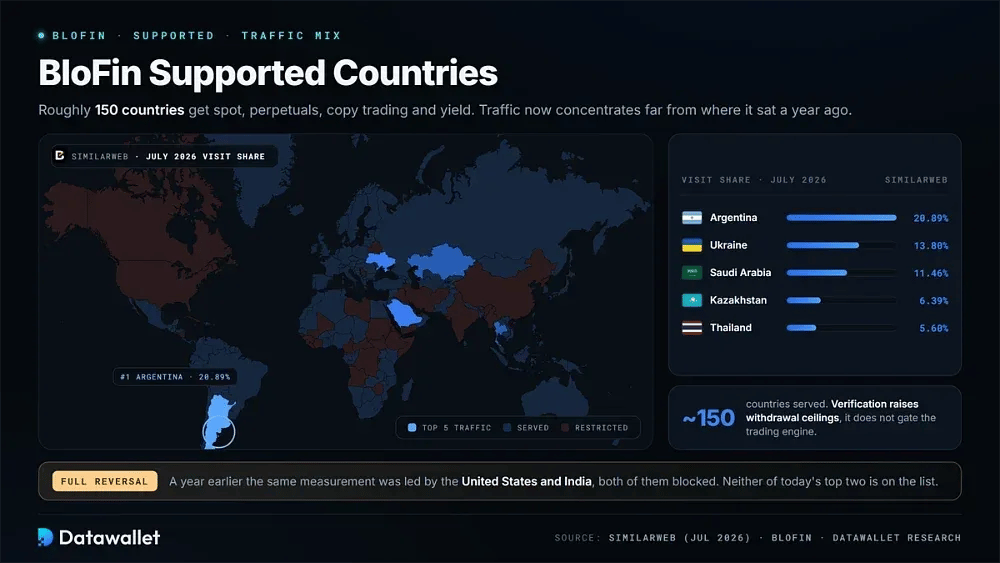
Beyond the restricted list, BloFin serves roughly 150 countries with spot markets, perpetual futures, copy trading and yield products. Verification affects withdrawal ceilings rather than access to the trading engine itself.
Traffic data indicates where the platform is gaining users. Similarweb's July figures rank Argentina first with 20.89% of visits. Ukraine follows at 13.8%, Saudi Arabia at 11.46%, Kazakhstan at 6.39% and Thailand at 5.6%.
The distribution is entirely different from a year earlier, when the United States and India led the same measurement despite both being blocked. Argentina and Ukraine now form the largest parts of the audience, and neither is on the exclusion list.
Key Supported Regions
- Latin America: Argentina, Brazil, Mexico, Colombia and Chile.
- Europe: Ukraine, Poland, Turkey and the United Kingdom.
- Asia-Pacific: Thailand, Vietnam, Indonesia, South Korea and Japan.
- Middle East and Africa: Saudi Arabia, Egypt, Nigeria, Kenya and South Africa.
- Central Asia: Kazakhstan, Uzbekistan, Georgia and Azerbaijan.
Language and Currency Support
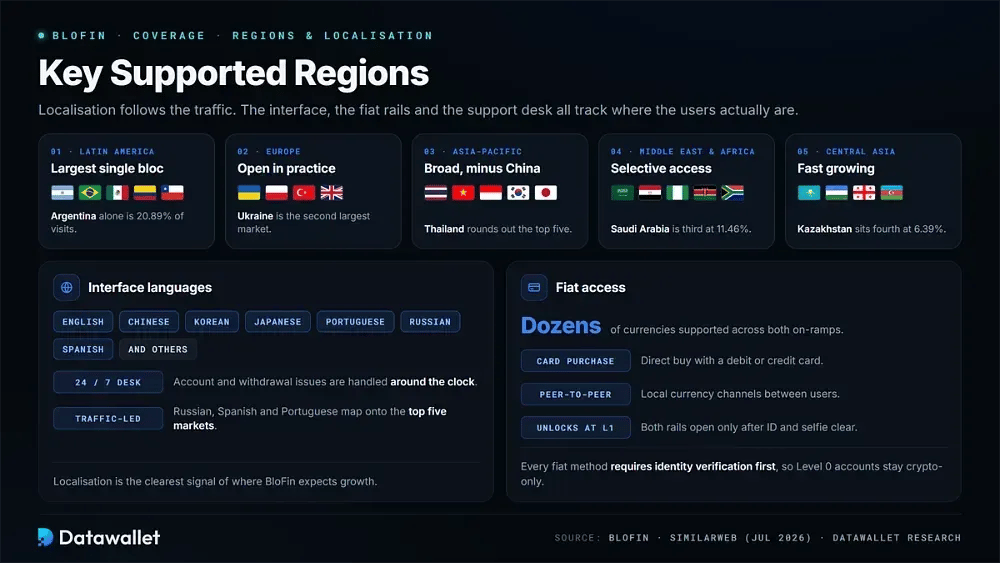
BloFin's localisation reflects its traffic mix. The interface is available in several languages, while support desks operate around the clock for account and withdrawal issues.
- Languages: English, Chinese, Korean, Japanese, Portuguese, Russian, Spanish and others.
- Fiat access: Card purchases and peer-to-peer channels support dozens of currencies. Every fiat method requires identity verification first.
Is BloFin Available in the United States?
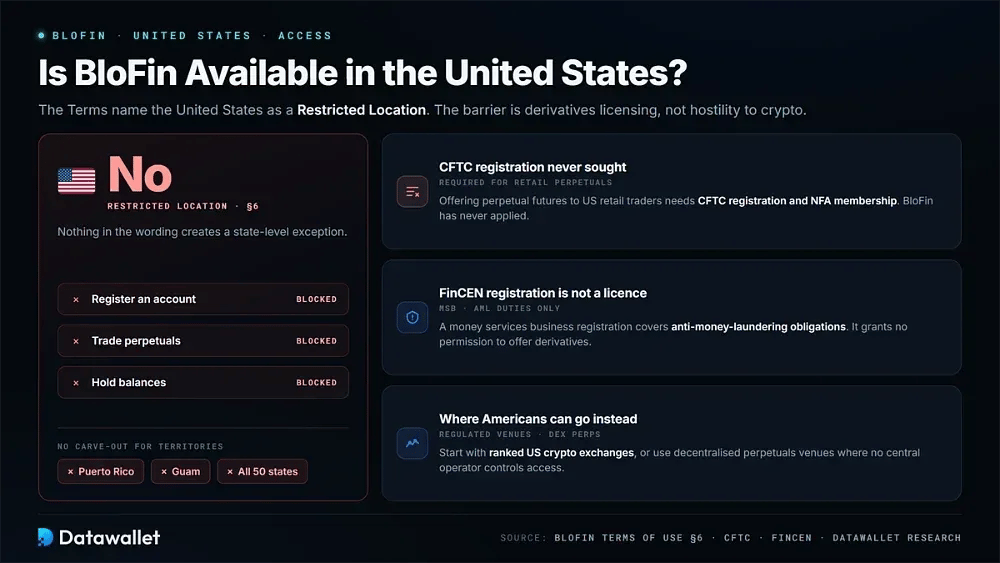
No. The Terms identify the United States as a Restricted Location, so Americans cannot lawfully register, trade or hold balances on BloFin. There is no state-level exception, nor does the wording provide a carve-out for territories such as Puerto Rico or Guam.
Derivatives licensing, rather than hostility to crypto itself, creates the barrier. Offering perpetual futures to US retail traders requires CFTC registration, which BloFin has never sought. A FinCEN money services registration covers anti-money-laundering duties only.
Americans seeking comparable depth should start with our ranking of the best crypto exchanges in the USA. Another option is to examine decentralised perpetuals protocols, where access is not controlled by a central operator.
Can You Use BloFin in the EU?
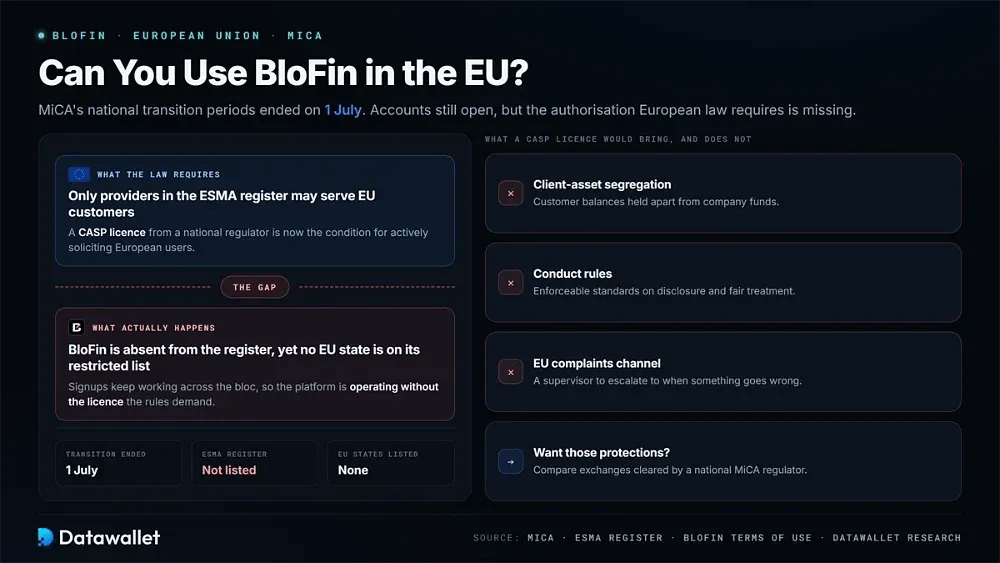
European access now depends on a licence that BloFin does not hold. MiCA's national transition periods ended on 1 July, after which only providers in the ESMA register may serve European customers.
BloFin is absent from that register. At the same time, no EU member state appears on its restricted list, so accounts continue to open in practice. The platform is therefore operating without the authorisation European law requires from providers actively soliciting local users.
A CASP licence brings client-asset segregation, conduct rules and an EU complaints channel. None of those protections apply here. Traders who want them can compare the MiCA-licensed crypto exchanges cleared by a national regulator.
What Happens If BloFin Blocks Your Account?
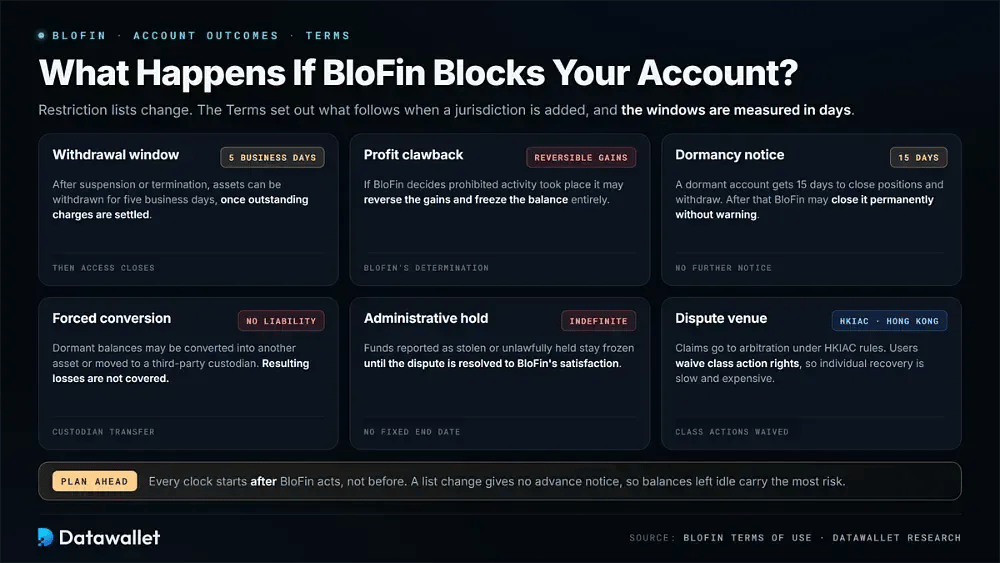
Restriction lists can change, and BloFin's Terms describe what happens when a user's jurisdiction is added. The available windows are short, with notice periods measured in days.
The account outcomes written into BloFin's Terms:
- Withdrawal window: After BloFin suspends or terminates an account, users have five business days to withdraw digital assets once any outstanding charges have been settled.
- Profit clawback: If BloFin determines that prohibited activity took place, it may reverse gains obtained from that activity and freeze the balance entirely.
- Dormancy notice: A dormant account gets 15 days to close positions and withdraw. After that period, BloFin may close it permanently without further warning.
- Forced conversion: Dormant balances may be converted into another asset or transferred to a third-party custodian. BloFin accepts no liability for resulting losses.
- Administrative hold: Funds reported as stolen or unlawfully held can remain frozen indefinitely until the underlying dispute is resolved to BloFin's satisfaction.
- Dispute venue: Claims are handled through arbitration in Hong Kong under HKIAC rules. Users waive class action rights, making individual recovery slow and expensive.
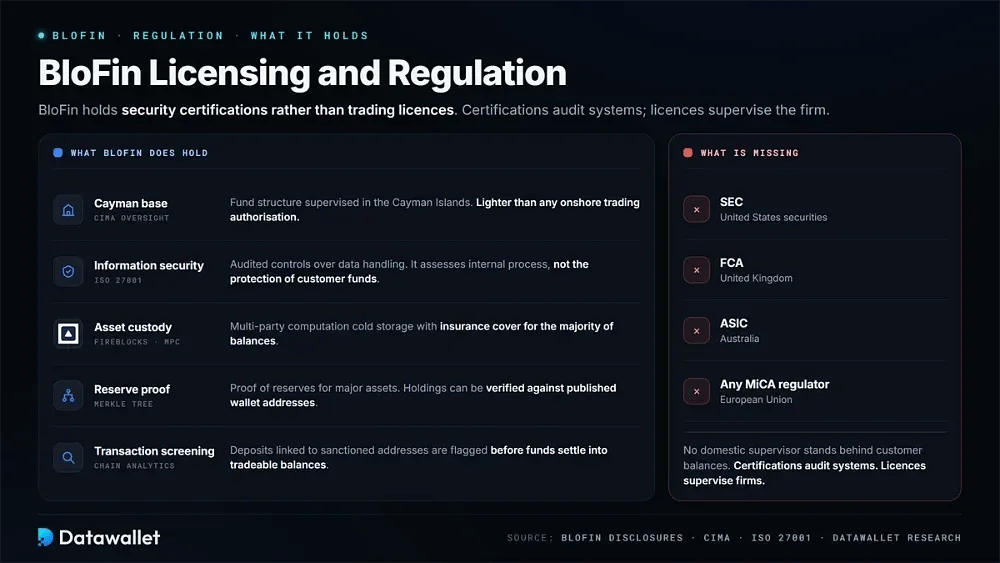
BloFin Licensing and Regulation
BloFin has security certifications rather than trading licences. The difference matters when something goes wrong: certifications audit systems, whereas licences give a supervisor authority over the firm.
The registrations and safeguards BloFin does hold:
- Cayman base: The exchange operates from the Cayman Islands under CIMA oversight of its fund structure. This regime is lighter than any onshore trading authorisation.
- Information security: ISO 27001 certification confirms audited controls over data handling. It assesses internal processes rather than the protection of customer funds.
- Asset custody: Fireblocks provides multi-party computation cold storage and insurance cover for the majority of customer balances.
- Reserve proof: BloFin publishes Merkle tree proof of reserves for major assets. Users can independently verify holdings against published wallet addresses.
- Transaction screening: Blockchain analytics identify deposits linked to sanctioned addresses or illicit sources before the funds settle into tradeable account balances.
- Missing authorisations: BloFin has no licence from the SEC, FCA, ASIC or any MiCA regulator. No domestic supervisor therefore stands behind customer balances.
BloFin KYC Requirements
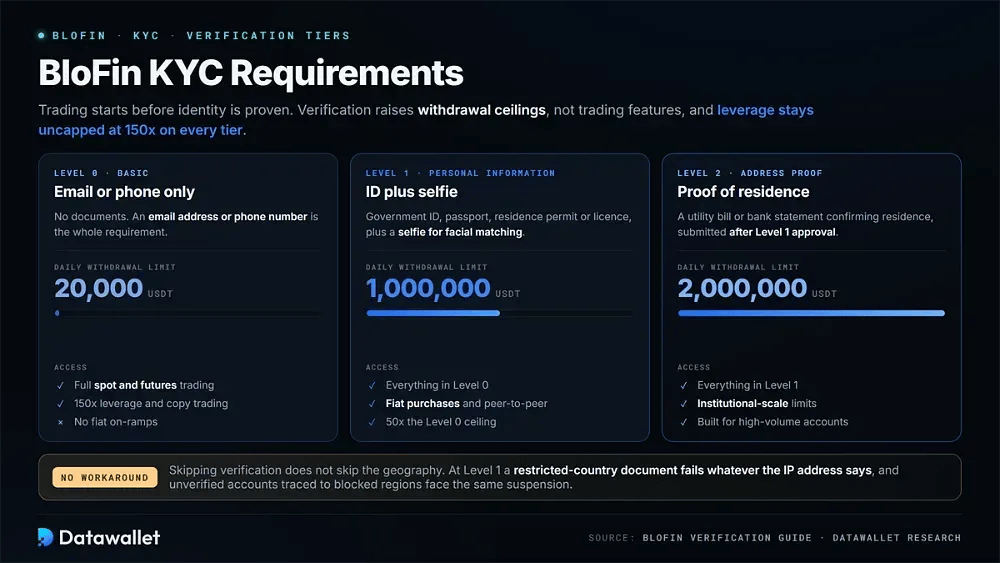
BloFin allows trading before users prove their identity. Verification raises withdrawal ceilings rather than unlocking new trading features, while leverage remains uncapped at every tier.
Verification Levels and Withdrawal Limits
BloFin's verification guide sets three tiers governing daily withdrawals. In most cases, documents pass automated review within 24 hours.
Level 0 (Basic)
- Requirement: An email address or phone number only.
- Daily withdrawal limit: 20,000 USDT.
- Access: Full spot and futures trading, including 150x leverage and copy trading.
Level 1 (Personal Information)
- Requirement: A government ID card, passport, residence permit or driving licence, plus a selfie for facial matching.
- Daily withdrawal limit: 1,000,000 USDT.
- Access: Fiat purchases and peer-to-peer channels open at this level.
Level 2 (Address Proof)
- Requirement: A utility bill or bank statement confirming residence, submitted after Level 1 approval.
- Daily withdrawal limit: 2,000,000 USDT.
- Access: Institutional-scale limits for high-volume and professional accounts.
Avoiding verification does not weaken the geographic restrictions. At Level 1, documents from a restricted country fail regardless of the IP address being used. Unverified accounts traced to blocked regions face the same risk of suspension.
Traders comparing anonymous options can assess BloFin alongside other no-KYC crypto exchanges and see how its ceiling compares with the highest no-KYC withdrawal limits.
About BloFin
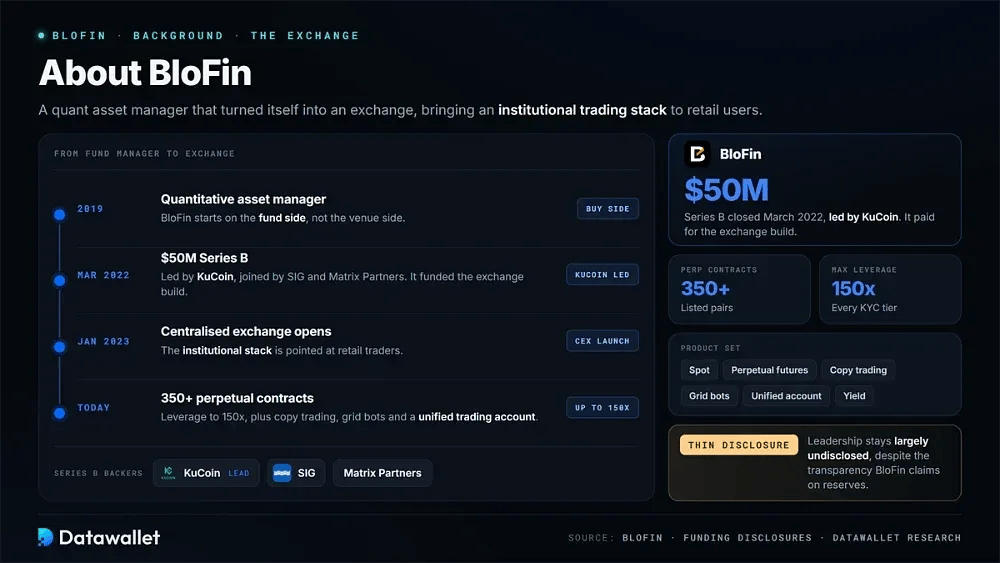
BloFin began in 2019 as a quantitative asset manager before opening its centralised exchange in January 2023. The shift brought an institutional trading stack to retail users. In March 2022, a $50 million Series B led by KuCoin and joined by SIG and Matrix Partners closed, funding the exchange build.
The platform now lists more than 350 perpetual contracts with leverage of up to 150x. It also offers copy trading, grid bots and a unified trading account. Leadership remains thinly disclosed despite the transparency BloFin aims to provide through reserve reporting.
Final Thoughts
BloFin exchanges regulatory coverage for broader reach. Sanctioned states remain permanently closed, while licensing-heavy markets are excluded by choice. The remaining 150 or so countries receive access to deep derivatives markets with light onboarding.
Europe remains the position to watch. Access continues in practice even though the authorisation issue is unresolved. If enforcement tightens or BloFin withdraws, traders there bear the consequences.
Before funding an account, check the Terms of Use rather than relying on a list that may have changed. Using a VPN puts your balance at risk, while the exchange loses nothing by closing the account.
.webp)