







Can I Buy USDT in the USA?
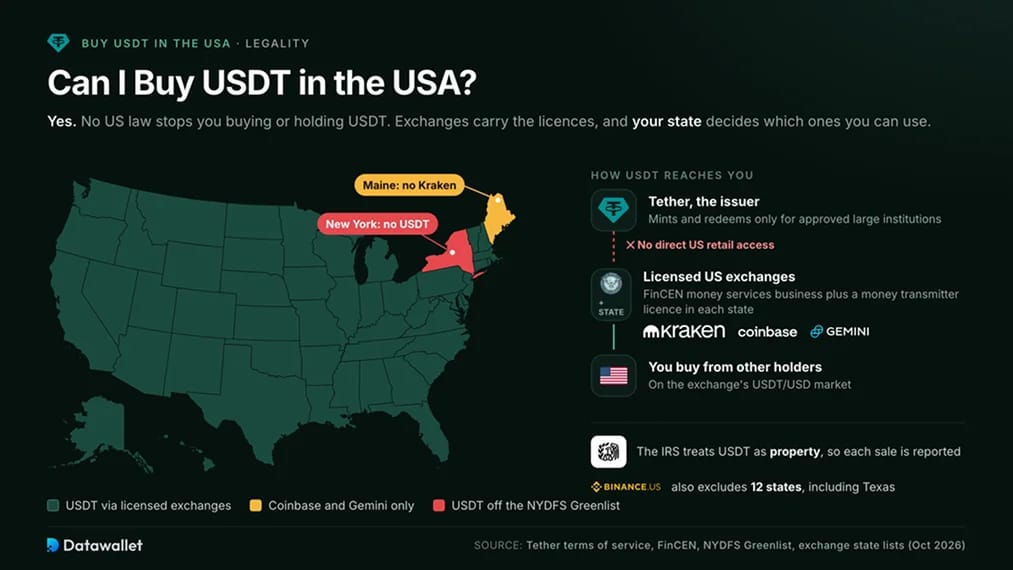
No federal or state law prevents individuals from buying, holding, or selling USDT. The IRS treats USDT as property for tax purposes. Exchanges carry the regulatory obligations. They must register as money services businesses with FinCEN, the Treasury bureau that polices financial crime, and hold a money transmitter license in each state they serve.
Direct purchases from Tether are unavailable to US individuals. Tether's terms of service exclude US persons except for a narrow group of approved large institutions, so Americans outside that carve-out cannot mint or redeem USDT directly. US buyers instead purchase tokens from other holders on exchanges such as Coinbase, Kraken, and Gemini, which list USDT under their own federal and state licenses.
Access is more restricted in New York. Its Department of Financial Services maintains a Greenlist of coins that BitLicense holders, the state's licensed crypto firms, may offer. USDT is absent. It never appeared when we started a Gemini signup with a Brooklyn address. Kraken does not serve New York or Maine at all. Our New York exchange guide covers what licensed platforms there offer.
How to Buy Tether (USDT) in the USA
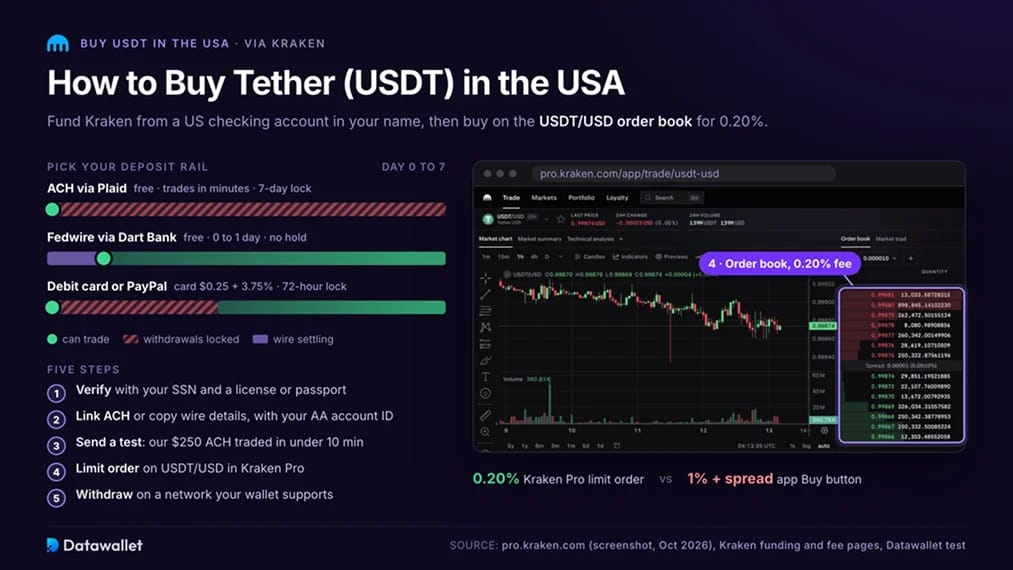
We buy USDT in the USA by transferring dollars from a checking account in our own name to Kraken and placing an order on its USDT/USD market.
The funding method determines when you can move your money out. ACH through Plaid links your bank login and makes funds tradable within minutes, but locks all withdrawals for seven days, including crypto. A Fedwire transfer to Dart Bank is free on Kraken's side and carries no hold.
Card deposits cost more. Several large issuers have also historically declined credit card crypto purchases or treated them as cash advances. Our Chase and Bank of America guides explain how the two largest US banks handle payments to crypto platforms.
Steps to buy USDT on Kraken from the USA:
- Open and verify your account: Register at Kraken using your legal name, date of birth, home address, and Social Security number. Upload a driver's license or passport along with a face photo. Our test account cleared that afternoon.
- Link your bank or copy the wire details: Select US dollars in the Funding tab, then choose ACH (Plaid) or Fedwire (Dart Bank). If the wire instructions request it, include your 16-character public account ID beginning with AA in the memo. Without it, Kraken may struggle to match the deposit.
- Send a test amount first: Your bank or Kraken may flag the first ACH transfer from a newly linked account for a fraud review. Our $250 deposit became tradable in under ten minutes, though the withdraw button remained grayed out for the full week. Use a wire if you need to move USDT off the platform quickly.
- Buy on the USDT/USD order book in Kraken Pro: Use a limit order to cap your purchase price instead of accepting a quote. Under Kraken's stablecoin fee schedule, trades cost 0.20% below $50,000 of monthly volume. The main app's Buy button charges 1% plus a spread.
- Withdraw on a network your destination supports: Check the exact withdrawal fee Kraken displays before confirming. Our USDT wallet guide covers options for coins you intend to keep.
USD to USDT Fees
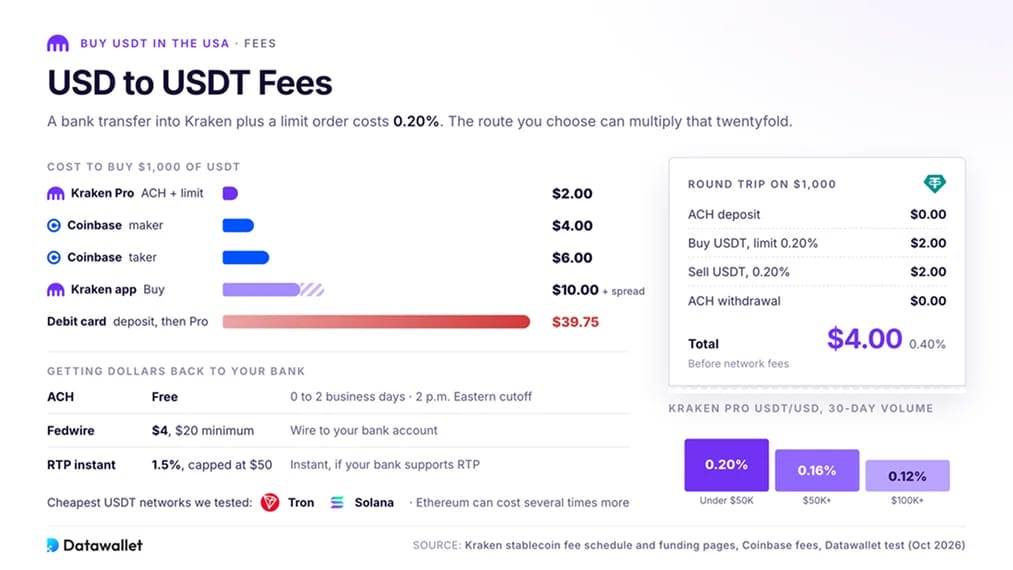
Buying USDT on Kraken's order book with funds deposited by bank transfer costs 0.20% per trade. Your choice of deposit method also affects how soon you can withdraw.
Deposits
- ACH via Plaid (best for regular buys): Deposits are free, start at $1, and become tradable almost immediately. All withdrawals are then held for seven days.
- Fedwire via Dart Bank (best for large or urgent buys): Kraken charges nothing, with settlement in zero to one business day and no withdrawal hold. Your bank will usually charge an outgoing wire fee.
- Debit card and PayPal: Card deposits cost $0.25 plus 3.75%. PayPal displays its processing fee at checkout. We use these methods only for small tests because both impose a 72-hour withdrawal hold.
Trading
- USDT/USD on Kraken Pro: Maker and taker fees are 0.20% below $50,000 of 30-day volume, dropping to 0.16% above that threshold and 0.12% above $100,000. Stablecoin trades do not contribute to Kraken's volume tiers for other pairs.
- Kraken app Buy and Convert: The quote includes a spread in addition to a 1% trading fee. Kraken+ waives the fee on up to $10,000 a month, but the spread remains.
- How Coinbase compares: Coinbase Advanced no longer gives USDT-USD discounted stable-pair pricing. Standard fees start at 0.40% for makers and 0.60% for takers. Our Coinbase fees breakdown lists every tier.
Withdrawals
- USDT to a wallet or another platform: Tron and Solana were the cheapest networks we tested. Ethereum mainnet can cost several times more during busy periods.
- Dollars back to your bank: ACH withdrawals are free, arriving in zero to two business days with a 2 p.m. Eastern cutoff. Fedwire charges $4 and requires a $20 minimum. If your bank supports instant RTP (Real-Time Payments), those transfers cost 1.5%, capped at $50.
Our total cost for a free ACH deposit, a limit-order purchase, a later sale, and an ACH withdrawal was 0.40%, before network fees.
Best USDT Exchanges in the USA
Four US-licensed platforms list USDT for American customers, though none sells it to New York residents. Our ranking weighs dollar funding options and USDT/USD trading costs alongside regulation. The best crypto exchanges in the USA guide covers the wider market beyond stablecoins.
Across the 48 states it serves, Kraken leads on cost and regulatory depth. Buyers who prefer a Nasdaq-listed company can choose Coinbase, but its USDT trading fees are two to three times higher.
Gemini operates under a New York trust charter and lists both USDT and Tether's US token, USAT. Binance.US has the lowest headline fees, although it excludes twelve states, including Texas.
Regulatory Status of USDT in the USA
USDT is legal to buy today. Exchanges must comply with federal money laundering and stablecoin rules, as well as state licensing requirements.
Signed in July 2025, the GENIUS Act gradually restricts which stablecoins US exchanges can list. A foreign-issued stablecoin may be offered from January 18, 2027, only if its issuer can comply with lawful US orders, including address freezes. From July 18, 2028, listings are limited to stablecoins from permitted issuers.
USDT's permitted status depends on Treasury finding El Salvador's rules comparable to the US regime and Tether registering with the OCC. The test appears in Treasury's August 2026 proposed rule. No comparability finding had been announced when we reviewed this page in October.
Tether has USAT as a fallback. Issued by OCC-supervised Anchorage Digital Bank, it launched on January 27, 2026. Its supply is still a small fraction of USDT's, and most offshore pairs continue to quote in USDT. Separately, the CLARITY Act, which would divide spot crypto oversight between the SEC and CFTC, had not become law at the time of writing.
Neither FDIC deposit insurance nor SIPC brokerage protection covers crypto balances, even on a licensed exchange. Our pick, Kraken, combines FinCEN registration and money transmitter licenses in 46 jurisdictions with a Wyoming bank charter. It has also held a Federal Reserve master account since March 2026.
Tax Implications of USDT in the USA
Most USDT trades generate little or no tax. Every sale must nevertheless be reported, and exchanges now report those sales directly to the IRS.
- Buying USDT with dollars is not taxable: A purchase establishes your cost basis because the IRS treats digital assets as property. Selling, swapping, or spending the token creates the tax event.
- Selling USDT usually produces tiny gains or losses: A sale remains a taxable disposal even when the result rounds to zero. Brief departures from the $1 peg can generate small gains or losses.
- Swapping crypto into USDT is a taxable sale: Exchanging Bitcoin for USDT realizes a gain or loss on the Bitcoin that day, even if no dollars enter your bank account. Ordinary income rates apply to holdings of a year or less. Longer holdings qualify for the 0%, 15%, or 20% long-term rates, with most states adding their own income tax.
- Form 1099-DA now reaches the IRS: Exchanges reported gross proceeds for 2025 sales. They must also report cost basis for coins purchased after 2025 and kept on the same platform. The Form 1099-DA instructions include an optional stablecoin rule allowing brokers to omit USDT-for-dollar sales totaling $10,000 or less in a year. You must still report those sales yourself.
- Rewards are ordinary income: Record each USDT reward payout at its dollar value when received. Exchange rewards count as income but do not appear on Form 1099-DA.
💡 For active users: USDT transferred to Kraken from an outside wallet is a noncovered asset. Kraken's 1099-DA therefore will not include what you paid for it. Keep your own cost basis records for transferred coins and export your full Kraken ledger quarterly. If you trade at volume, bring in a CPA. This is general information rather than tax advice.
Why Americans Hold USDT
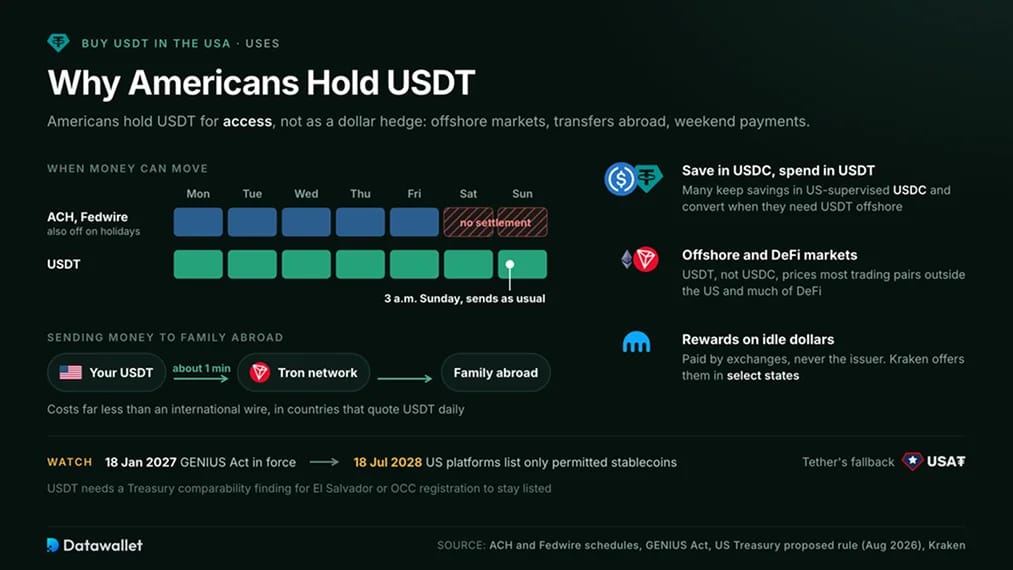
For Americans who already bank in dollars, USDT provides access to markets and transfers rather than protection from a weak currency.
- Access to offshore and on-chain markets: USDT, rather than USDC, is the pricing currency for most trading pairs outside the US and much of decentralized finance, meaning blockchain-based lending and trading apps. Traders need USDT to move funds into those venues. Our USDT statistics page tracks its lead over rival stablecoins.
- Sending money abroad: Family members can receive USDT in countries where local exchanges and peer-to-peer markets quote it daily. Tron transfers settle in about a minute and cost far less than an international wire.
- Moving money outside banking hours: Unlike ACH and Fedwire, which do not settle on weekends or federal holidays, USDT already held in an account can be sent at 3 a.m. on Sunday as easily as midday Tuesday. Active traders keep a standing stablecoin balance for this reason.
- Rewards on idle dollars: Any yield comes from exchanges or lending platforms because the GENIUS Act bars issuers from paying interest. Kraken's rewards feature is available only in select states. Our stablecoin interest rates roundup compares current offers and their risks.
- A deliberate split with USDC: Many US investors hold savings in USDC, which a US company issues under US supervision. They convert to USDT when they need it offshore. Our guide to the safest stablecoins compares their reserves and regulation.
Final Thoughts
Kraken gave us the cheapest regulated route to USDT from a US bank account, with free ACH and Fedwire deposits and a 0.20% USDT/USD order book fee. Its regulatory credentials include FinCEN registration and 46 money transmitter licenses, alongside a Wyoming bank charter and a Federal Reserve master account. For more detail on both platforms, read our Kraken review and Coinbase vs Kraken comparison.
Use a wire when you need to withdraw quickly, and place limit orders on Kraken Pro instead of using the app's Buy button. Quarterly exports will help you check your records against Form 1099-DA. Residents of Maine and New York need another platform, with New Yorkers restricted to Greenlist stablecoins.
The key deadline is July 2028. US platforms will have to stop offering USDT unless Tether secures a comparability finding for El Salvador or registers the token another way. Holders would then need to sell or convert to USAT or USDC. Keep only working balances on exchanges and the rest in a wallet you control. Recheck Tether's status before each new year.
%20(1).webp)