
6 Best Crypto Exchanges in Singapore
The most important factor to consider as a Singaporean investor is whether your chosen exchange is on the Monetary Authority of Singapore license register, because that single detail now determines which platforms you can legally fund from a local bank account.
A new Digital Token Service Provider regime took effect on 30 June 2025, and offshore venues that Singaporeans once defaulted to exited the country. Bybit and Bitget pulled back from the local retail market, and Binance still sits on the MAS Investor Alert List.
What remains is a shorter selection of Major Payment Institution (MPI) licensees that settle Singapore dollars over PayNow and FAST in seconds.
We tested every platform below from a Singapore account, running PayNow and FAST top-ups from DBS and OCBC, clearing KYC through Singpass where supported, and timing how quickly SGD became available to trade.
Our Top Picks: Best Platforms for 2026
- Coinbase - Best Crypto Exchange in Singapore
- Coinhako - Top Local Pick Based in Singapore
- Independent Reserve - SGD Wallets Plus OTC
- OKX - Deep Liquidity with Singpass KYC
- Crypto.com - All-in-One Crypto App and Card
- Gemini- Recommended for Security-First Custody

Top Crypto Platform in Singapore - Coinbase
Coinbase is the best exchange in Singapore because it pairs a full MAS license with the cleanest beginner experience in the market, strong custody, and direct SGD funding through FAST and PayNow.
Supported Assets
250+ cryptocurrencies
SGD Deposit Methods
PayNow, FAST, Debit Card
Licensing & Regulation
MAS Major Payment Institution (Coinbase Singapore Pte. Ltd.)
Compare Top Singaporean Crypto Exchanges
1. Coinbase
Coinbase is the first platform we point most Singaporeans to, and the reason is trust. It secured its MAS Major Payment Institution license in October 2023, and as a US-listed public company with one of the cleanest compliance records in the sector, it offers the kind of confidence a first-time buyer wants.
The app is clean, the buy flow is obvious, and SGD clears in through FAST bank transfer and PayNow. The catch most beginners miss is pricing. The one-tap, simple buy is convenient but carries a markup, while Coinbase Advanced Trade lowers fees to 0.6% of the trade, depending on volume, so larger orders belong there.
The platform lists 250+ assets, supports staking on majors like ETH and SOL, and publishes regular reserve transparency. Our Coinbase review walks through the fee tiers. For a Singaporean who weighs regulation, security, and ease of use over the widest listing, it is the strongest all-round platform on the market.
Pros
- MAS MPI licensed, publicly listed, with a strong security and custody record.
- Genuinely beginner-friendly, with SGD funding by FAST and PayNow.
- Advanced Trade lowers fees for anyone comfortable using the order book.
Cons
- The simple buy carries a noticeable markup over Advanced Trade.
- Smaller altcoin selection than OKX or Crypto.com.
- Some products and pairs are limited compared with their US offering.
.webp)
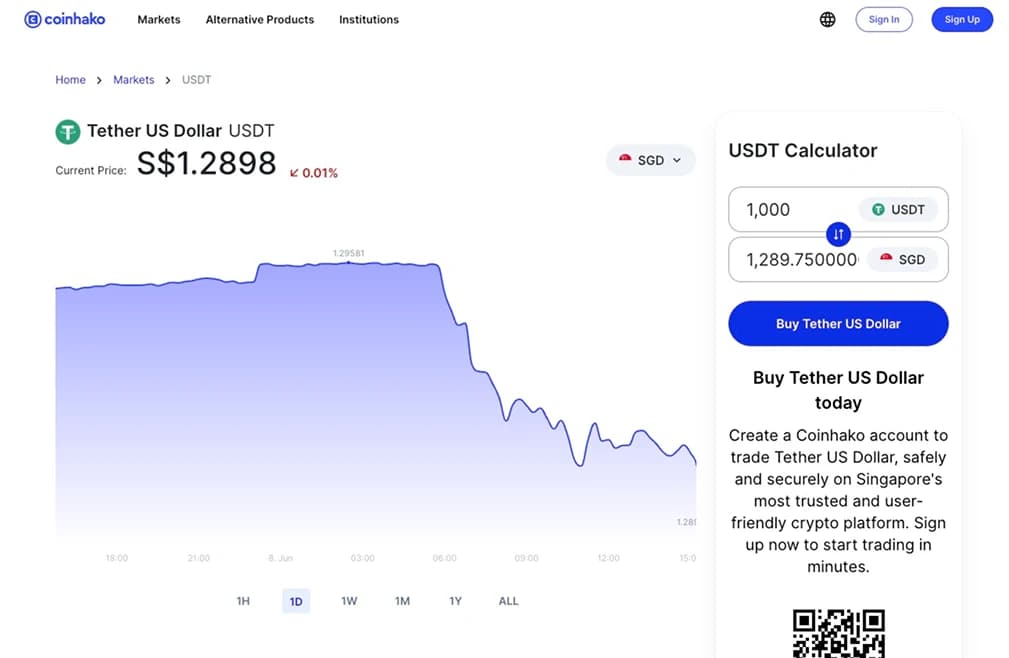
2. Coinhako
Coinhako is the top homegrown option in Singapore, and the reason is local fit. Founded here in 2014, it holds an MAS Major Payment Institution license and is built for the SGD investor rather than being retrofitted for one. We funded it by PayNow from an OCBC account, and the balance was tradable almost immediately.
The product stays close to what a local buyer needs. You get 130+ assets, Recurring Buys for dollar-cost averaging, an SGD wallet so you can hold fiat between trades, and staking on a handful of proof-of-stake coins. The interface is deliberately simple, which is a strength for newcomers and a limit for anyone wanting derivatives.
On cost, the instant buy carries a spread, and trades run on a flat fee model, so it pays to understand the pricing before larger orders. We break the numbers down in our Coinhako fees guide. Security and compliance are the draw here: MAS oversight, local customer support, and a track record stretching back a decade.
Pros
- Singapore-based and MAS MPI licensed, with instant PayNow and FAST SGD funding.
- Beginner-friendly buy flow, Recurring Buys, and an SGD wallet for holding fiat.
- Long local track record with responsive Singapore-based support.
Cons
- No futures, margin, or advanced derivatives for active traders.
- Instant buy carries a spread, so larger orders need care on pricing, with fees starting at 3%.
- Narrower asset list than global venues like OKX or Crypto.com.
3. Independent Reserve
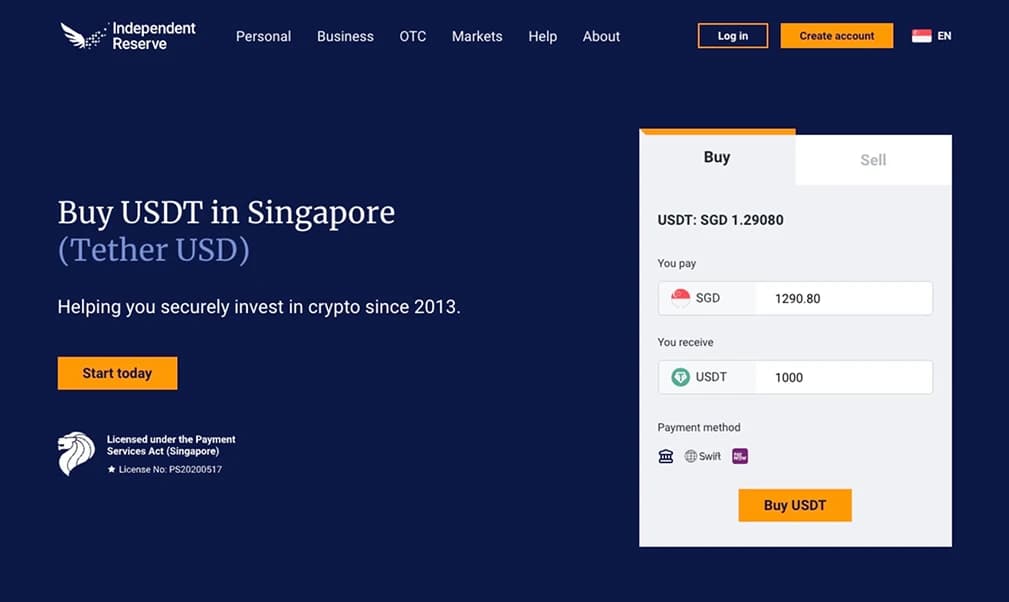
Independent Reserve earns its spot by treating fiat properly. Established in 2013 and the first digital asset exchange to be licensed by MAS, it runs both SGD and USD wallets, so you can hold and trade in either currency without bouncing through a stablecoin. We moved SGD in by PayNow, and the desk handled it cleanly.
The platform favors substance over flash. It lists a focused set of 30+ established assets rather than chasing every new token, applies a volume-tiered fee that starts around 0.5% and falls toward 0.02% for active accounts, and runs an OTC desk for orders above S$50,000 where slippage matters.
Security is a core selling point, with ISO 27001 certification and a governance team drawn from traditional finance. The trade-off is range: if you want long-tail altcoins or derivatives, this is not the exchange. For an SGD or USD investor who values a regulated, secure exchange with a real OTC option, it is one of the most credible names here.
Pros
- First MAS-licensed digital asset exchange, with native SGD and USD wallets.
- Volume-tiered fees down to 0.02% and an OTC desk for larger orders.
- ISO 27001 certified with strong governance and a long local history.
Cons
- Curated asset list, with no derivatives or long-tail altcoins.
- Entry-level fees are higher until you build trading volume.
- The user interface is functional rather than advanced.
4. OKX
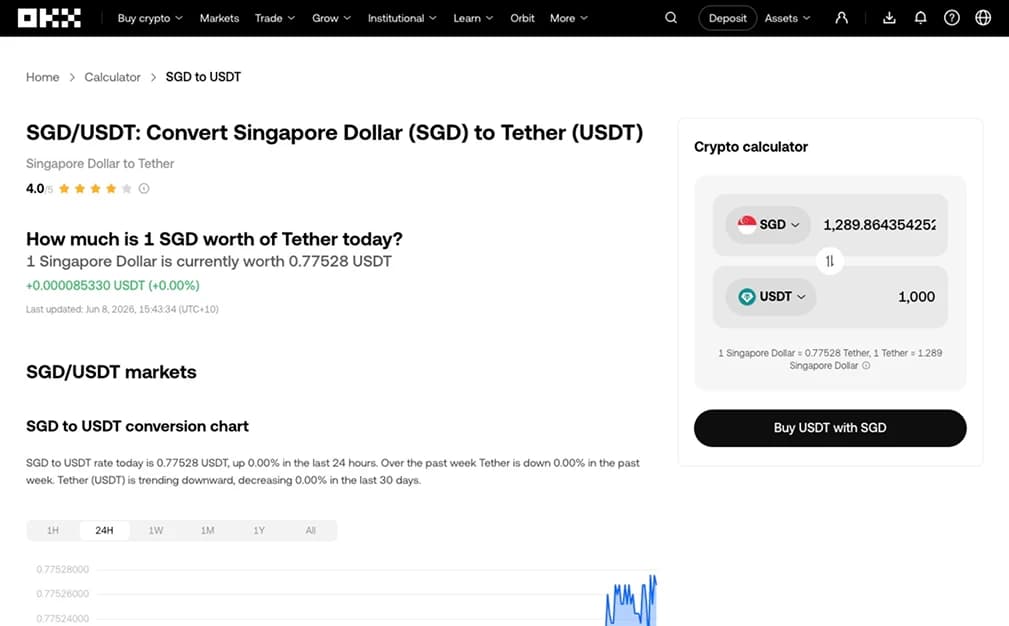
OKX is the pick when you want global depth without leaving the regulated perimeter. Its Singapore entity holds an MAS Major Payment Institution license, and onboarding is unusually smooth because it integrates directly with Singpass for identity verification, so KYC took us minutes rather than days.
Beyond funding, it is a serious exchange. You get 300+ assets, deep spot liquidity, OKX Earn for yield, and the self-custody OKX Wallet that connects to DeFi, NFTs, and on-chain apps. Spot fees start around 0.1%, competitive for this market, and the interface scales from a simple instant buy to professional charting. We cover the platform in depth in our OKX review.
SGD moves in over PayNow and FAST, with a P2P marketplace as a backup route. The one caution is that the advanced product surface can overwhelm a first-time buyer, so start on spot and treat leverage carefully. For users who want both regulation and the widest practical range, it is one of the strongest options here.
Pros
- MAS MPI licensed with fast Singpass-based identity verification.
- 300+ assets, deep liquidity, OKX Earn, and a self-custody Web3 wallet.
- Instant SGD funding via PayNow and FAST, plus a P2P backup.
Cons
- The advanced interface has a learning curve for beginners.
- Leverage and derivatives can tempt inexperienced traders into outsized risk.
- Yield products on some tokens are gated to accredited investors.
5. Crypto.com
Crypto.com is the all-in-one option, and its Singapore entity, Foris DAX Asia, has held an MAS Major Payment Institution license since 2023. The draw is the ecosystem, which includes trading, staking, and a Visa card that pays rewards, all inside one app. SGD funds in through FAST bank transfer.
The exchange lists 400+ assets, one of the wider menus among licensed platforms here, alongside spot trading, staking, and yield products. The Crypto.com Visa card is the feature locals talk about most, letting you spend crypto with cashback-style rewards tied to your tier. Our Crypto.com review covers the trade-offs in full.
On cost, entry-tier spot fees run around 0.25% maker and 0.50% taker, higher than OKX, though staking the CRO token lowers them. It publishes Proof-of-Reserves attestations. The honest read is that the value sits in the card and the bundled ecosystem rather than the cheapest trading, so weigh it against how you actually plan to use the account.
Pros
- MAS MPI licensed, with a broad 400+ asset menu and SGD via FAST.
- Visa card with rewards plus staking and yield in one app.
- Proof-of-Reserves attestations and a large global user base.
Cons
- Entry-tier trading fees are higher than those of OKX or Gemini.
- Best card rewards require locking up CRO.
- The all-in-one app can feel cluttered for users who only want to trade.
.webp)
6. Gemini
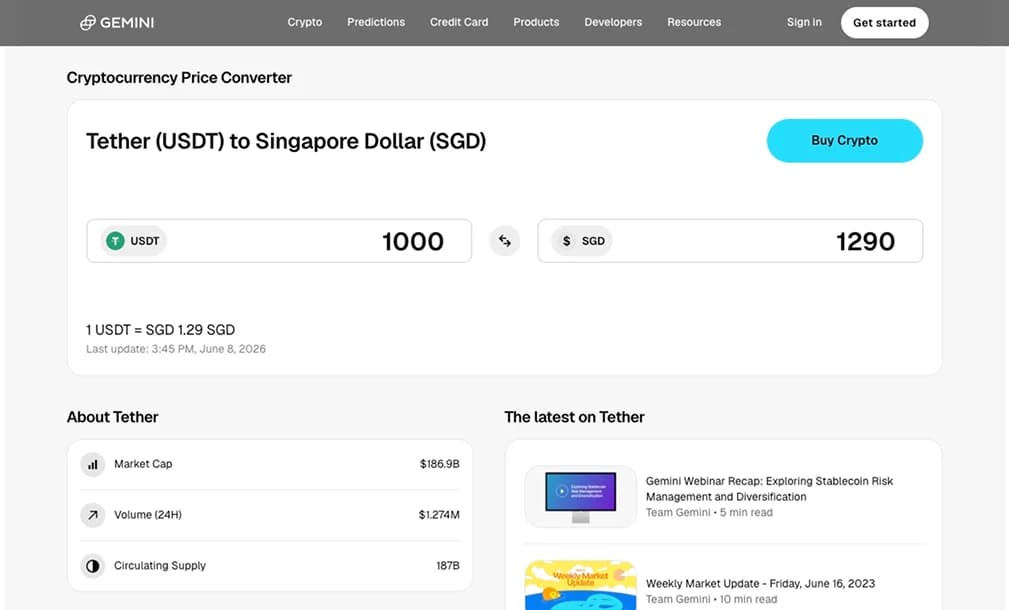
Gemini rounds out the list for users who put custody and security first. It operates in Singapore under an MAS in-principle approval for a Major Payment Institution license, a step short of the full grant the others hold, which is worth knowing before you commit larger balances.
The platform is built around safety. The majority of assets sit in cold storage, it has a clean security history, and its ActiveTrader interface gives serious users proper order types and charting. It lists 70+ vetted assets, leaning toward established coins rather than speculative listings, with staking on select tokens.
Pricing is reasonable on ActiveTrader, roughly 0.2% maker and 0.4% taker, while the simple mobile buy carries a wider spread. For a Singaporean who weighs custody and a conservative listing policy above breadth, it remains a solid, security-led choice.
Pros
- Strong cold-storage custody and a clean security track record.
- ActiveTrader gives advanced order types at fair maker/taker fees.
- Vetted, conservative asset list with SGD funding by FAST.
Cons
- Operates under MAS in-principle approval, not yet a full MPI license.
- Smaller asset selection than OKX or Crypto.com.
- Simple mobile buy carries a wider spread than ActiveTrader.
How to Choose a Crypto Exchange in Singapore
Picking an exchange starts with checking the MAS register and knowing how you plan to trade. These are four steps we follow to help pick an exchange:
- Confirm the MAS license. The most important filter is whether the platform holds a Major Payment Institution license on the MAS register. Coinbase, Coinhako, Independent Reserve, OKX, and Crypto.com hold full MPI licenses; Gemini operates under in-principle approval.
- Match the SGD rail to your habits. All licensed names settle via PayNow or FAST through a local bank, so funding from DBS, OCBC, UOB, or Standard Chartered is fast and direct. If you want to hold fiat between trades, Coinbase, Independent Reserve, and Coinhako run SGD wallets.
- Fit the asset list and tools to your goal. Simple majors and a first buy point to Coinbase or Coinhako, the widest menu to Crypto.com or OKX, an OTC desk to Independent Reserve, and custody-first storage to Gemini. Do not pay for breadth you will not use.
- Understand the retail guardrails. MAS bars licensed platforms from offering credit-card funding to retail buyers and from running incentive promotions, so a clean, low-friction funding flow is normal here, not a missing feature.
Crypto & Bitcoin Regulation in Singapore
Singapore is strict on conduct but welcoming in principle, and the rulebook keeps expanding. Holding and trading crypto is legal, and the compliance burden falls on the exchanges. Three elements matter most:
- MAS MPI License: Under the Payment Services Act 2019, in force since January 2020, MAS treats crypto firms as Digital Payment Token (DPT) providers. The Major Payment Institution license is the permission that lets a platform buy, sell, and exchange crypto for local customers.
- A 2025 tightening: From 30 June 2025, a Digital Token Service Provider regime under the Financial Services and Markets Act forced any Singapore-based firm serving clients abroad to hold a license or close that line of business. MAS signaled such licenses would be rare, prompting Bybit and Bitget to retreat.
- Built-in friction for retail: Treating crypto as ill-suited to most retail investors, MAS bans credit-card buying for that group, forbids public advertising and incentive schemes, requires segregation of customer assets, and enforces Travel Rule reporting above S$1,500.
The practical message is to stick to a name on the MAS register, fund it directly from your bank via PayNow or FAST, and treat an absent feature, like card top-ups, as policy rather than a shortcoming.
How Is Crypto Taxed in Singapore?
Singapore is one of the more favorable places in the world to hold crypto, which is a large part of why adoption runs so high. The treatment splits cleanly by intent:
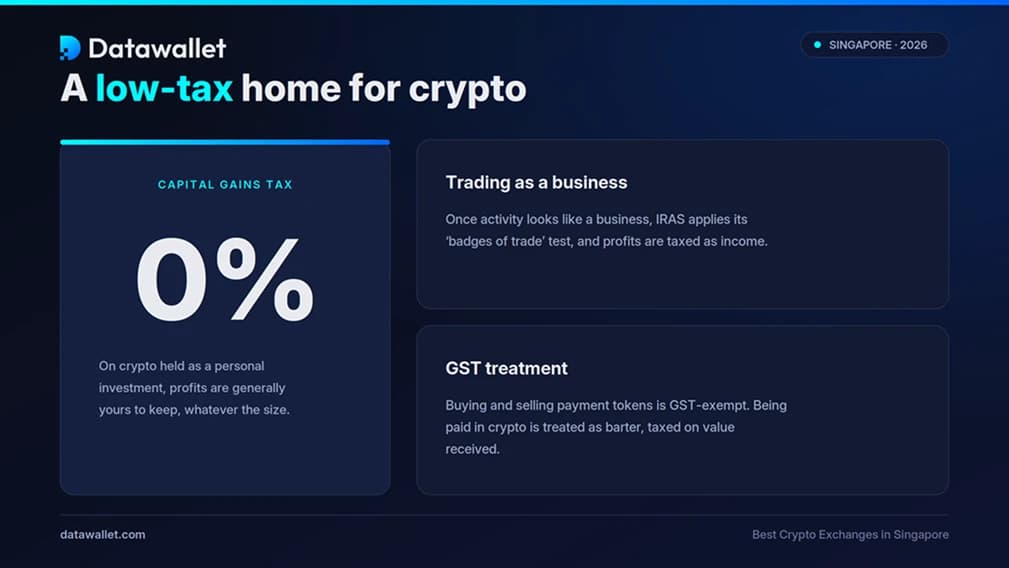
- No capital gains tax: Singapore does not levy capital gains tax on any asset class, crypto included. If you buy Bitcoin as a personal investment and later sell at a profit, that gain is generally not taxed, regardless of size.
- Income tax on trading as a business: If your activity looks like a business, the Inland Revenue Authority of Singapore applies its "badges of trade" test, weighing frequency, holding period, and profit motive. Profits then fall under standard income tax rather than tax-free gains.
- GST and payment: Buying and selling digital payment tokens is generally exempt from Goods and Services Tax, though GST can apply to service fees. Being paid in crypto for goods or services is treated as a barter trade and taxed on the value received.
This structure is why Singapore consistently ranks among the best low-tax crypto countries. The line between investing and trading as a business is thin, so keep records of every buy, sell, and transfer, and confirm your position with a qualified tax adviser. This is general information, not tax advice.
Cryptocurrency Adoption in Singapore
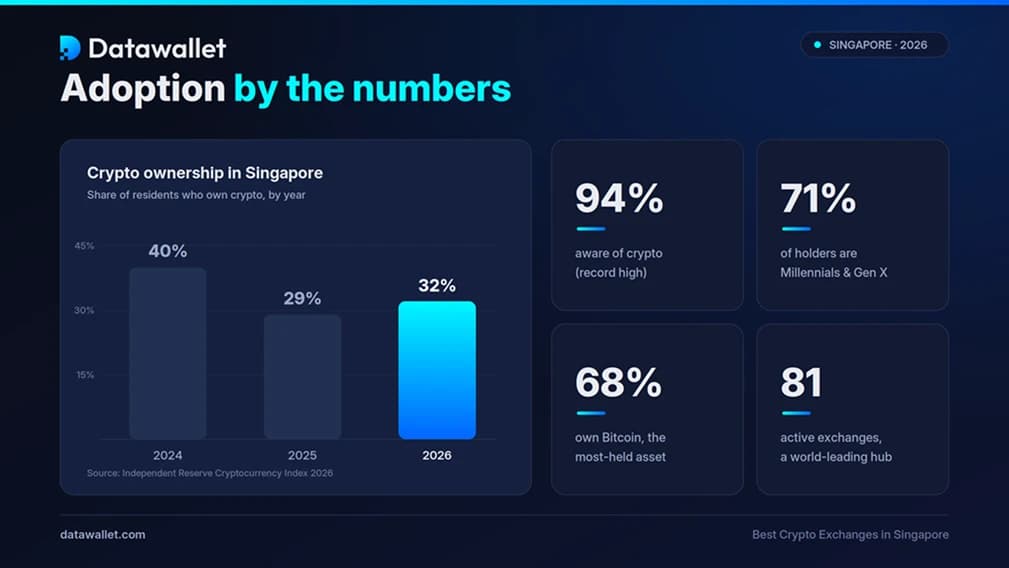
For a city of under six million, Singapore carries outsized weight in digital assets, a function of affluence, connectivity, and regulatory clarity rather than need. A few patterns stand out:
- A regional leader: Statista places Singapore at the front of Asia-Pacific adoption, helped by a wired-up population and the absence of any capital gains tax.
- Owned widely, held carefully: Estimates put ownership near a quarter of residents in 2025, though most keep crypto under a tenth of their portfolio and describe themselves as long-term holders.
- Safety beats price: Surveys here repeatedly find users picking exchanges on security and regulatory footing ahead of the cheapest fees, mirroring the licensed-first instinct the market rewards.
For the broader numbers, see our crypto adoption statistics and our guide to the best crypto exchanges in Asia.
How to Buy Bitcoin in Singapore
Buying Bitcoin here means funding a licensed exchange in SGD and swapping it for BTC. Here are the steps:
- Pick a licensed platform. For trust and an easy first buy, Coinbase or Coinhako; for SGD and USD wallets plus OTC, Independent Reserve; for depth with regulation, OKX. Confirm the MPI license before you sign up.
- Complete identity verification. Singapore platforms verify with a government ID and, on OKX, directly through Singpass. Verification usually clears within minutes to a day.
- Deposit Singapore dollars. Transfer SGD by PayNow or FAST from a bank account in your own name. A DBS or OCBC transfer typically lands in seconds to a few minutes.
- Buy Bitcoin (BTC). Open the BTC pair, enter your amount, and use a limit order on a pro interface like OKX or Coinbase Advanced Trade to avoid the instant-buy spread.
- Secure your Bitcoin. Move larger holdings off the exchange to a hardware wallet such as Ledger or Trezor. Our guide to the best crypto wallets covers the options.
The habit that protects you here is simple: trade on a licensed venue, fund from an account in your own name, and self-custody anything you are not actively trading.
Final Thoughts
Choose by what you value most. For trust, security, and the easiest first buy, Coinbase is the default in Singapore.
For a homegrown SGD-native platform, use Coinhako. For SGD and USD wallets plus OTC, Independent Reserve is the better fit. For global depth within the regulated perimeter, use OKX. For an all-in-one app and card, Crypto.com makes sense, while Gemini is the custody-first choice.
The bigger shift is that Singapore tightened the rules and cleared out the offshore names, so the license on the MAS register, not the marketing, now decides where your SGD belongs.
Our Methodology
We put each platform through the same Singapore-user workflow: registering an account, completing KYC by Singpass or document upload, depositing through PayNow and FAST, placing trades, and processing withdrawals. Six factors fed each score:
- Trust Score: Our rating out of 5 weights MAS licensing status, security history, custody transparency, and platform longevity.
- SGD Funding: Whether SGD moves cleanly by PayNow or FAST, tested on settlement speed from local bank accounts.
- Fees: Maker and taker fees, spreads on instant buys, and any funding or withdrawal charges on a representative round trip.
- Asset Availability: The range of coins and products, from majors to long-tail tokens, derivatives, and yield.
- Security and Custody: Cold storage, certifications, and account-protection features such as MFA.
- Local Usability: App performance, KYC flow, Singpass support, and customer service quality.
Our weighting favored platforms that a Singaporean can legally fund and use right now, placing MAS licensing and SGD access above raw coin counts. The testing ran from March to June 2026.
Frequently asked questions

.webp)

.webp)
