






Who is Jack Mallers?
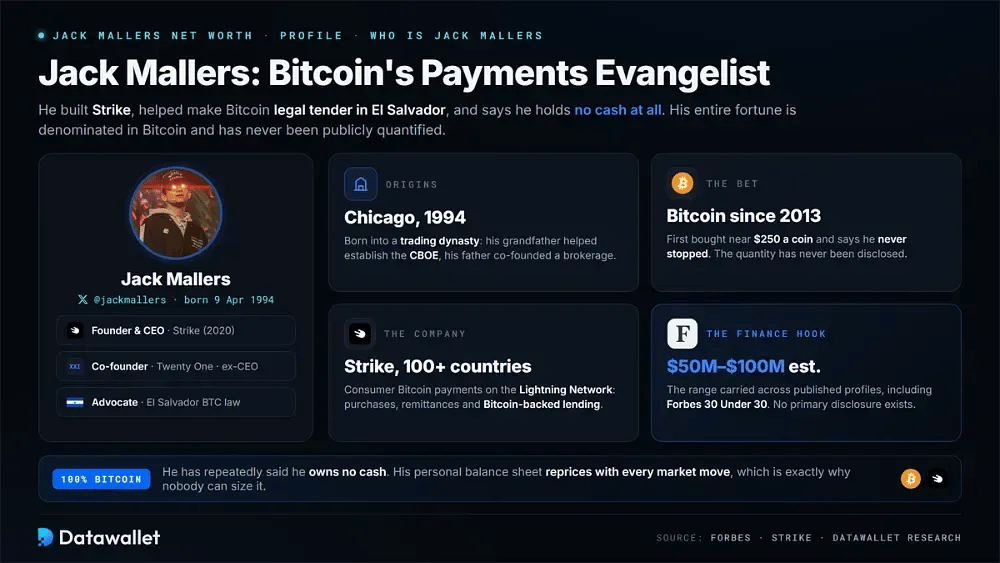
Jack Mallers, born April 9, 1994, in Chicago, is a Bitcoin entrepreneur best known for founding Strike and for helping bring Bitcoin to El Salvador as legal tender. He is one of the most visible advocates for Bitcoin as a payments network rather than a speculative asset.
Raised in a family embedded in Chicago's trading industry, he skipped the traditional finance path and taught himself to code. That mix of market fluency and engineering shaped a career spent building consumer products on the Lightning Network, Bitcoin's fast, low-cost settlement layer.
In April 2025 he co-founded Twenty One Capital alongside Tether and SoftBank, leading it through a SPAC merger onto the NYSE. He resigned as CEO in July 2026 after strategic disagreements with the board, returning full time to Strike.
What makes his fortune unusually difficult to size is his own philosophy. Mallers has repeatedly said he holds no cash and keeps his wealth entirely in Bitcoin, meaning his personal balance sheet reprices with every market move and has never been publicly quantified.
Jack Mallers' Background
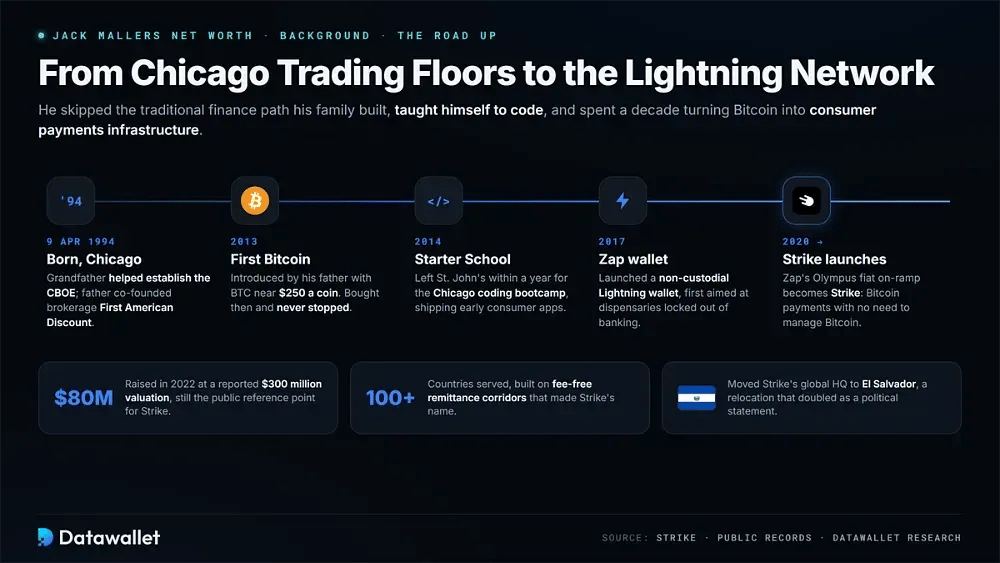
Mallers' path runs from a Chicago trading dynasty through a coding bootcamp and an open-source Lightning wallet, into the payments company that made his name and the treasury vehicle he later walked away from.
Early Life and Education
Mallers grew up surrounded by markets. His grandfather, William J. Mallers Sr., helped establish the Chicago Board Options Exchange, while his father, William Mallers Jr., co-founded the brokerage First American Discount Corporation, giving him early exposure to trading floors and financial infrastructure.
He briefly attended St. John's University in New York before leaving within a year to pursue software. He enrolled at Starter School, a Chicago coding bootcamp, where he sharpened his development skills and shipped early consumer apps in fitness and transportation.
Discovering Bitcoin
His father introduced him to Bitcoin in 2013, when the asset traded near $250 a coin. Mallers has said he bought then and never stopped, though the quantity has never been disclosed. That early conviction became the foundation of his personal wealth.
By 2017 he had focused on the Lightning Network as the missing layer for real-world Bitcoin payments. He launched Zap, a non-custodial Lightning wallet, initially aimed at cannabis dispensaries locked out of conventional banking services.
Building Strike
Zap evolved toward mainstream adoption with Olympus in 2019, letting users buy Bitcoin with fiat and access it instantly over Lightning. In 2020 the product was rebranded as Strike, removing the need for users to manage Bitcoin directly.
Strike scaled quickly, raising $80 million in 2022 at a reported $300 million valuation, launching fee-free remittance corridors, and expanding to more than 100 countries. Mallers also moved the company's global headquarters to El Salvador, a relocation that doubled as a political statement.
Bitcoin Advocacy
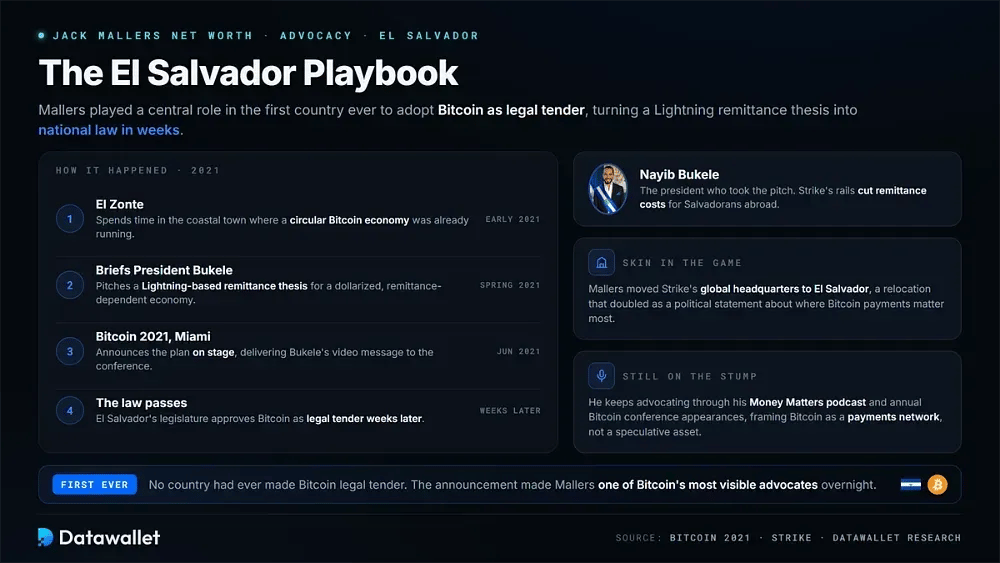
Mallers played a central role in El Salvador's decision to adopt Bitcoin as legal tender in 2021, briefing President Nayib Bukele on a Lightning-based remittance thesis after spending time in the coastal town of El Zonte.
He announced the plan on stage at Bitcoin 2021 in Miami, and the law passed weeks later. Strike's rails cut remittance costs for Salvadorans, and he has continued advocating through his Money Matters podcast and annual conference appearances.
Jack Mallers' Net Worth in 2026
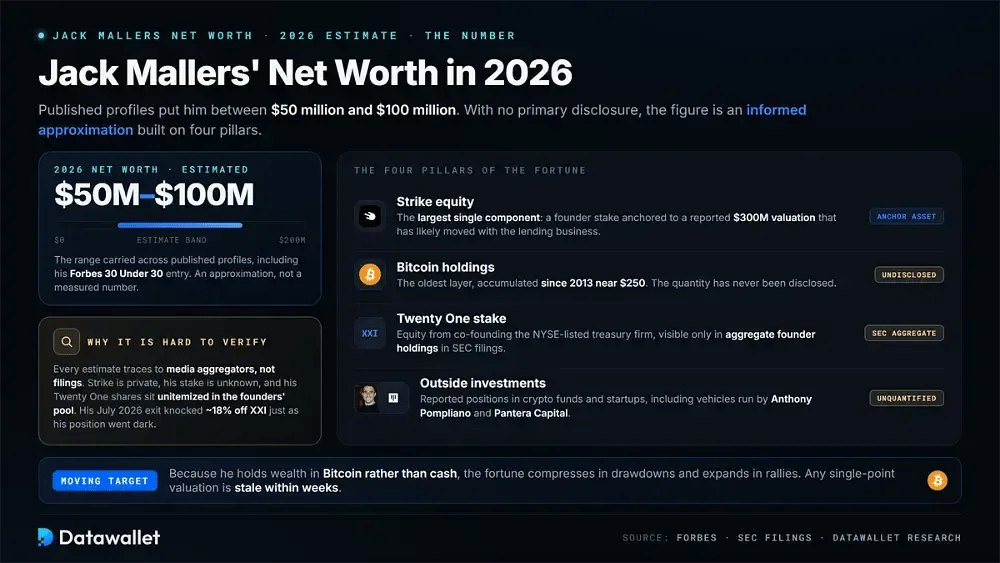
Jack Mallers' net worth in 2026 is estimated between $50 million and $100 million, a range carried across published profiles including his Forbes 30 Under 30 entry. No primary disclosure exists, so the figure remains an informed approximation rather than a measured number.
His wealth in 2026 rests on four main pillars:
- Strike equity: His founder stake in the private company is the largest single component, anchored to a reported $300 million valuation that has likely moved with the lending business.
- Bitcoin holdings: Coins accumulated since 2013 near $250 form the oldest layer of his wealth, though the quantity has never been publicly disclosed by Mallers.
- Twenty One stake: Equity retained from co-founding the NYSE-listed treasury firm, visible only in aggregate founder holdings within SEC filings rather than broken out individually.
- Outside investments: Reported positions in crypto funds and startups, including vehicles run by Anthony Pompliano and Pantera Capital, add an unquantified diversification layer.
The composition matters as much as the total. Because he holds his wealth in Bitcoin rather than cash, his fortune compresses in drawdowns and expands in rallies, making any single-point valuation stale within weeks.
Why the Figure Is Hard to Verify
Every published estimate traces back to media aggregators rather than filings. Strike is private, so its current valuation and his percentage are unknown, and his Twenty One shares are not itemized separately from the founders' pool in public disclosures.
His July 2026 exit adds another variable. Leaving the CEO role does not erase his equity, but XXI shares fell roughly 18% on the announcement, trimming the market value of any retained stake at exactly the moment his position became less visible.
How Much Bitcoin Does Jack Mallers Own?
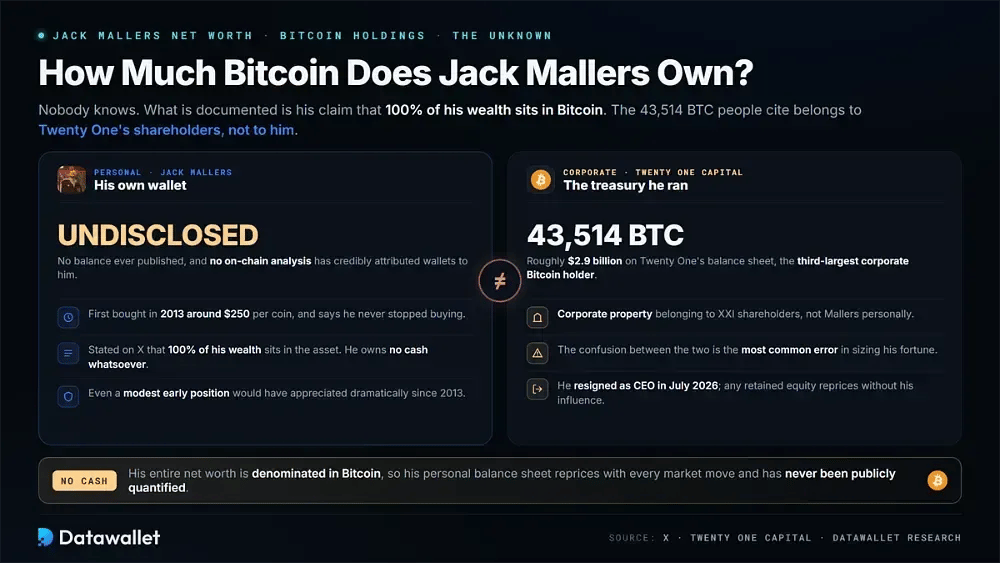
Jack Mallers has never disclosed his personal Bitcoin balance, and no on-chain analysis has credibly attributed wallets to him. What is documented is his repeated claim that he owns no cash whatsoever, with his entire net worth denominated in Bitcoin.
He first bought in 2013 around $250 per coin and has publicly stated on X that 100% of his wealth sits in the asset. Even a modest early position would have appreciated dramatically, but without a disclosed figure the size remains genuinely unknown.
The confusion often stems from conflating him with the treasury he ran. Twenty One Capital holds 43,514 BTC on its balance sheet, worth roughly $2.9 billion, but that is corporate property belonging to shareholders rather than Mallers personally.
Twenty One Capital: The Rise and the Exit
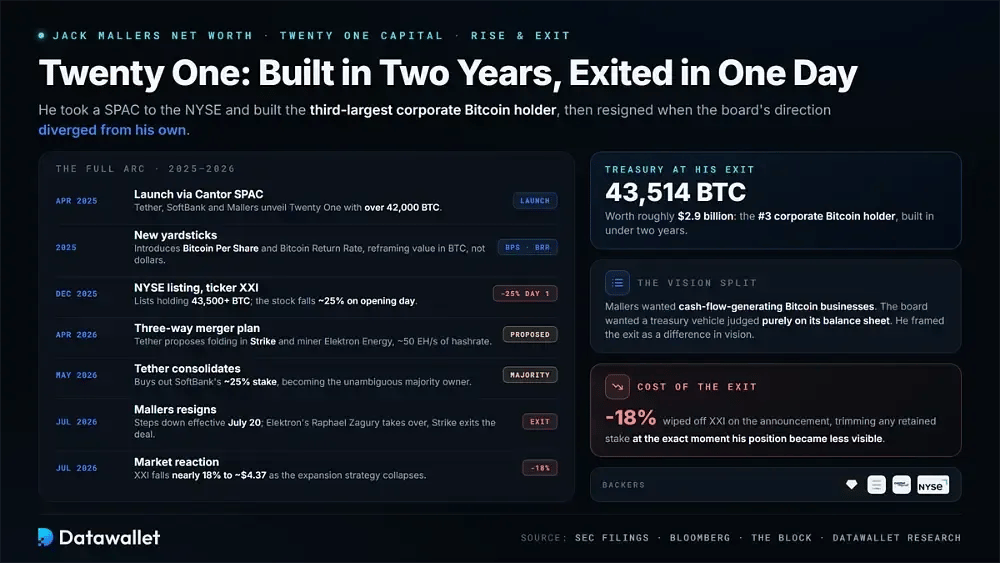
Twenty One Capital was the most ambitious project of Mallers' career and the shortest-lived. He built it into the third-largest corporate Bitcoin holder in under two years, then resigned as chief executive after the board's direction diverged from his own.
The full arc of his Twenty One tenure breaks down as follows:
- April 2025 launch: Tether, SoftBank, and Mallers unveiled Twenty One via a Cantor Equity Partners SPAC, starting with over 42,000 BTC and a mission to maximize Bitcoin per share.
- New metrics: He introduced Bitcoin Per Share and Bitcoin Return Rate, reframing shareholder value in Bitcoin terms rather than dollars, a deliberate break from conventional treasury reporting.
- December 2025 listing: Shares began trading on the NYSE under the ticker XXI holding over 43,500 BTC, though the stock fell around 25% on its opening day.
- May 2026 consolidation: Tether bought out SoftBank's roughly 25% stake, leaving the stablecoin issuer as the unambiguous majority owner of the company Mallers ran.
- April 2026 merger plan: Tether proposed combining Twenty One with Strike and miner Elektron Energy, an integrated vehicle spanning treasury, payments, and roughly 50 EH/s of hashrate.
- July 2026 resignation: Mallers stepped down effective July 20, with Elektron's Raphael Zagury taking over as CEO and Strike exiting the proposed combination.
- Market reaction: XXI fell nearly 18% to around $4.37 as investors absorbed both the leadership change and the collapse of the expansion strategy.
According to Bloomberg, the three-way deal fell apart alongside his departure. Mallers framed the split as a difference in vision, saying he wanted cash-flow-generating Bitcoin businesses rather than a treasury vehicle judged purely on its balance sheet.
What is Strike in 2026?
Strike is the Bitcoin financial services platform Mallers founded in 2020 and returned to full time in July 2026. It operates in more than 100 countries, offering Bitcoin purchases, Lightning payments, cross-border transfers, and Bitcoin-backed lending.
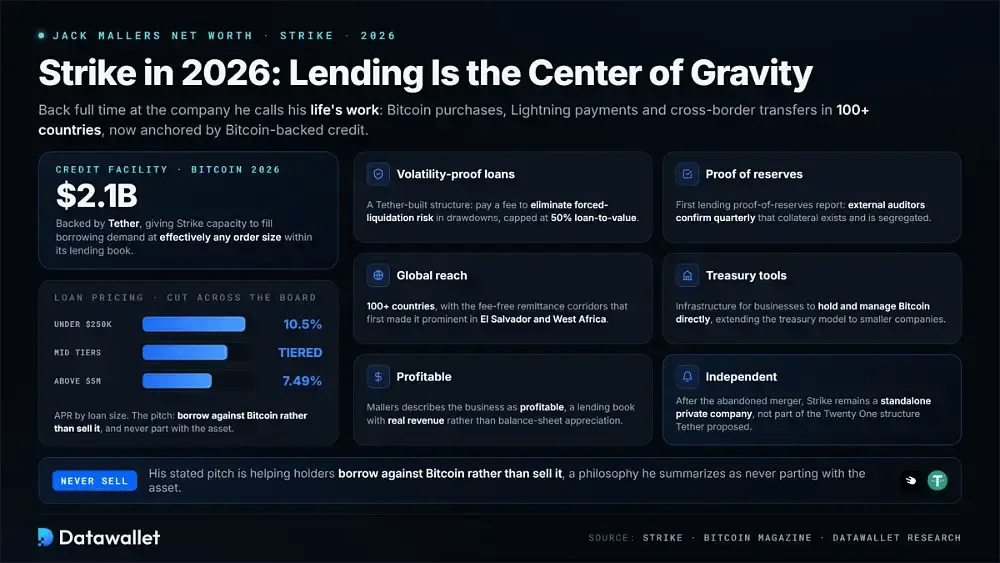
The lending business has become its centre of gravity. At Bitcoin 2026 in Las Vegas, Mallers announced a $2.1 billion credit facility backed by Tether, giving Strike capacity to fill borrowing demand at effectively any order size within its lending book.
Key products and commitments Strike introduced in 2026 include:
- Volatility-proof loans: A structure built with Tether letting borrowers pay a fee to eliminate forced liquidation risk during drawdowns, capped at 50% loan-to-value.
- Proof of reserves: Strike's first lending proof-of-reserves report, with external auditors providing quarterly confirmation that customer collateral exists and is segregated.
- Lower rates: Pricing tiers cut across the board, ranging from roughly 10.5% APR on loans under $250,000 to about 7.49% above $5 million.
- Independence: Following the abandoned merger, Strike remains a standalone private company rather than folding into the Twenty One structure Tether had proposed.
- Global reach: The platform serves over 100 countries, with fee-free remittance corridors that first made it prominent in El Salvador and West Africa.
- Treasury tools: Infrastructure allowing businesses to hold and manage Bitcoin directly, extending the Bitcoin treasury model down to smaller companies.
Mallers has described the business as profitable and framed it as his life's work. His stated pitch is helping holders borrow against Bitcoin rather than sell it, a philosophy he summarizes as never parting with the asset.
What Is Shaping Mallers' Wealth in 2026?
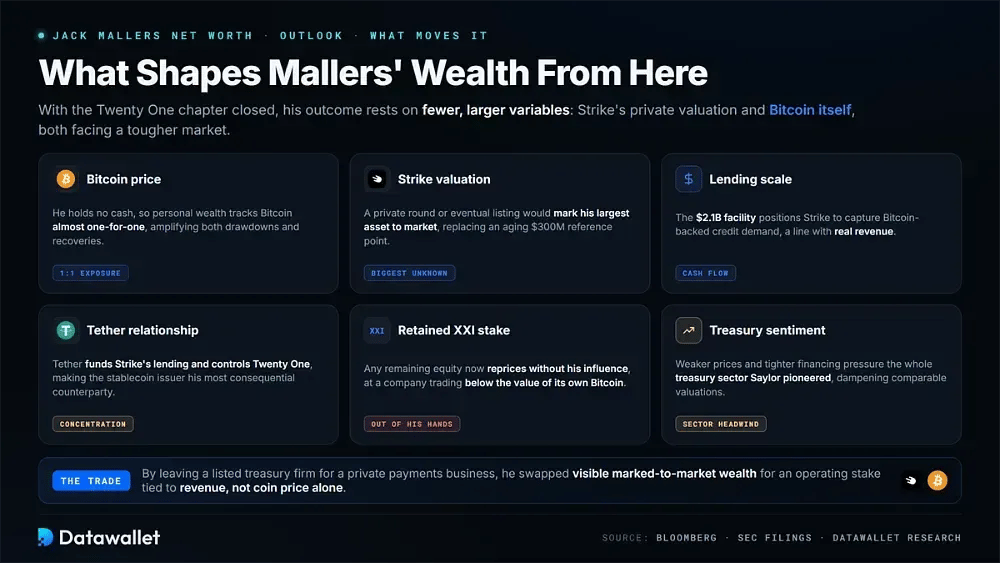
Mallers' fortune now hinges on fewer, larger variables than a year ago. With the Twenty One chapter closed, his financial outcome rests overwhelmingly on Strike's private valuation and on Bitcoin itself, both of which face a tougher market.
Several forces are driving his 2026 financial trajectory:
- Bitcoin price: Because he holds no cash, his personal wealth tracks Bitcoin almost one-for-one, amplifying both drawdowns and recoveries across his balance sheet.
- Strike valuation: A private round or eventual listing would mark his largest asset to market, replacing an aging $300 million reference point with a current figure.
- Lending scale: The $2.1 billion facility positions Strike to capture Bitcoin-backed credit demand, a business line with real revenue rather than balance-sheet appreciation.
- Tether relationship: Tether funds Strike's lending and controls Twenty One, making the stablecoin issuer covered in our Tether statistics his most consequential counterparty.
- XXI stake: Any retained Twenty One equity now reprices without his influence, at a company trading below the value of its own Bitcoin holdings.
- Treasury sentiment: Weaker prices and tighter financing have pressured the entire treasury sector that Michael Saylor pioneered, dampening valuations across comparable vehicles.
The strategic shift is notable. By exiting a listed treasury company for a private payments business, Mallers traded visible, marked-to-market wealth for an operating stake whose value is harder to observe but tied to revenue rather than coin price alone.
Final Thoughts
Jack Mallers enters late 2026 with a fortune still estimated at $50 million to $100 million, but with a materially different shape than a year ago. The public treasury vehicle is gone from his title, and Strike is once again the whole story.
What stands out to us is how deliberately unmeasurable he has kept his wealth. No coin count, no Strike valuation, no itemized stake, just a repeated insistence that everything he owns is denominated in Bitcoin and that he has no intention of selling any of it.
That conviction is the bet. If Bitcoin-backed lending becomes core financial infrastructure and Strike scales into it, his fortune compounds on fundamentals. If the treasury downturn deepens and credit demand stalls, a fortune held entirely in one asset compresses exactly as designed.
.webp)