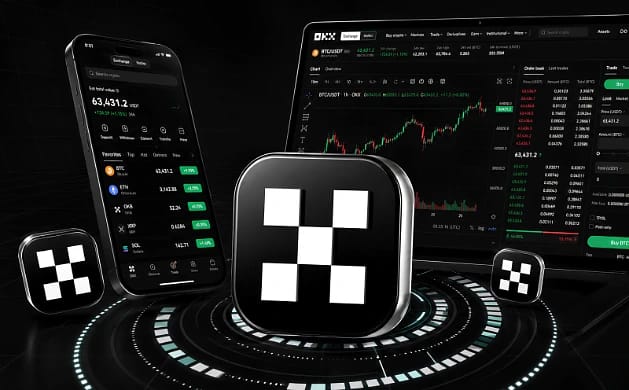


About OKX
Founded in 2017 by Star Xu, OKX is a crypto exchange built for users who want centralized and decentralized tools under one account. Its products span spot, perpetuals, options, trading bots, copy trading, Earn, a multi-chain wallet, and stablecoin payments. Since July, that lineup has also included around-the-clock tokenized US stock markets.
CoinGecko consistently places OKX among the world's leading exchanges by trading volume. OKX reports more than 120 million registered users in 100+ countries, although available products vary by jurisdiction and verification level.
The company's profile shifted sharply this year. In March 2026, Intercontinental Exchange, parent company of the New York Stock Exchange, invested roughly $200 million at a $25 billion valuation and took a board seat. The firms later formed the OKXICE joint venture to bring tokenized NYSE equities and ICE futures to OKX users.
OKX Features
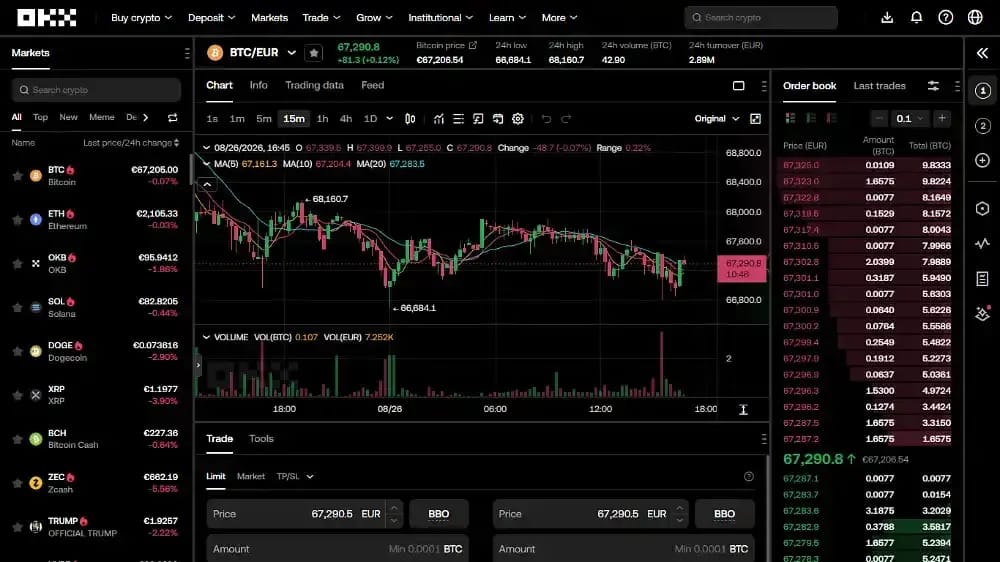
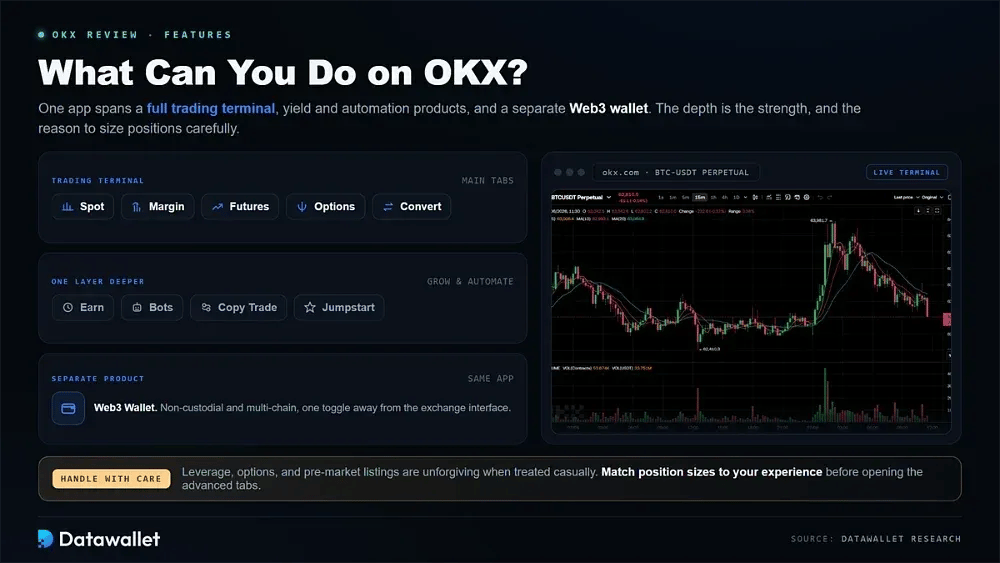
Opening OKX brings up Spot, Margin, Futures, Options, and Convert on the trading side. Earn, Bots, Copy Trade, and Jumpstart sit one layer deeper, while the Web3 wallet remains a separate product within the same app.
The platform's strength is the depth available across its product categories. That same breadth demands care: leverage, options, and pre-market listings are unforgiving when treated casually. Match position sizes to your experience before moving into the advanced tabs.
Trading Types
OKX ranges from straightforward spot purchases to multi-leg derivatives. You can begin with simpler products, then add complexity once your security settings are configured and your risk management is disciplined.
The exchange currently offers these trading products:
- Spot: Order book trading across 350+ tokens and 500+ pairs. Major markets such as BTC/USDT and ETH/USDT generally offer tight spreads and deep liquidity under most market conditions.
- Margin: Borrow against collateral to increase spot exposure using cross or isolated mode. Treat it as futures-lite: keep sizing small, set exits in advance, and avoid holding positions through volatile announcements.
- Perpetual Futures: USDT-margined, USDC-margined, and coin-margined contracts offer leverage up to 125x. Our OKX Futures review covers contract specifications, funding mechanics, and leverage tiers in detail.
- Expiry Futures: Quarterly and bi-quarterly contracts settle on defined dates. They are useful when you prefer a known expiry rather than rolling perpetual exposure and letting recurring funding payments eat into returns.
- Options: BTC and ETH options come with a full chain view and an RFQ marketplace for negotiated block trades. Few centralized venues outside Deribit can match that combination.
- X-Perps: Perpetuals tracking the seven largest US tech stocks. EEA users can access them through OKX's MiFID II entity after passing a mandatory appropriateness assessment.
- Pre-Market Futures: Trade tokens before their official listing with leverage capped at 2x. Liquidity is thin, and you are taking a view on a listing price with limited information, so position sizing matters.
Earn Options
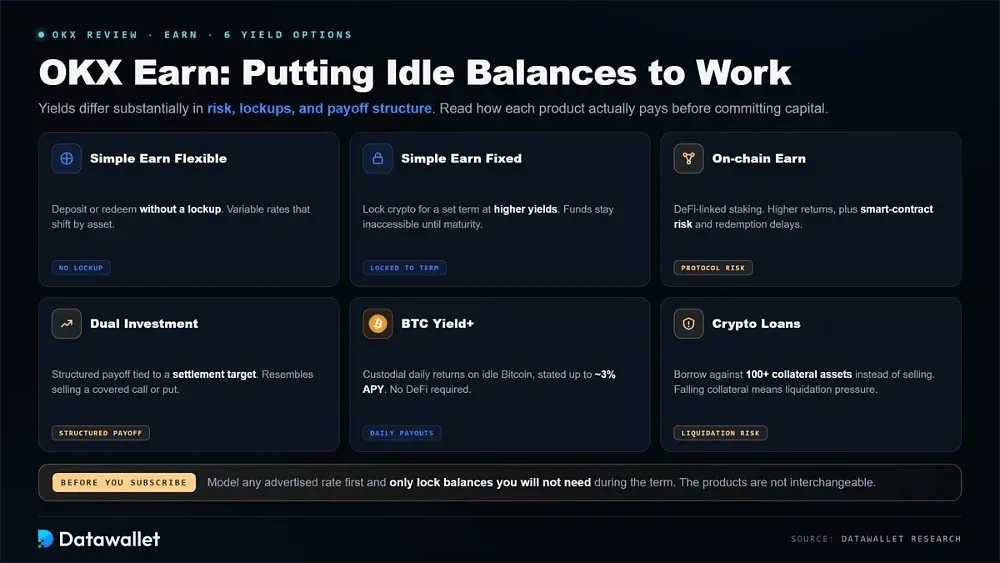
OKX Earn can put idle balances to work, but the products differ substantially in risk. Read the payoff structure before committing capital.
The main yield options are:
- Simple Earn (Flexible): Deposit or redeem without a lockup, with variable rates that change by asset. Before committing meaningful size, model any advertised rate using our crypto staking calculator.
- Simple Earn (Fixed): Lock crypto for a defined period in return for higher yields. Because the funds remain inaccessible until maturity, only commit balances you will not need during the term.
- On-chain Earn: Staking linked to DeFi protocols. Returns may be higher, but they add smart-contract and protocol risk to price risk, along with redemption delays tied to on-chain settlement.
- Dual Investment: A structured product whose result depends on whether the settlement price reaches a target. Its payoff resembles selling a covered call or put, so understand the structure before subscribing.
- BTC Yield+: A custodial product that pays daily returns on idle Bitcoin, with stated rates up to around 3% APY. It is a straightforward option for holders seeking passive yield without using DeFi protocols.
- Crypto Loans: Borrow against 100+ supported collateral assets with flexible repayment terms rather than selling. Falling collateral values create liquidation pressure on the entire position.
Additional Services
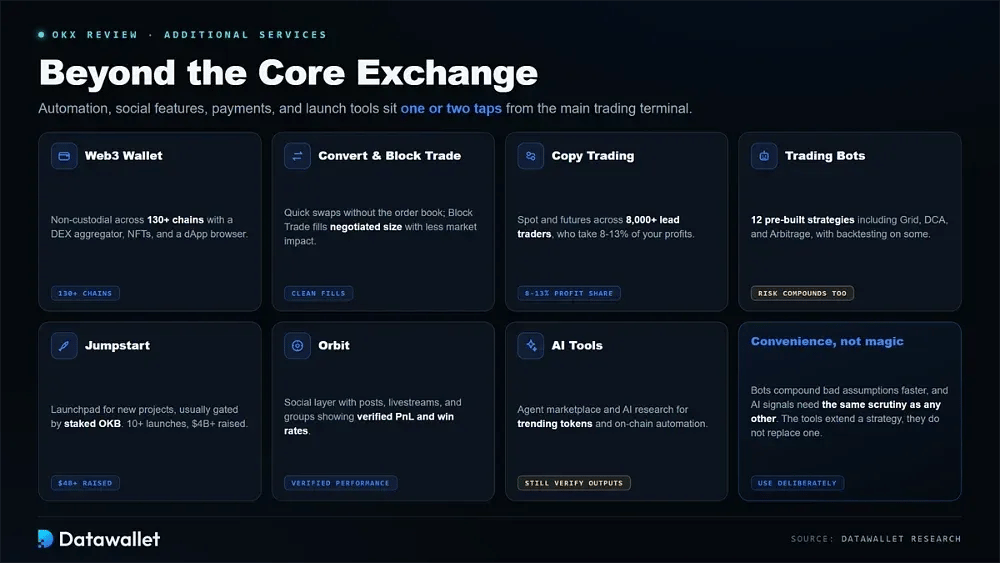
Outside the core exchange, OKX adds automation and social features alongside payments and project launch tools. Most sit only one or two taps from the main trading terminal.
These were the most useful secondary products we tested:
- Web3 Wallet: A non-custodial, multi-chain wallet covering 130+ blockchains, with a DEX aggregator, NFT access, and a dApp browser. Our OKX Wallet review examines it in depth.
- Convert & Block Trade: Convert handles quick swaps without requiring you to work the order book. Block Trade is designed for negotiated size, offering cleaner fills and less market impact than breaking large orders across the open book.
- Copy Trading: Spot and futures copying is available across 8,000+ lead traders, who receive 8-13% of your profits. Our best crypto copy trading platforms ranking compares the alternatives.
- Trading Bots: There are 12 pre-built strategies, including Grid, DCA, Arbitrage, and Recurring Buy, with backtesting available on some. Bots do not remove risk; they can make bad assumptions compound faster.
- Jumpstart: OKX's launchpad for new projects, where participation typically requires staked OKB. To date, the program has launched 10+ projects and raised more than $4 billion for participating teams.
- Orbit: A social layer within the app where users can post commentary, livestream, and create trading groups while showing verified performance data such as portfolio returns, PnL, and win rates.
- AI Tools: OKX Wallet includes an AI agent marketplace and AI-assisted research for surfacing trending tokens and automating on-chain tasks. The outputs still require the same scrutiny as any other signal.
OKX Tokenized Stocks and the ICE Partnership
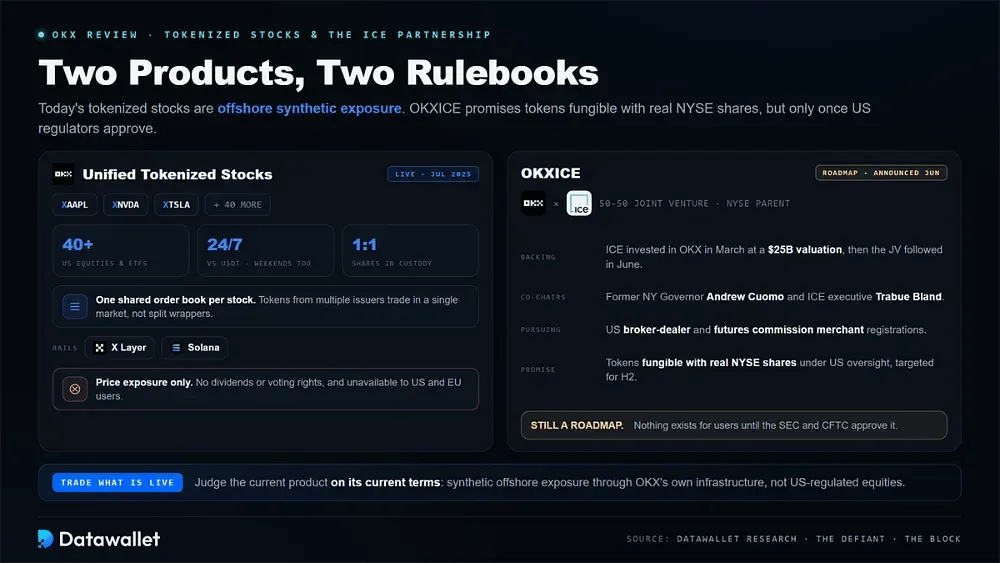
In July, OKX introduced Unified Tokenized Stocks with more than 40 US equities and ETFs listed under X-prefixed tickers including XAAPL, XNVDA, and XTSLA. These markets trade against USDT 24/7, including weekends and holidays. Through the xStocks framework, every token is backed 1:1 by shares held in custody.
Each stock uses a single order book. That structure consolidates tokens from multiple issuers into one shared market instead of splitting liquidity across separate wrappers. Deposits and withdrawals operate on X Layer and Solana. The tokens provide price exposure only, without dividends or voting rights, and they are unavailable to US and EU users. Our best tokenized stock trading exchanges ranking compares competing venues.
A regulated path is developing alongside the current product. Following ICE's March investment, the firms announced OKXICE in June. The 50-50 joint venture is co-chaired by former New York Governor Andrew Cuomo and ICE executive Trabue Bland and is pursuing US broker-dealer and futures commission merchant registrations, with rollout targeted for the second half of the year.
The two products should be treated differently. The tokenized stocks available today provide offshore synthetic exposure through OKX's own infrastructure. OKXICE, by contrast, promises tokens fungible with real NYSE shares under US oversight. The joint venture remains a roadmap until the SEC and CFTC approve it, so trade the live product according to its current terms.
What Is OKB and X Layer?
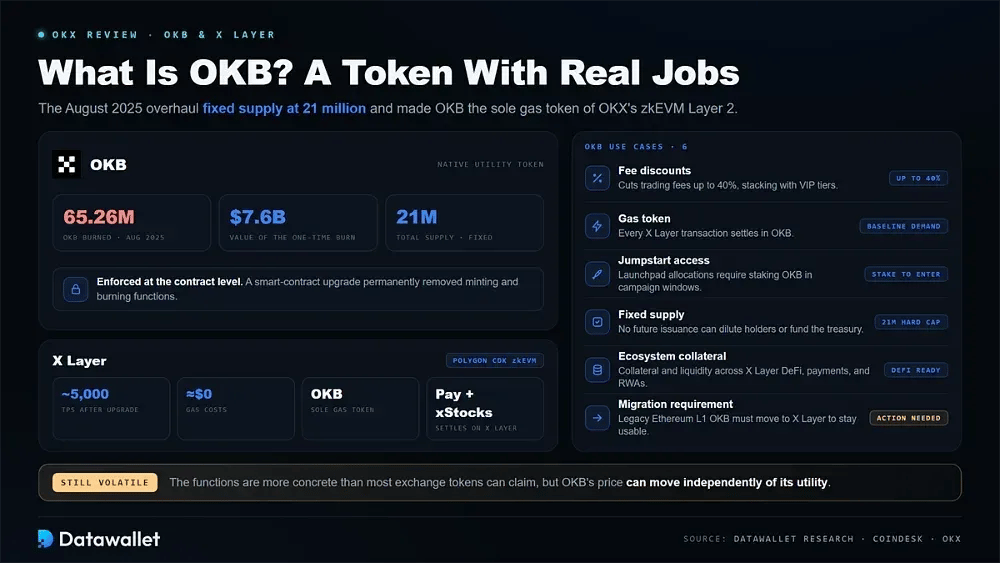
OKB is OKX's native utility token. Its economics changed substantially in August 2025, when the exchange carried out a one-time burn of 65.26 million OKB worth roughly $7.6 billion. The move fixed total supply at 21 million tokens, while a smart-contract upgrade permanently removed minting and burning functions.
X Layer forms the other half of that overhaul. Built with Polygon CDK, OKX's zkEVM Layer 2 was upgraded to around 5,000 transactions per second with near-zero gas costs. OKB became its sole gas token as OKTChain and Ethereum L1 OKB were phased out. X Layer now supports OKX Pay, xStocks settlement, and an expanding DeFi stack, which earned it a place in our best Layer 2 cryptos list.
Those functions are more concrete than most exchange tokens can claim. OKB remains a volatile asset, however, and its price can move independently of its utility.
OKB Use Cases
Within the OKX ecosystem, OKB's main uses are:
- Fee discounts: Holding OKB can reduce trading fees by up to 40% relative to base rates. The discount stacks with VIP tier reductions rather than replacing them.
- Gas token: Every X Layer transaction settles in OKB. Wallet transfers, DeFi interactions, and xStocks movements on the network therefore create steady baseline demand for the token.
- Jumpstart access: Launchpad allocations usually require staking OKB during campaign windows. Rewards are distributed in proportion to your share of the total participant pool.
- Fixed supply: The 21 million cap is enforced at the contract level, with minting removed. Future issuance therefore cannot dilute holders or fund discretionary treasury operations.
- Ecosystem collateral: OKB can be used as collateral and liquidity across X Layer DeFi protocols, connecting its utility to the network's payment, RWA, and trading applications.
- Migration requirement: Legacy Ethereum L1 OKB must be moved to X Layer to remain usable. Our bridge to X Layer guide explains the process step by step.
Is OKX Regulated?
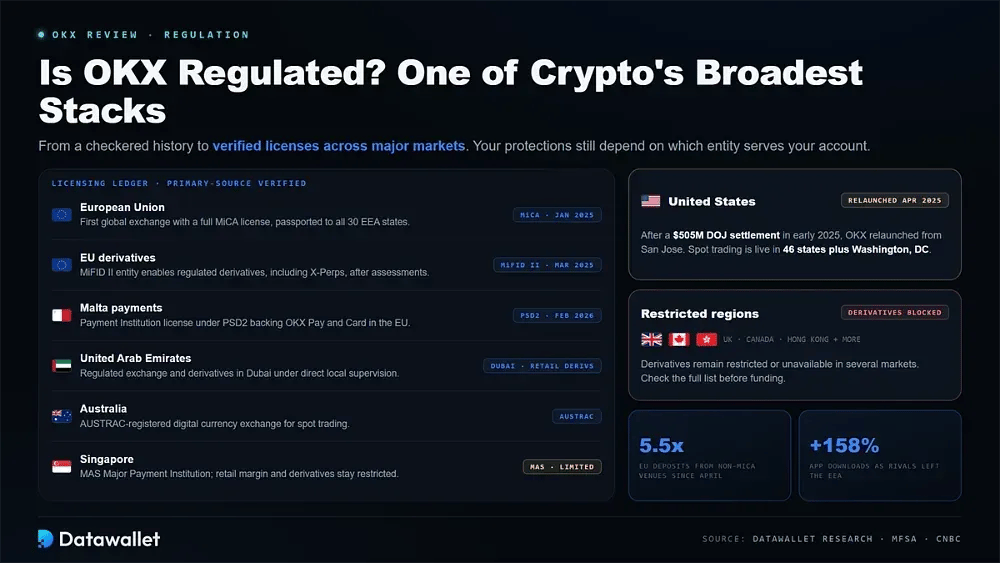
OKX has moved from a checkered compliance history to one of crypto's broadest licensing stacks. Your protections still depend on the entity serving your account, which varies according to where you live and register.
Primary sources currently verify the following:
- European Union: In January 2025, OKX became the first global exchange to obtain a full MiCA license from the Malta Financial Services Authority, passported across all 30 EEA member states.
- EU derivatives: A MiFID II-licensed entity added in March 2025 enables regulated derivatives for EEA users. That includes X-Perps stock perpetuals, with retail access subject to mandatory appropriateness assessments.
- Malta payments: This February, OKX secured a Payment Institution license under PSD2. The authorization supports OKX Pay and OKX Card stablecoin services across the EU.
- United States: After a $505 million DOJ settlement in early 2025, OKX relaunched from San Jose that April. Spot trading is live in 46 states plus Washington, DC.
- United Arab Emirates: OKX runs a regulated exchange and derivatives platform in Dubai, making it one of the few venues where retail derivatives access operates under direct local supervision.
- Australia: OKX is registered with AUSTRAC for digital currency exchange services. That registration covers spot trading for Australian residents under the country's anti-money-laundering reporting framework.
- Singapore: OKX operates under a Major Payment Institution license from MAS. Local rules still restrict margin and derivatives services for retail users.
- Restricted regions: Derivatives remain restricted or unavailable in the UK, Canada, Hong Kong, and other markets. Our OKX restricted countries page maintains the full list.
The MiCA transition has produced a measurable tailwind. Since April, OKX says crypto deposits into its European entity from non-MiCA-licensed exchanges increased 5.5x. App downloads rose 158% as competitors withdrew from the EEA.
Is OKX Safe?
We consider OKX safest when it is used as a trading venue rather than a vault. Our usual routine applies: turn on every security control, start with a small deposit, test a withdrawal, and only scale once funds move cleanly in both directions.
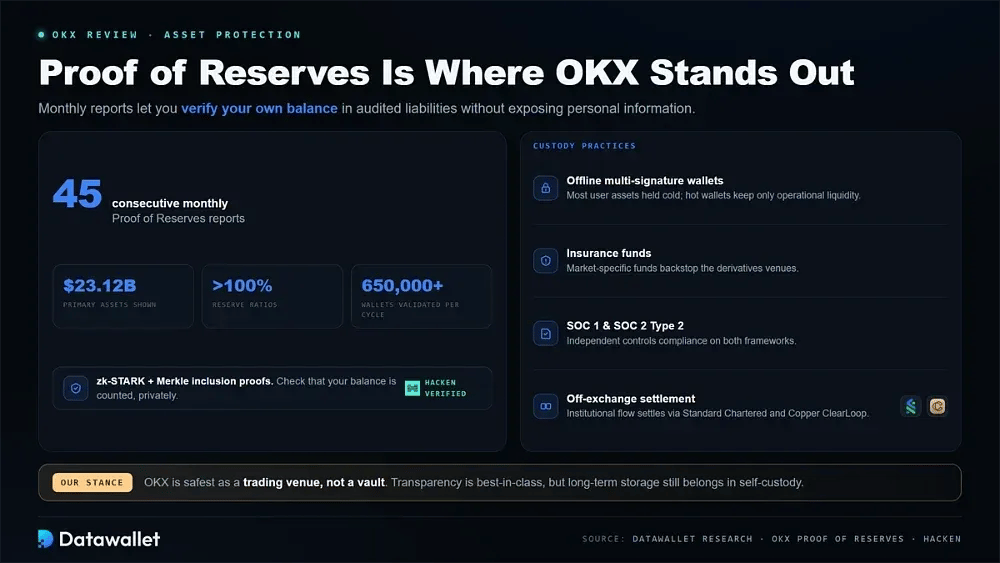
Transparency is where OKX distinguishes itself. Its Proof of Reserves program has published 45 consecutive monthly reports. Those reports show $23.12 billion in primary assets with reserve ratios above 100%, and each is independently verified by Hacken.
Account Safety Measures
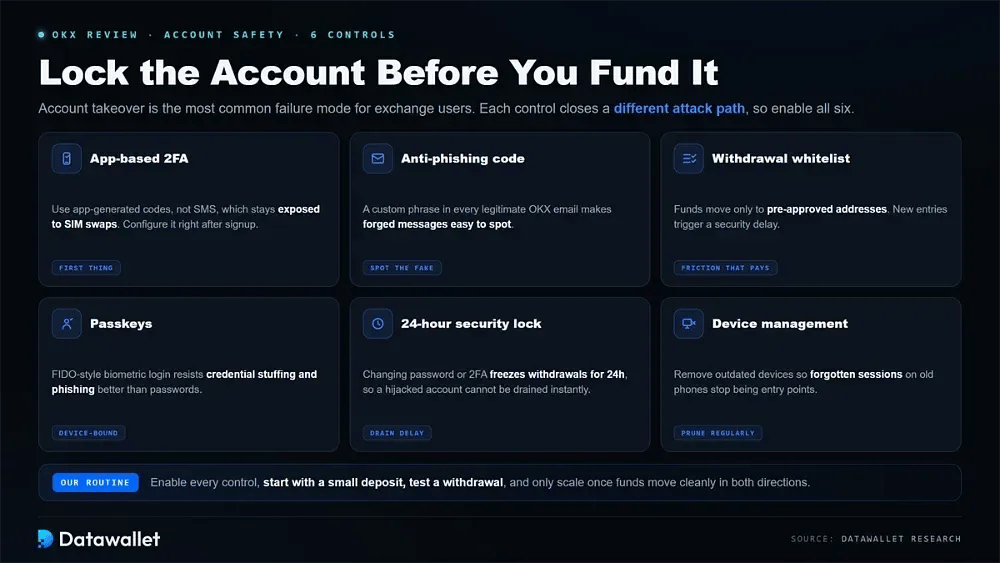
Account takeover is the most common failure mode for exchange users. Because each control below closes a different attack path, we enable all of them before making the first meaningful deposit.
On every account, these are the settings we activate first:
- App-based 2FA: OKX recommends Google Authenticator or similar app-generated codes instead of SMS, which remains exposed to SIM-swap attacks. Configure it immediately after creating the account.
- Anti-phishing code: A custom phrase appears in every legitimate OKX email. If a message lacks the code, a forged email becomes easier to identify before you click anything inside it.
- Withdrawal whitelist: Funds can only be sent to pre-approved addresses. Adding a new address triggers a security delay, which creates friction but helps stop attackers who gain access to your login.
- Passkeys: FIDO-style passkeys use biometric or device-bound verification for login. They are a meaningful improvement over password-only access and resist credential-stuffing and phishing attempts.
- 24-hour security lock: Changing your password, 2FA, or other security settings freezes withdrawals for 24 hours. The delay is designed to prevent a compromised account from being emptied immediately.
- Device management: Regularly removing outdated devices from the authorized list prevents forgotten sessions on old phones or laptops from remaining active entry points.
Asset Protection
The reserve program is best-in-class. Monthly reports combine zk-STARK verification with Merkle tree inclusion proofs, allowing you to verify that your balance is included in audited liabilities without exposing personal information. Hacken validates wallet ownership across more than 650,000 addresses during each cycle.
Custody practices follow industry standards. OKX says most user assets are held in offline multi-signature wallets, while hot wallets retain only operational liquidity. The setup is backed by market-specific insurance funds, SOC 1 Type 2 and SOC 2 Type 2 compliance, plus off-exchange institutional settlement through Standard Chartered and Copper ClearLoop.
Security History
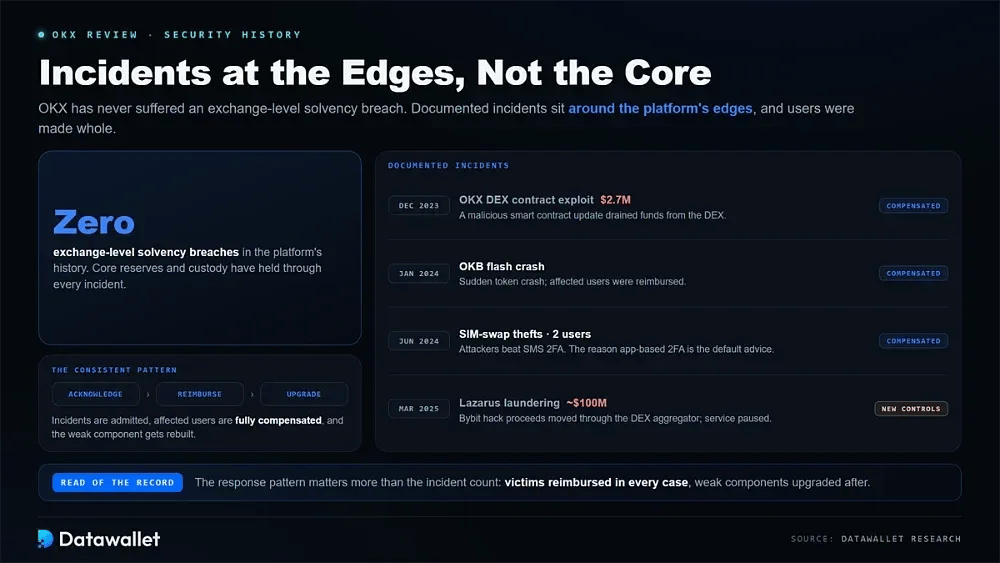
OKX has not suffered an exchange-level solvency breach, though incidents around the edges of the platform are documented. A malicious smart contract update drained $2.7 million from the OKX DEX in December 2023. In June 2024, attackers used SIM-swap attacks against SMS 2FA to steal funds from two users. OKX fully compensated victims in both incidents.
In March 2025, North Korea's Lazarus Group moved roughly $100 million from the Bybit hack through OKX's DEX aggregator. OKX temporarily suspended the service and introduced new controls to detect and block laundering attempts.
The exchange also compensated users after a January 2024 OKB flash crash. The pattern has been consistent: incidents are acknowledged, affected users are reimbursed, and the weak component is upgraded.
OKX User Reviews
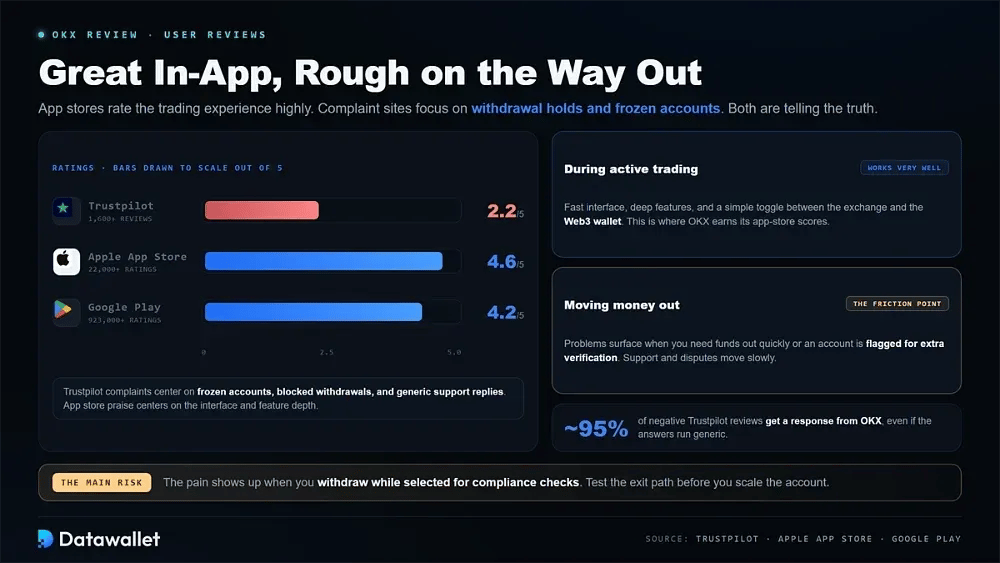
OKX shows the familiar split seen across many global exchanges when you compare review platforms. App store users tend to score the interface and trading features highly. Complaint-heavy sites, meanwhile, focus on withdrawal holds, frozen accounts, and slow customer support.
That divide matches our experience. During active trading, OKX works very well. Problems become more noticeable when you need to move money out quickly or when an account is flagged for additional verification.
The exchange's ratings and reviews break down as follows:
- Trustpilot: 2.2/5 from 1,600+ reviews. Frozen accounts, blocked withdrawals, and generic support responses are recurring complaints, although OKX responds to roughly 95% of negative reviews.
- Apple App Store: 4.6/5 from 22,000+ reviews. Users frequently praise the interface, its feature depth, and the simple toggle between the exchange and Web3 wallet.
- Google Play: 4.2/5 from 923,000+ reviews. Sentiment is similar to the App Store, though complaints about slow support and verification delays appear more often.
The takeaway: OKX earns much stronger reviews for its in-app trading experience than for withdrawals and dispute resolution. The main risk emerges when you need to remove funds and your account is selected for additional compliance checks.
OKX Fee Schedule
OKX's costs fall into two broad groups. Trading fees apply to spot, futures, and options. Non-trading costs include withdrawal network fees, perpetual funding payments, and third-party payment charges for fiat purchases.
The exchange uses a tiered fee system based on 30-day volume and account balance. Check the figures shown on your order ticket, since your effective rate can change with VIP status, OKB discounts, and promotions.
Spot Fees
Maker pricing on spot starts slightly below that of most large competitors. Active traders often pay less than the published base rate because both higher volume and OKB holdings qualify for additional discounts.
The spot fee structure is:
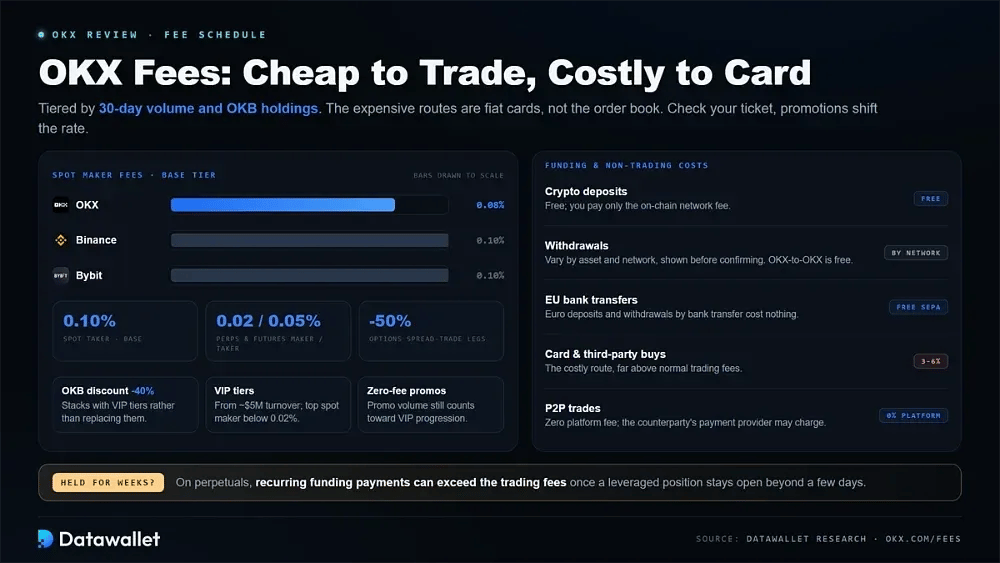
- Base rates: 0.08% maker and 0.10% taker. That is marginally cheaper on the maker side than Binance and Bybit, which both start their spot schedules at 0.10% in each direction.
- VIP tiers: Rates decline as 30-day trading volume increases. VIP 1 typically begins at around $5 million in turnover, while top-tier spot maker fees fall below 0.02%.
- OKB discounts: Holding OKB can reduce base rates by up to 40%. The discount combines with VIP tier pricing rather than replacing the tier rate shown on the ticket.
- Zero-fee promotions: OKX periodically offers zero-fee campaigns for selected spot pairs. Volume traded during those periods still counts toward subsequent VIP tier progression.
Perpetual, Futures & Options Fees
Derivatives pricing is competitive with the wider market. For leveraged positions held beyond a few days, however, taker charges and recurring funding payments usually matter more than the headline trading rate.
The derivatives schedule includes:
- Perpetuals and futures: Base-tier fees are 0.02% maker and 0.05% taker, in line with the industry standard benchmarked in our best crypto futures exchanges ranking.
- Funding costs: Long and short positions exchange periodic funding payments on perpetuals. When a position remains open for weeks, those payments can exceed the trading fees.
- Options: Options use a separate tiered schedule with similar reductions. Spread trades receive a 50% discount on the current tier rate for each leg.
Deposits, Withdrawals & P2P
Funding an account can be inexpensive if you choose the right method. Card purchases and third-party providers are the costly routes, with charges that can far exceed normal trading fees.
Before depositing, these are the main funding costs to know:
- Crypto deposits: OKX does not charge for crypto deposits. You only pay the standard on-chain network fee when sending assets from an external wallet or another exchange.
- Withdrawals: Fees vary by asset and network and are displayed before confirmation. Transfers between OKX users are free.
- Fiat rails: Card and third-party purchases usually cost 3-6%, depending on region and payment method. EU users can deposit and withdraw euros by bank transfer for free.
- P2P: Peer-to-peer trades carry zero platform fees, although the counterparty's payment provider may still charge fees before the fiat or crypto settles.
OKX Pay and the OKX Card
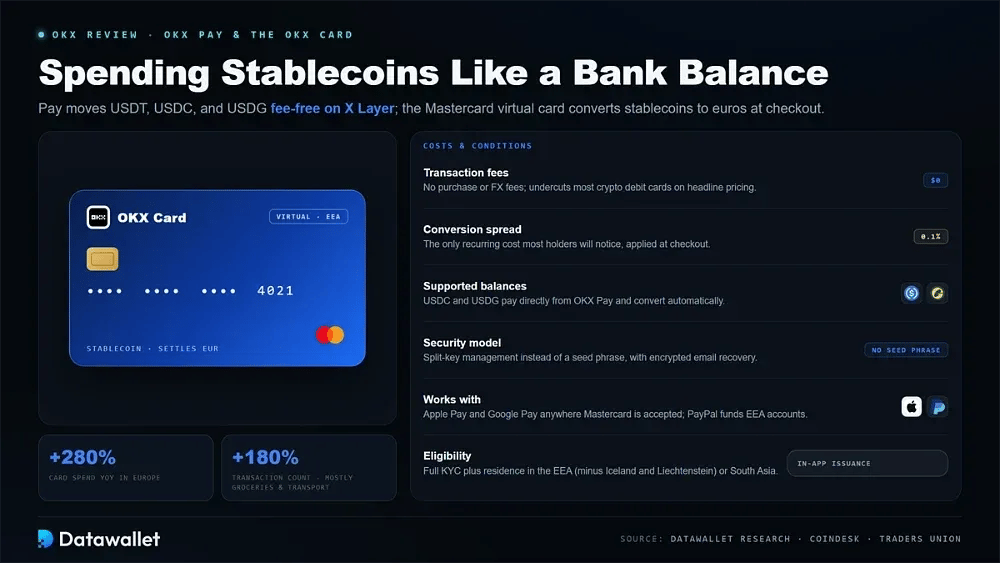
Launched in April 2025, OKX Pay uses X Layer as a payments network. Users can send and receive USDT, USDC, and USDG without fees. Security relies on split-key management rather than a seed phrase, with encrypted email recovery available if a device is lost.
The OKX Card followed this January across the EEA. The Mastercard-powered virtual card converts stablecoin balances into euros at the point of purchase and works anywhere Mastercard is accepted, including through Apple Pay and Google Pay. OKX expanded it to South Asia in July, while a PayPal integration supports EEA account funding.
Across Europe, OKX reported a 280% year-on-year increase in card spending. Transaction counts rose 180%, with most of the growth coming from routine purchases such as groceries and transport.
Costs & Conditions
Before ordering, these are the main costs and conditions:
- Transaction fees: Purchases carry no transaction or foreign exchange fees. On headline pricing, that undercuts most competitors in our best crypto debit cards comparison.
- Conversion spread: A 0.1% market spread applies when stablecoins are converted into euros at checkout. For most cardholders, this is the only recurring cost likely to be noticeable.
- Supported balances: USDC and USDG can be used as payment currencies. Funds come directly from the OKX Pay balance and convert automatically, removing the need to sell manually before spending.
- Eligibility: Users need full identity verification and must reside in the EEA, excluding Iceland and Liechtenstein, or in the newly added South Asian markets. Card issuance is handled in-app.
Final Thoughts
OKX ends the year as a materially different platform from the one we reviewed twelve months earlier. ICE's investment and the OKXICE joint venture changed its institutional profile, while three Malta licenses, 24/7 tokenized stock markets, and a payments stack with real usage have expanded it beyond its former trading-first identity.
Its weaknesses remain familiar. Trustpilot still shows complaints about frozen accounts, fiat on-ramps continue to depend on expensive third-party providers, and users served outside licensed regions have limited regulatory recourse when disputes arise.
Before committing meaningful funds, our routine is unchanged. Complete both KYC levels upfront and enable app-based 2FA, the anti-phishing code, and the withdrawal whitelist. Then deposit a small test amount, place a trade, and make a test withdrawal over your usual network. Our OKX vs Binance comparison shows how the exchange compares with its largest rival.