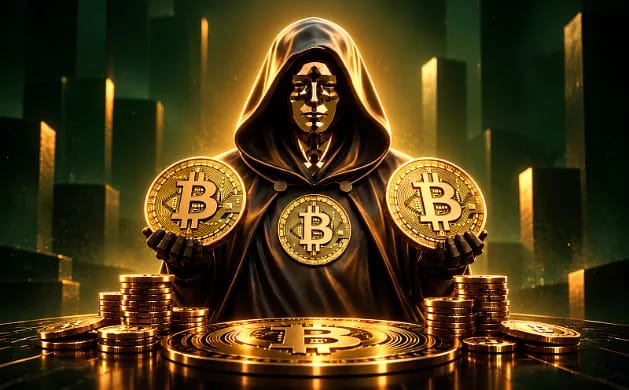



Who is Satoshi Nakamoto?
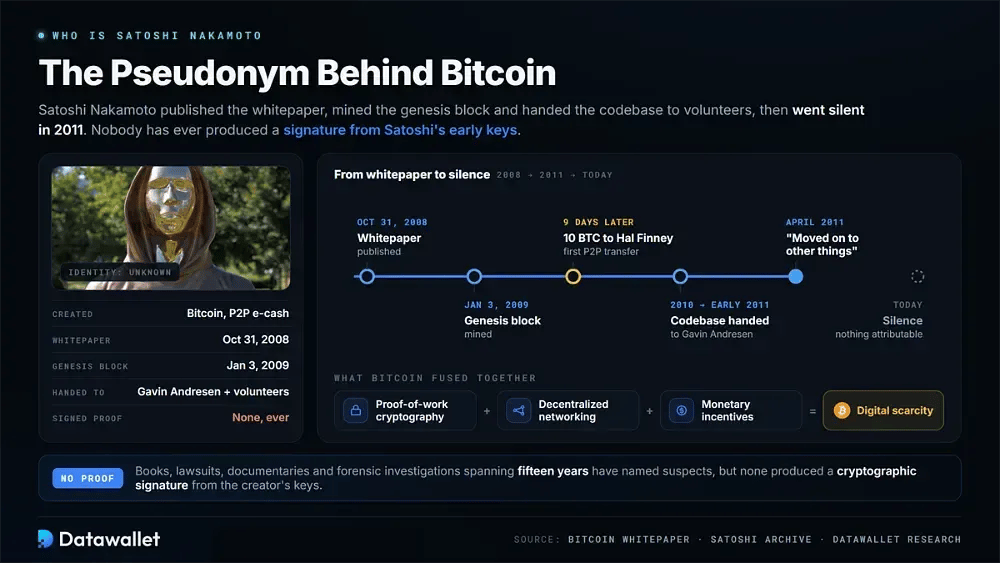
Satoshi Nakamoto is the pseudonym used by Bitcoin's creator. Bitcoin is a peer-to-peer electronic cash system that combined proof-of-work cryptography with decentralized networking and monetary incentives, creating digital scarcity without banks, governments, payment intermediaries, or a central administrator controlling issuance, settlement, or the ledger.
He published the Bitcoin whitepaper on October 31, 2008. The genesis block followed on January 3, 2009, and nine days later Satoshi sent 10 BTC to Hal Finney. During 2010 and early 2011, he gradually transferred stewardship of the codebase to Gavin Andresen and other volunteers.
In his last verified messages, Satoshi said he had moved on to other projects. Nothing cryptographically attributable to him has appeared since. Fifteen years of books, lawsuits, documentaries, and forensic investigations have still failed to produce a signature from Satoshi's early keys that confirms who actually built Bitcoin.
Top Candidates For Being Satoshi Nakamoto
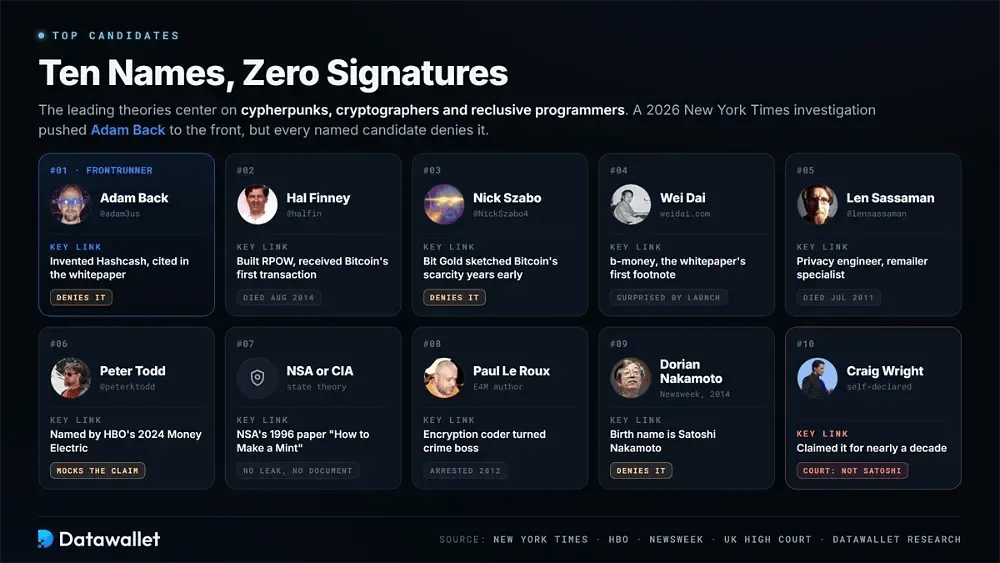
Most Satoshi theories focus on cypherpunks, academic cryptographers, and reclusive programmers whose work, writing habits, locations, or personal timelines overlap with Bitcoin's 2008 to 2011 creation period.
The rankings changed sharply in 2026 after investigative journalism elevated one long-discussed figure above the rest. Still, every named candidate denies involvement, and none has supplied cryptographic proof.
1. Adam Back
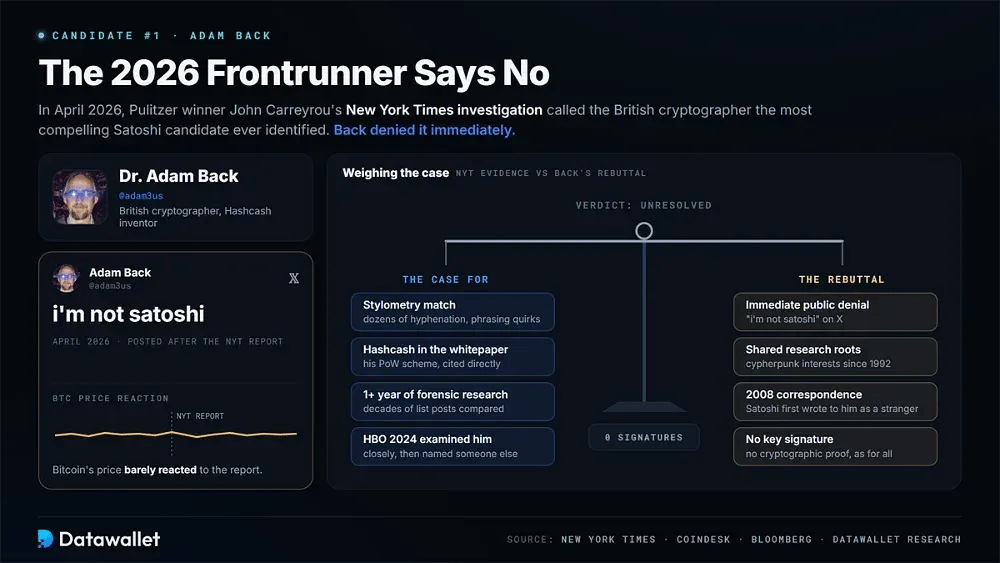
Dr. Adam Back (@adam3us) became the frontrunner in April 2026. Pulitzer Prize winner John Carreyrou published a New York Times investigation arguing that the British cryptographer is the most compelling Satoshi candidate ever identified, drawing on more than a year of forensic research.
Much of the case comes from stylometric analysis that matched dozens of Satoshi's unusual hyphenation and phrasing habits with Back's decades of mailing list posts. Back also invented Hashcash, the proof-of-work scheme cited directly in Bitcoin's whitepaper. HBO's 2024 documentary examined him extensively before ultimately naming someone else.
Back denied everything immediately, posting "i'm not satoshi." He attributed the similarities to shared cypherpunk research interests dating to 1992 and pointed to 2008 correspondence suggesting Satoshi first approached him as a stranger. Bitcoin's price barely moved after the report.
2. Hal Finney
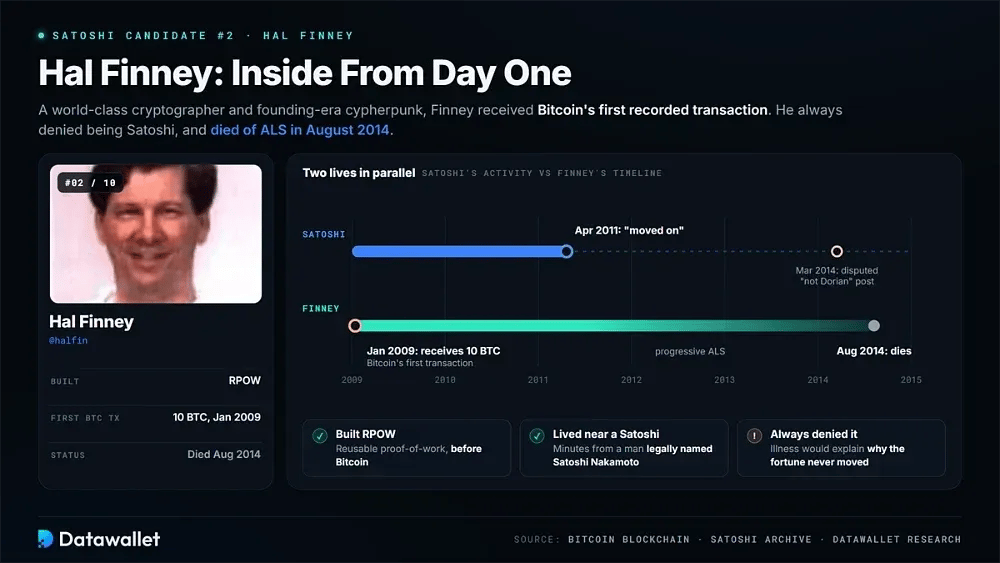
Hal Finney (@halfin) remains a widely discussed candidate because he was a world-class cryptographer and founding-era cypherpunk. He also received Bitcoin's first recorded transaction, putting him at the network's operational core within its opening fortnight in January 2009.
His background aligns closely with Satoshi's. Finney created RPOW, a reusable proof-of-work system that predated Bitcoin, lived minutes from a man legally named Satoshi Nakamoto, and wrote with a clarity and temperament that many observers consider strikingly similar to Satoshi's forum posts and emails.
Finney consistently denied being Bitcoin's author. He died of ALS in August 2014, after Satoshi's accounts had already fallen permanently silent. If Finney was Bitcoin's architect, his progressive illness would offer an explanation for both the unmoved fortune and the creator's continued absence.
3. Nick Szabo
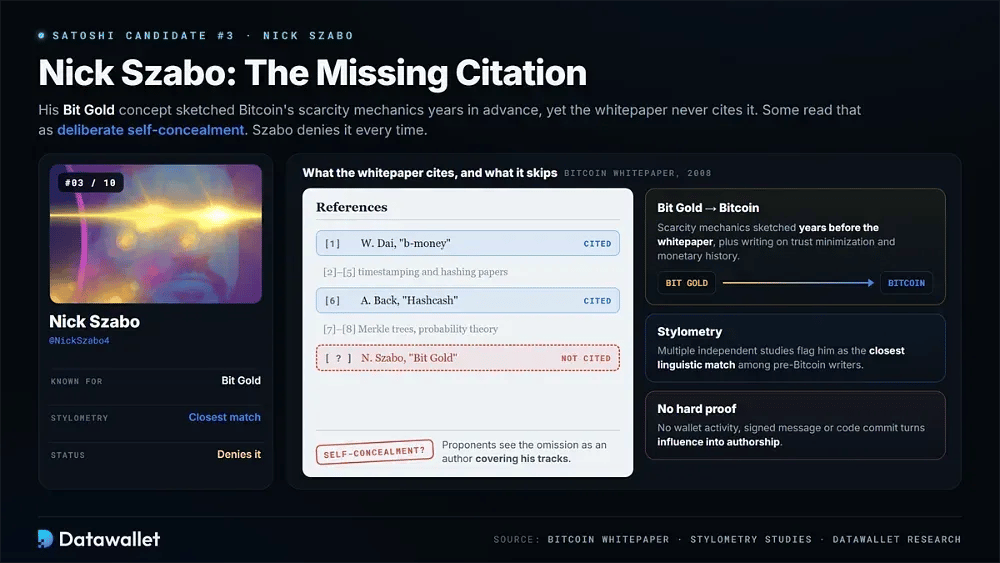
Nick Szabo (@NickSzabo4) is routinely shortlisted because Bit Gold anticipated Bitcoin's scarcity mechanics years earlier. His writing about trust minimization, digital contracts, and monetary history also closely resembles the philosophical foundations found throughout the whitepaper and Satoshi's early communications.
Supporters point to several independent stylometric studies that identified Szabo as the closest linguistic match among pre-Bitcoin writers. They also note that Bit Gold was conspicuously absent from the whitepaper's citations, which some interpret as an attempt by the author to conceal his own intellectual trail.
Szabo has denied being Satoshi whenever the question has arisen. No wallet activity, signed message, code commit, or documentary evidence has turned his clear conceptual influence into proof that he personally wrote and released Bitcoin's software.
4. Wei Dai
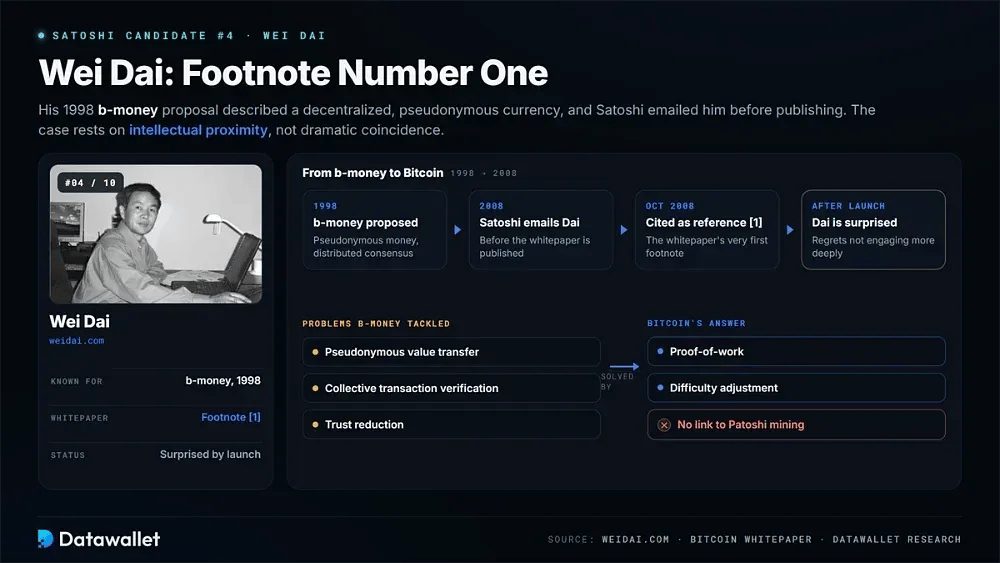
Wei Dai belongs on any serious candidate list because his 1998 b-money proposal described a decentralized, pseudonymous currency secured through distributed consensus. Before publishing Bitcoin, Satoshi personally emailed Dai and cited b-money as a foundational reference in the whitepaper's first footnote.
The argument for Dai is based more on intellectual proximity than unusual coincidence. B-money addressed pseudonymous value transfer, collective transaction verification, and trust reduction, the same design problems Bitcoin later solved through proof-of-work and difficulty adjustment mechanics.
There is still no public key signature, repository trail, or on-chain link connecting Dai to the Patoshi-pattern mining attributed to Satoshi. Dai has also said Bitcoin's launch surprised him and that he regretted not engaging more deeply with its creator.
5. Len Sassaman
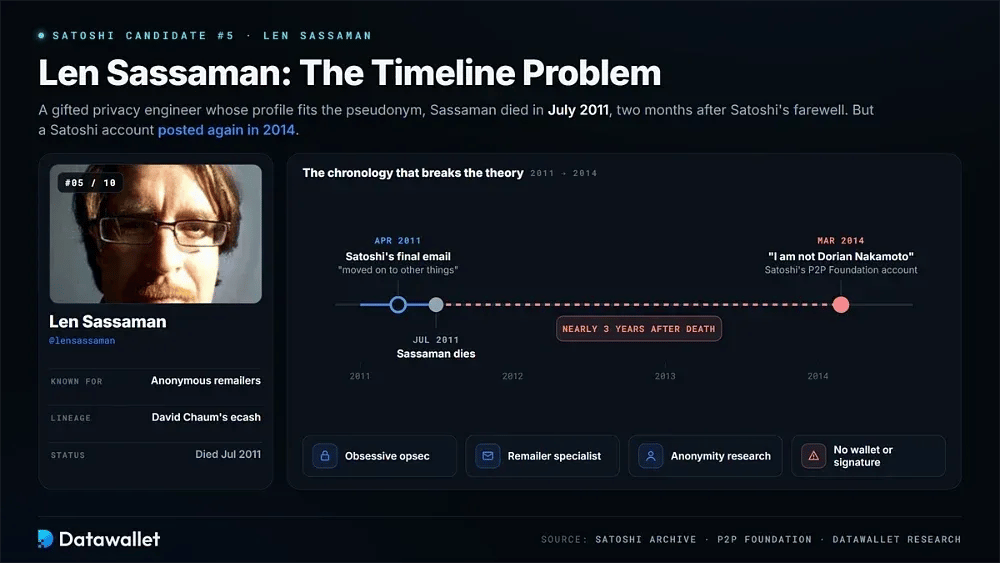
Len Sassaman (@lensassaman) became a prominent posthumous candidate because he was a talented privacy engineer, connected cypherpunk, and cryptographic remailer specialist. His ideology, technical ability, and intense focus on operational security fit the psychological profile many people associate with Satoshi.
Supporters frequently cite his anonymity research and mentorship within David Chaum's ecash lineage. The timing of his death is another central point: Sassaman died in July 2011, barely two months after Satoshi's final known email said he had moved on to other things.
Chronology also creates the theory's biggest problem. Satoshi's dormant P2P Foundation account posted "I am not Dorian Nakamoto" in March 2014, almost three years after Sassaman's death. No wallet movement or signed message has resolved that contradiction.
6. Peter Todd
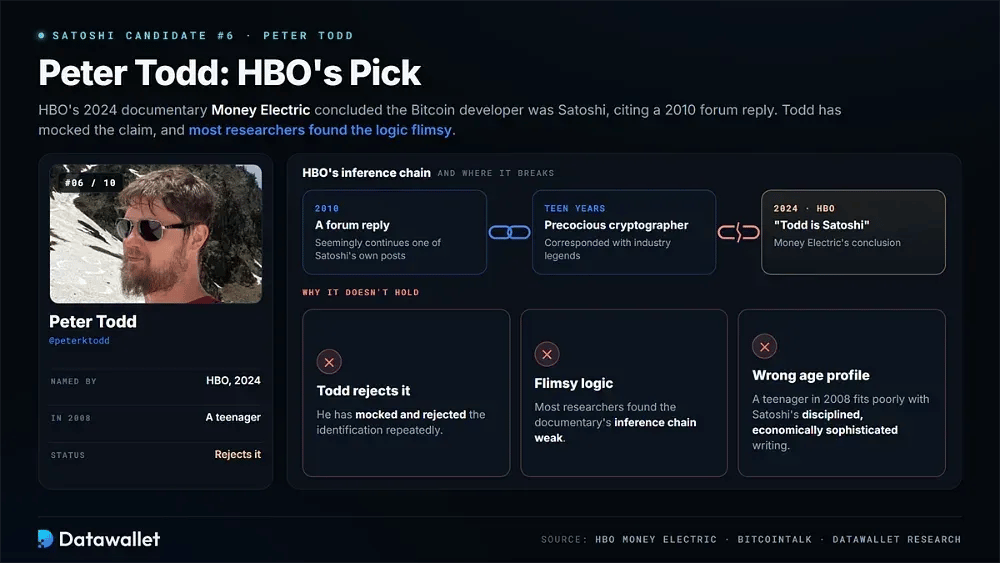
Peter Todd (@peterktodd) became a mainstream candidate after HBO's 2024 documentary Money Electric concluded that he was Satoshi. The film cited a 2010 forum reply that appeared to continue one of Satoshi's own posts, along with Todd's unusually early cryptography background as a teenager corresponding with prominent figures in the field.
Those who support the theory argue that Todd communicates like a protocol insider and understood Bitcoin's mechanics remarkably early. They also see him as fitting the profile of a gifted young developer who might have adopted an older persona to gain credibility within the cypherpunk community.
Todd has repeatedly mocked and rejected the claim. Most researchers considered the documentary's chain of inference weak, while his documented activities as a teenager in 2008 fit poorly with the disciplined and economically sophisticated authorship period associated with Bitcoin's creation.
7. NSA or CIA
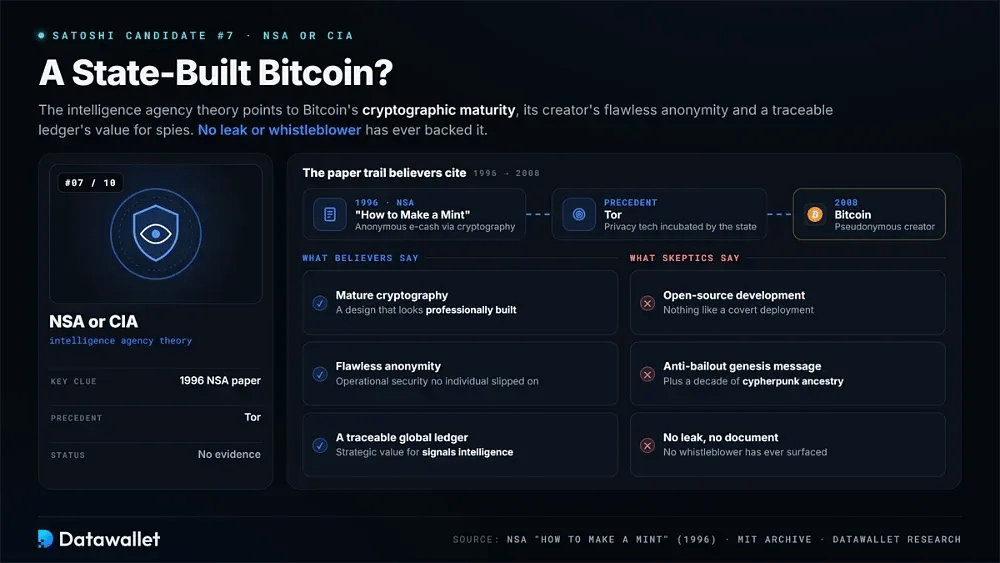
Another theory holds that Bitcoin originated inside the NSA, CIA, or an allied research program. Supporters point to the system's cryptographic sophistication, Satoshi's flawless operational anonymity, and the intelligence value of a transparent monetary ledger that can be traced globally.
They often cite the NSA's 1996 paper "How to Make a Mint", which described anonymous electronic cash based on cryptography. Intelligence services have also incubated privacy technologies, including Tor, well before their broader geopolitical effects became clear.
Skeptics see a different pattern. Bitcoin's open-source development, explicitly anti-bailout genesis message, and long cypherpunk lineage do not resemble a covert state deployment. No leak, document, or whistleblower has ever substantiated government authorship.
8. Paul Le Roux
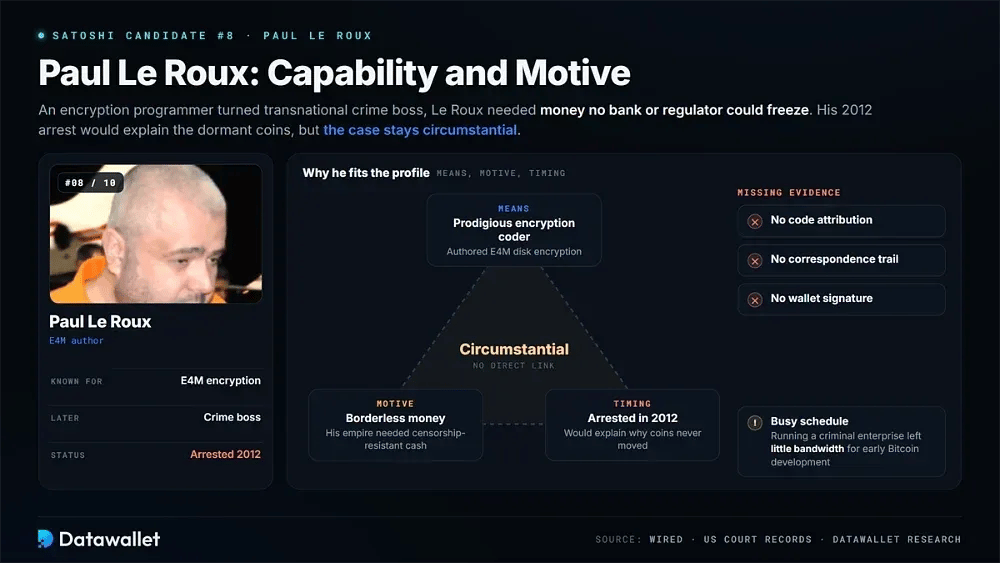
Paul Le Roux appears in serious speculation because he was both an accomplished encryption programmer and a transnational crime boss. His empire also had an obvious use for borderless, censorship-resistant money beyond the reach of banks, regulators, and law enforcement.
The theory rests heavily on capability and motive. Le Roux created E4M disk encryption software, understood offshore financial engineering in depth, and was arrested in 2012. That timing could explain why Satoshi's coins remained untouched despite becoming extraordinarily valuable.
The evidence remains circumstantial. No source-code attribution, correspondence trail, or wallet signature links Le Roux with Satoshi's communications, and his documented workload managing a criminal enterprise raises questions about whether he had the capacity to maintain Bitcoin's early development.
9. Dorian Nakamoto
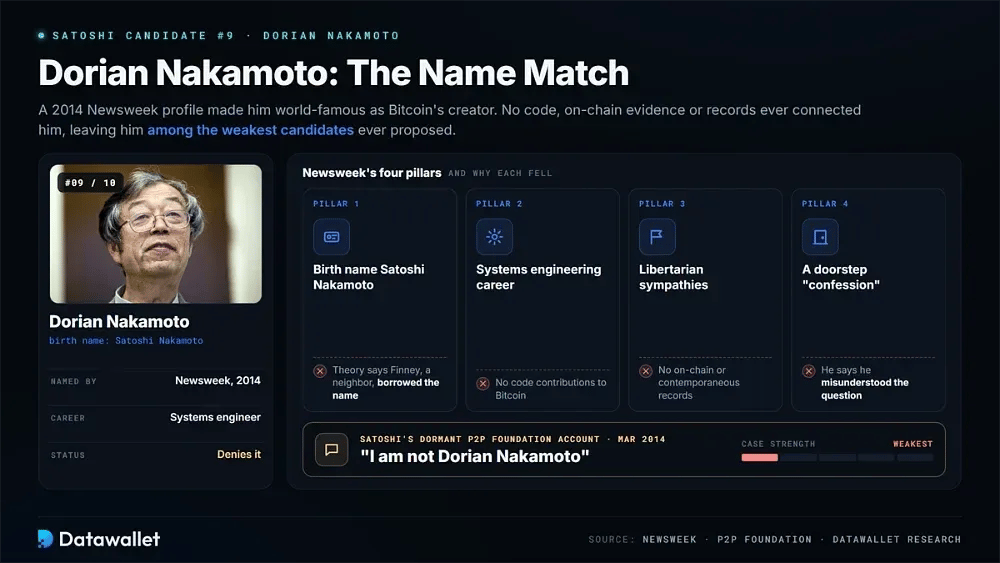
Dorian Nakamoto became internationally known when a 2014 Newsweek profile identified him as Bitcoin's creator. The article relied on his birth name, Satoshi Nakamoto, along with his systems engineering career, libertarian sympathies, and an ambiguous doorstep statement that reporters interpreted as an admission.
The theory was weak from the start. His proximity to Hal Finney's neighborhood encouraged speculation that Finney had borrowed the name, but no code contribution, on-chain evidence, or contemporaneous record ever tied Dorian to Bitcoin's development. Dorian said he had misunderstood the reporter's question.
The strongest counterevidence came when Satoshi's dormant P2P Foundation account posted "I am not Dorian Nakamoto" at the height of the media frenzy. Whatever the provenance of that message, the broader record leaves Dorian among the weakest candidates ever taken seriously.
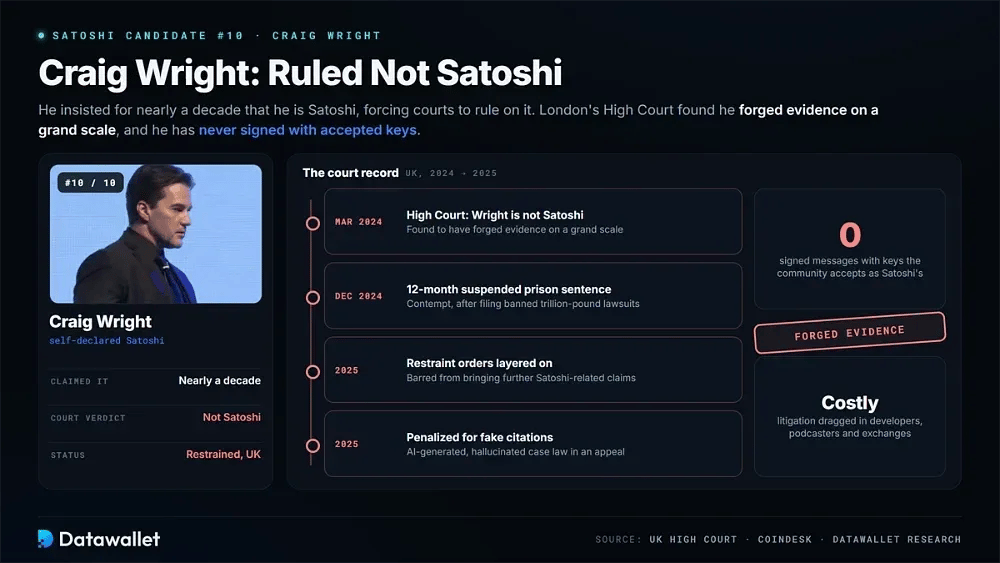
10. Craig Wright
Craig Wright appears on the list not because of strong supporting evidence, but because he spent almost a decade claiming to be Satoshi. Those assertions forced courts in multiple jurisdictions to adjudicate the issue and pulled developers, podcasters, and exchanges into extremely expensive litigation.
The court findings were severe. London's High Court ruled in March 2024 that Wright is not Satoshi and had forged evidence extensively. In December 2024, he received a twelve-month suspended prison sentence for contempt after filing prohibited trillion-pound lawsuits.
By 2025, UK judges had imposed restraint orders preventing Wright from pursuing further Satoshi-related claims and penalized him for submitting AI-generated hallucinated citations in an appeal. He has never signed a message using keys the community recognizes as Satoshi's.
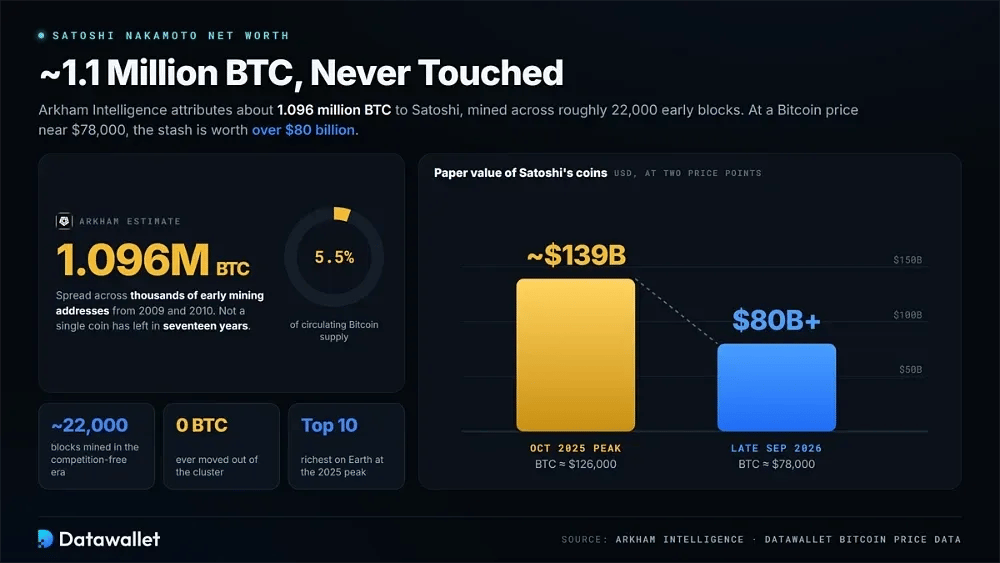
Satoshi Nakamoto's Net Worth and BTC Holdings
According to Arkham Intelligence, Satoshi Nakamoto controls approximately 1.096 million BTC spread across thousands of early mining addresses. With the Bitcoin price near $78,000 in late September 2026, that fortune is worth more than $80 billion. Not one coin has left these wallets in seventeen years.
At Bitcoin's roughly $126,000 peak in October 2025, Satoshi's paper wealth reached nearly $139 billion, briefly placing him among the ten richest people on Earth. Arkham's research links the holdings to rewards from about 22,000 blocks mined during Bitcoin's earliest period, when competition was essentially nonexistent.
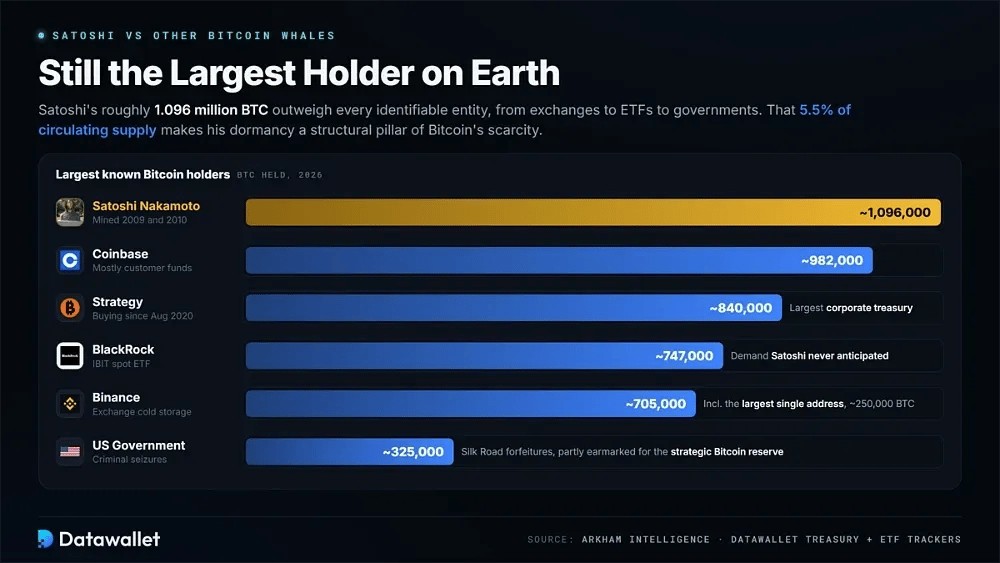
How Satoshi Compares to Other Bitcoin Whales
Satoshi's holdings exceed those of every other identifiable Bitcoin entity, accounting for about 5.5% of circulating supply. That scale makes the continued dormancy of his coins an important part of Bitcoin's scarcity and market stability.
Here is how the largest known Bitcoin holders stack up against Satoshi in 2026:
- Satoshi Nakamoto: Approximately 1.096 million BTC mined in 2009 and 2010, entirely untouched, making Bitcoin's anonymous creator the single largest holder in the network's history.
- Coinbase: Around 982,000 BTC held across custody and exchange wallets, with most belonging to millions of customers rather than sitting on the company's own corporate balance sheet.
- Strategy: Roughly 840,000 BTC accumulated since August 2020, the largest corporate treasury tracked on Datawallet's Bitcoin treasury dashboard, acquired through repeated debt and equity raises.
- BlackRock: Approximately 747,000 BTC inside the IBIT spot fund, with daily flows available through Datawallet's Bitcoin ETF tracker, representing institutional demand Satoshi never anticipated.
- Binance: Roughly 705,000 BTC across exchange cold storage. One wallet contains almost 250,000 BTC, making it the largest single Bitcoin address currently in existence.
- US Government: Around 325,000 BTC obtained through criminal seizures, including Silk Road forfeitures, now partially earmarked for America's strategic Bitcoin reserve policy framework.
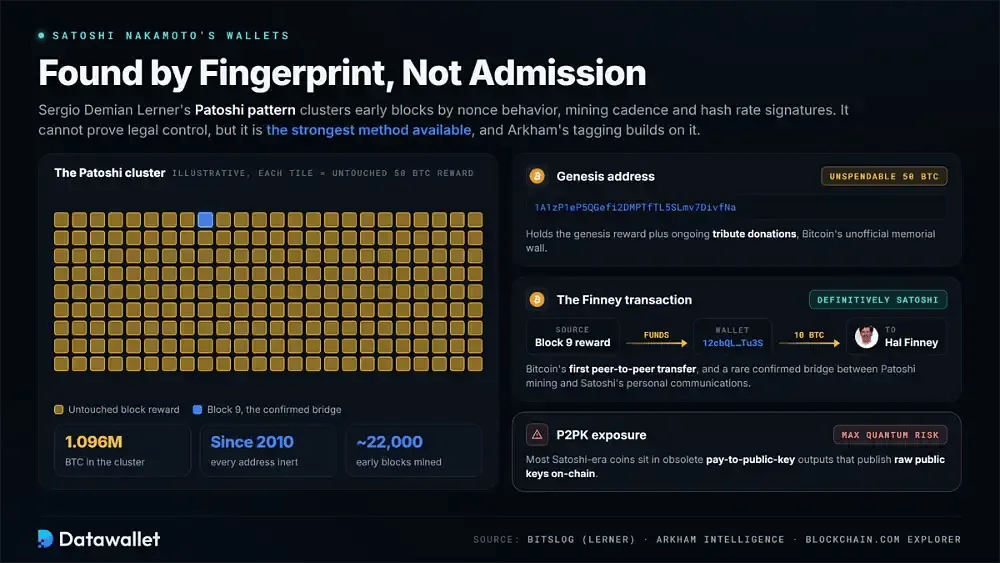
Satoshi Nakamoto's Wallets
Researchers identify Satoshi's wallets through on-chain forensics rather than any admission of ownership. The best-known method is Sergio Demian Lerner's Patoshi pattern research, which groups early blocks by distinctive nonce incrementing behavior, synchronized mining cadence, and recurring hash-rate signatures.
The heuristic cannot establish legal control. Even so, it remains the strongest available method for clustering thousands of dormant addresses from 2009 into a probable Satoshi treasury, and Arkham's entity tagging builds directly on Lerner's original findings.
Notable Satoshi wallets and addresses researchers consistently reference:
- Genesis Address: 1A1zP1eP5QGefi2DMPTfTL5SLmv7DivfNa holds the unspendable 50 BTC genesis reward plus continuing tribute donations. It now functions as Bitcoin's unofficial memorial wall for its creator.
- Finney Transaction Wallet: 12cbQLTFMXRnSzktFkuoG3eHoMeFtpTu3S sent Bitcoin's first peer-to-peer transfer of 10 BTC to Hal Finney, making it one of the few addresses definitively operated by Satoshi.
- Early Mining Addresses: Hundreds of wallets containing untouched 50 BTC block rewards form the backbone of the Patoshi cluster and collectively support the 1.096 million BTC estimate.
- P2PK Exposure: Most Satoshi-era coins remain in pay-to-public-key outputs, an obsolete format that exposes raw public keys on-chain and therefore carries the maximum theoretical quantum vulnerability.
- Block 9 Address: The coinbase reward used to fund Finney's transaction originated here, providing researchers with a rare confirmed connection between Patoshi mining activity and Satoshi's personal communications.
- Dormancy Record: Every address in the cluster has remained inactive since 2010. On-chain analysts treat that seventeen-year stillness as the estate's strongest behavioral fingerprint.
Are Satoshi's Wallets Safe?
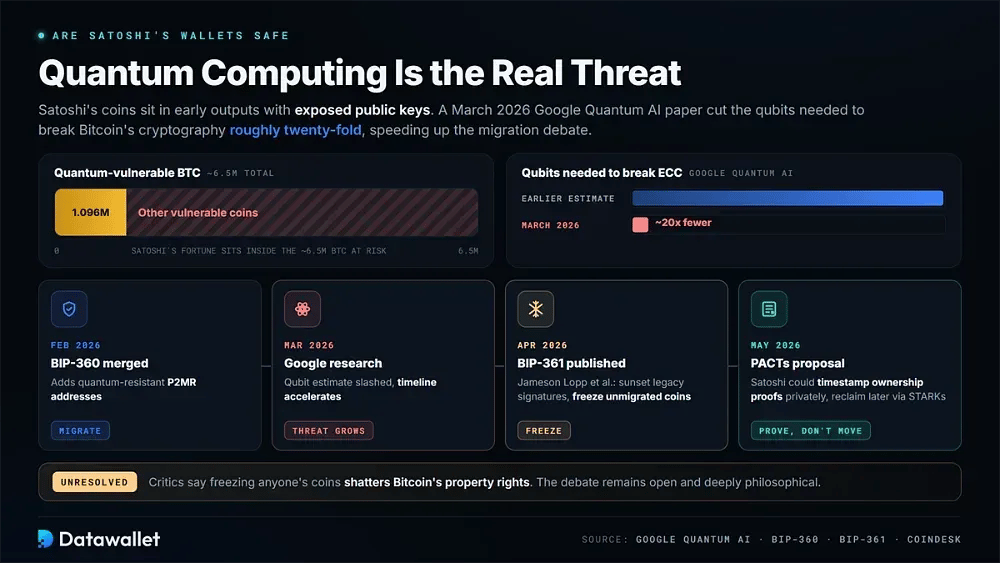
Quantum computing is the main threat to Satoshi's holdings because much of the fortune remains in early pay-to-public-key outputs with exposed keys. In March 2026, Google Quantum AI published research reducing the estimated qubit count required to break Bitcoin's elliptic curve cryptography by roughly twenty-fold, accelerating the community's migration timeline.
Developers had already begun responding. BIP-360, merged in February 2026, introduces quantum-resistant P2MR addresses. BIP-361, published that April by Jameson Lopp and co-authors, proposes retiring legacy signatures and ultimately freezing unmigrated coins, including the roughly 6.5 million vulnerable BTC that contain Satoshi's fortune.
Opponents argue that freezing anyone's coins would violate Bitcoin's property-rights guarantees. A newer PACTs proposal would instead allow Satoshi to privately timestamp ownership proofs and later reclaim frozen coins using quantum-resistant STARK verification. The question remains unresolved and deeply philosophical.
How Researchers Try to Unmask Satoshi
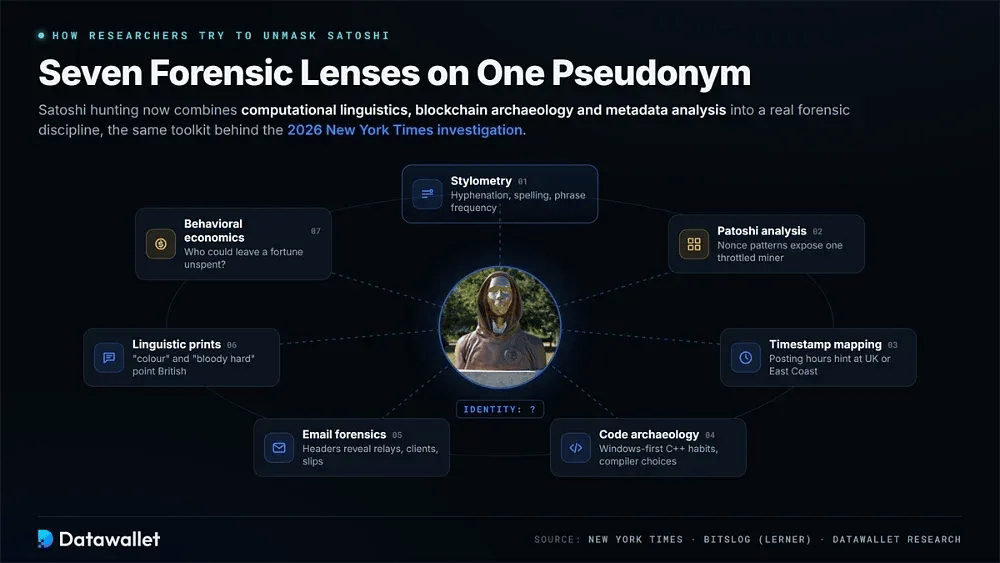
The search for Satoshi has moved well beyond simple guesswork. Computational linguistics now sits alongside blockchain archaeology and metadata analysis in a forensic discipline that contributed to the 2026 New York Times investigation and continues to narrow the candidate field.
These are the primary investigative techniques researchers use today:
- Stylometry: Algorithms compare Satoshi's hyphenation quirks, spelling conventions, and phrase frequencies with hundreds of candidate writers. This method underpins Carreyrou's statistical case for Adam Back.
- Patoshi Analysis: Lerner's nonce-pattern research fingerprints the creator's mining software and points to one dominant miner who deliberately throttled output while leaving every reward unspent.
- Timestamp Mapping: Researchers map the hours when Satoshi posted and coded to infer likely sleep cycles and time zones, repeatedly producing patterns consistent with UK or East Coast residency.
- Code Archaeology: Analysts examine Bitcoin's original C++ for unusual conventions, compiler choices, and Windows-first development habits that limit the pool of programmers who realistically match the profile.
- Email Forensics: Preserved headers from Satoshi's exchanges with early collaborators reveal relay routes, client software, and occasional anonymization mistakes that investigators compare with candidate histories.
- Linguistic Fingerprints: British spellings such as "colour" and idioms including "bloody hard" appear throughout Satoshi's writing, shifting probability toward Commonwealth English speakers within the candidate pool.
- Behavioral Economics: The choice never to spend a single coin filters candidates by wealth, ideology, and mortality because few living people could indefinitely ignore an eleven-figure fortune.
Why Satoshi's Coins Have Never Moved
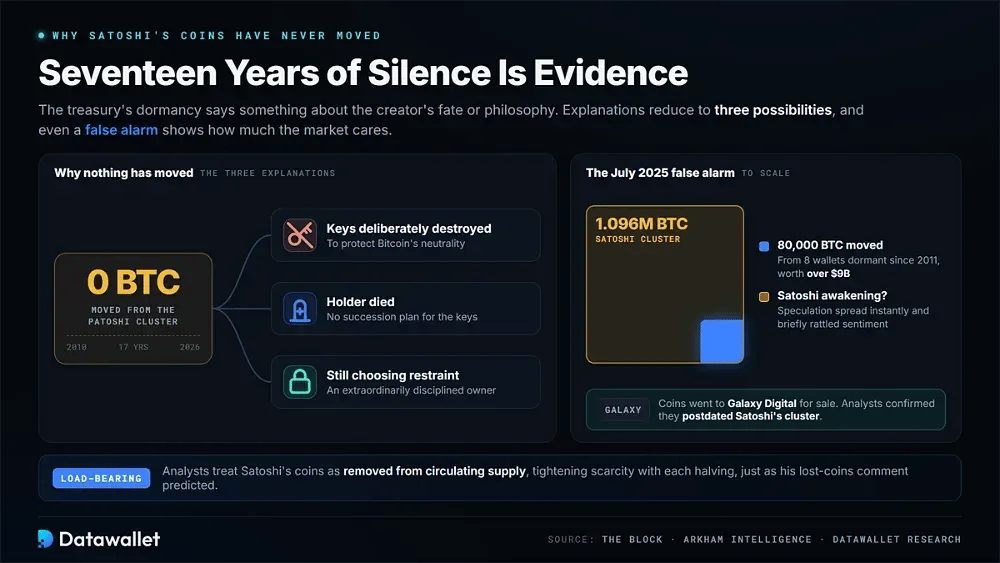
Seventeen years of dormancy have become evidence in their own right, shaping theories about Satoshi's fate and philosophy. Most explanations fall into three broad possibilities. The keys may have been deliberately destroyed to protect Bitcoin's neutrality, the owner may have died without a succession plan, or an extraordinarily disciplined holder may still be choosing not to spend.
The market received a reminder of that sensitivity in July 2025. Eight wallets dormant since 2011 suddenly moved 80,000 BTC, worth more than $9 billion, to Galaxy Digital for sale. Rumors that Satoshi had returned spread immediately before analysts established that the coins were newer than his known mining cluster.
The episode highlighted the imbalance in market reactions. An unrelated whale briefly unsettled sentiment through a false alarm, while genuine movement from Patoshi-pattern addresses would be the most significant on-chain event in Bitcoin's history and would revive every identity theory at once.
Dormancy has also become economically important. Analysts effectively treat Satoshi's million coins as outside circulating supply, increasing scarcity alongside each halving cycle. His continued silence therefore supports every other holder's position in the way his famous comment about lost coins predicted.
Satoshi Nakamoto Quotes
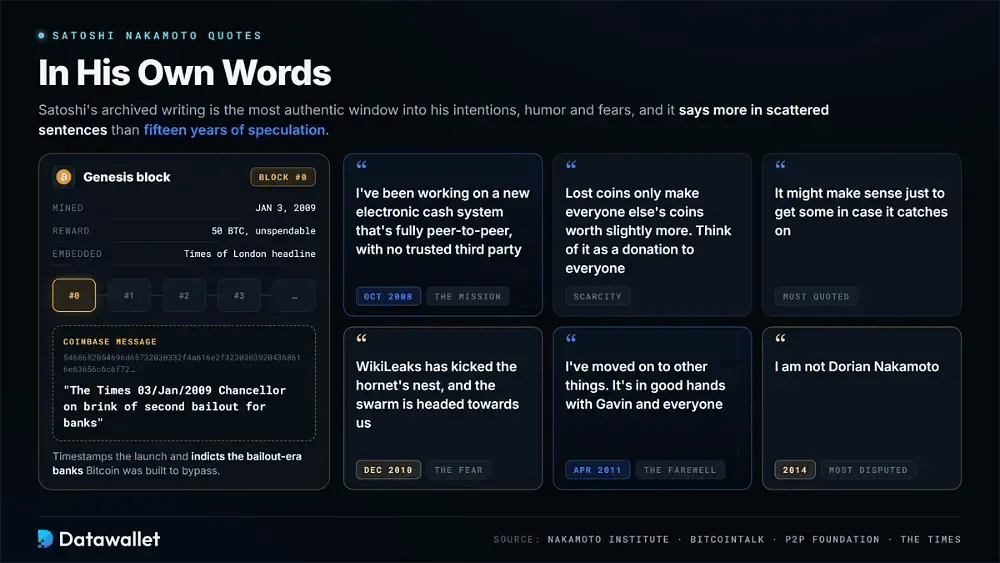
Satoshi's archived writing offers the clearest direct view of his intentions, humor, and concerns. A handful of scattered statements reveal more about the creator than fifteen years of speculation.
Key Satoshi statements and what each one reveals:
- "The Times 03/Jan/2009 Chancellor on brink of second bailout for banks": This Times of London headline, embedded in the genesis block, timestamps Bitcoin's launch while criticizing the bailout-era banking system it was designed to bypass.
- "I've been working on a new electronic cash system that's fully peer-to-peer, with no trusted third party": His October 2008 announcement email condenses Bitcoin's central purpose into a single understated sentence.
- "Lost coins only make everyone else's coins worth slightly more. Think of it as a donation to everyone": This Bitcointalk post described permanent loss as distributed scarcity, a statement BIP-361's authors now invert when arguing for quantum-era freezes.
- "It might make sense just to get some in case it catches on": One of his most frequently quoted remarks, it reflects genuine uncertainty about whether Bitcoin would survive even its first year.
- "WikiLeaks has kicked the hornet's nest, and the swarm is headed towards us": Written in December 2010, the remark showed his concern that political attention might arrive before the network was resilient enough to withstand it.
- "I am not Dorian Nakamoto": Posted through Satoshi's dormant P2P Foundation account in 2014, it remains the strangest and most disputed message attributed to him after his disappearance.
- "I've moved on to other things. It's in good hands with Gavin and everyone": His April 2011 email remains the closest thing Bitcoin's creator ever gave to a farewell.
What Will Happen if Satoshi Nakamoto Returns?
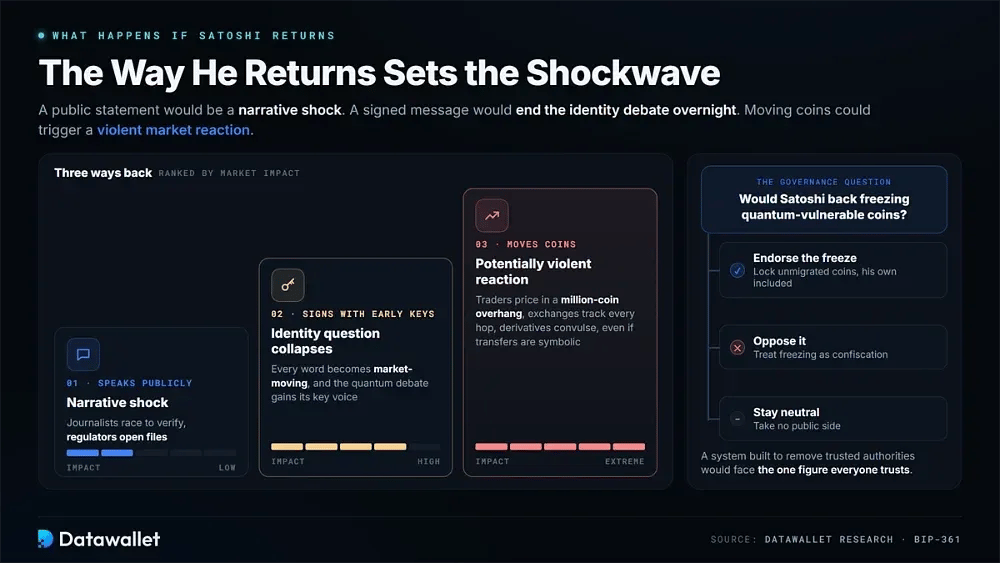
A public statement from Satoshi would create immediate narrative shock without necessarily causing direct financial damage. Journalists would rush to establish authenticity, regulators would reopen files, and Bitcoin's leaderless culture would have to confront the return of the founder it spent fifteen years turning into a myth.
Signing a message with genesis-era keys would have much greater significance. It could resolve the identity question overnight in a way that documentaries, lawsuits, and stylometric models never have. Every statement that followed would become market-moving information, while the 2026 quantum migration debate would suddenly gain its most consequential participant.
Moving coins would create a different kind of reaction and could be violent. Traders would begin pricing the possibility of selling from a million-coin overhang. Exchanges would follow each transaction hop closely, and derivatives markets would likely convulse even if the movement turned out to be symbolic rather than an attempt to liquidate.
A verified return would reopen governance questions Bitcoin appeared to have left behind. Satoshi could support freezing vulnerable coins, reject the idea as confiscation, or remain neutral. A system created to remove trusted authorities would then face the influence of the one figure many participants still trust.
Final Thoughts
Satoshi Nakamoto's net worth matters because it puts a number on his conviction. More than $80 billion accumulated from coins mined when Bitcoin was nearly worthless, yet none of it was touched through the crashes, speculative manias, and all-time highs that followed.
The deeper 2026 story is the convergence of two investigations. Stylometric journalism is narrowing the identity field while quantum-era proposals debate what should happen to coins whose owner may never return to protect them.
Until an early key signs a message or the Patoshi wallets move, Satoshi remains both one of the world's richest individuals and its most successful ghost.