What is Babylon? Bitcoin Staking Explained
Summary: Babylon is the protocol that turned Bitcoin into a staking asset. It lets holders lock native BTC on the Bitcoin chain to help secure proof-of-stake networks, earning rewards while keeping full custody of their coins.
The project moved from a points-based testnet into a live economy in April 2025, when the Babylon Genesis chain and its BABY token went live. More than 56,000 BTC now sits in its staking contracts, making it the largest Bitcoin staking protocol by a wide margin.
What is Babylon?
Babylon is a Bitcoin staking protocol and a Cosmos SDK Layer 1 known as Babylon Genesis. It allows Bitcoin holders to lock BTC directly on Bitcoin and use that stake to secure separate proof-of-stake (PoS) chains, a model the team frames as Bitcoin's third use case after holding and payments.
The design keeps Bitcoin where it is. There is no wrapping into a synthetic token like WBTC, no bridge to another chain, and no custodian holding the coins. Stakers keep their keys throughout, and the lock is enforced by Bitcoin's own scripting rather than an external contract.
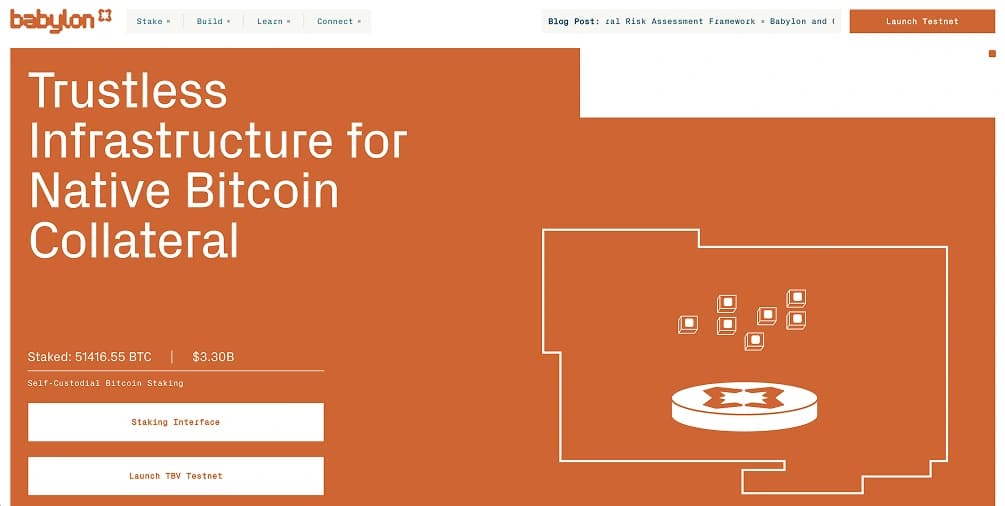
Babylon Genesis sits at the centre of this system. It is both a standalone chain secured by staked Bitcoin and the control plane that directs that security and liquidity to other networks. Founded in 2022 by Stanford professor David Tse and Fisher Yu, the protocol has grown into one of the largest pieces of Bitcoin DeFi, or "BTCFi", with more than $3 billion of BTC committed to it according to DefiLlama.
How Does Babylon Bitcoin Staking Work?
Babylon runs as a two-sided market. Bitcoin holders supply economic security, and PoS chains, rollups, and appchains consume it in exchange for a share of their rewards. In practice:
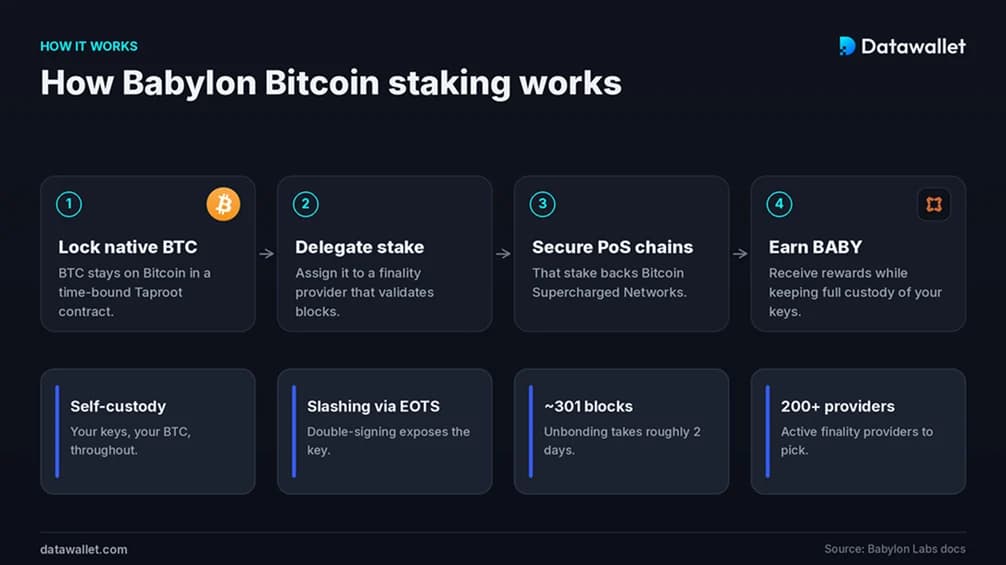
- Bitcoin stays on Bitcoin: You lock BTC in a time-bound Taproot staking contract on the Bitcoin chain. The coins never move to another network, and you can withdraw once the lock expires.
- Self-custody throughout: The staking script is built on Bitcoin's native UTXO model, so no third party ever takes possession of your BTC.
- Finality providers do the validating: Most stakers delegate to a finality provider, a specialised operator that signs blocks on the networks being secured. More than 200 finality providers are active.
- Slashing is live and cryptographic: Babylon uses Extractable One-Time Signatures (EOTS). If a finality provider double-signs at the same block height, its private key is mathematically exposed, which triggers a pre-signed Bitcoin transaction that burns a portion of the BTC delegated to it. Honest stakers are unaffected.
- Unbonding is measured in Bitcoin blocks: Withdrawing staked BTC takes roughly 301 Bitcoin blocks, around two days, anchored to Bitcoin timestamping rather than a social checkpoint.
On rewards: staking BTC through Babylon pays modest yield in BABY, in the low single digits annually. For most early participants the airdrop was the bigger draw than recurring income, worth remembering before you stake for yield alone.
Babylon Genesis and Bitcoin Supercharged Networks
The networks that buy Babylon's security are called Bitcoin Supercharged Networks (BSNs). Per Babylon's documentation, a BSN is any chain that anchors its block finality to staked Bitcoin on top of its own consensus, gaining Bitcoin-grade economic weight without inflating its native token to pay for security.
Babylon Genesis is the first BSN and the control plane for the rest. Built on the Cosmos SDK with CometBFT consensus and CosmWasm support, it coordinates staking, reward distribution, and cross-chain messaging over IBC. The chain runs a dual-staking model, where CometBFT validators secure it with delegated BABY while finality providers add a second, Bitcoin-backed finality layer.
The larger goal is multi-staking, the headline feature of Babylon's third phase. A single BTC stake can secure several BSNs at once, earning a separate reward stream from each without the holder unbonding and restaking. It moved from testnet through 2025 and is how Babylon scales from one secured chain into many.
Genesis is also acquiring EVM capability, which would let Solidity developers deploy BTCFi applications such as lending and trading directly on a Bitcoin-secured L1. Combined with support for liquid staking tokens built on top of staked BTC, the chain is positioning itself as a liquidity hub rather than only a security layer.
BABY Tokenomics
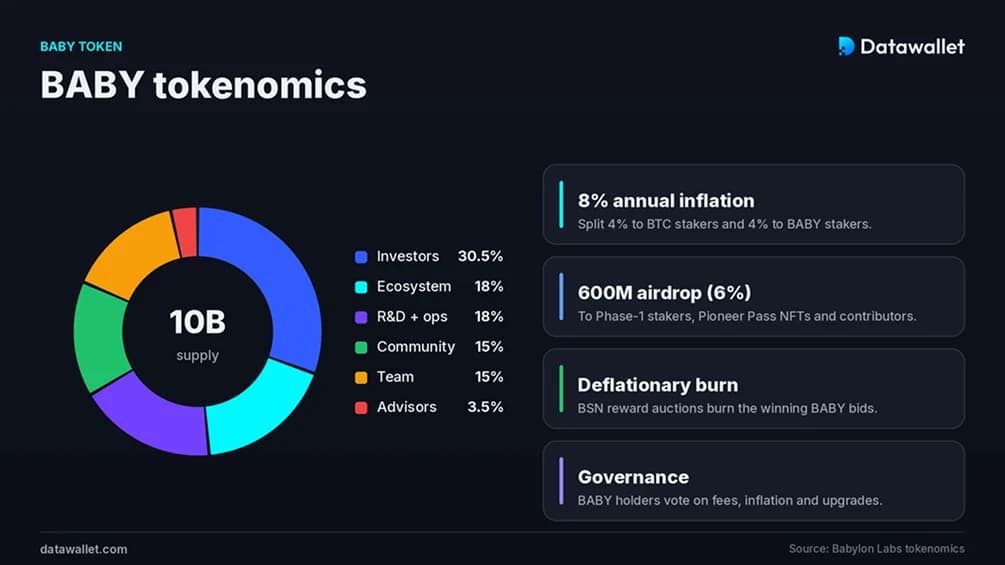
BABY is the native gas, governance, and staking token of Babylon Genesis. It launched in April 2025 alongside the mainnet, with an initial supply of 10 billion tokens and an 8% annual inflation rate that funds staking rewards.
- Reward split: Inflation is divided evenly, with 4% going to BTC stakers and 4% to BABY stakers, so both sides of the dual-staking model are paid in BABY.
- Governance: BABY holders vote on upgrades and parameters such as fees and inflation. BTC stakers do not vote directly, as the validator they delegate to votes on their behalf.
- Burn mechanism: Following a governance proposal, rewards that BSNs send to Genesis are auctioned on-chain, with bids denominated in BABY and the winning bid burned. As more BSNs join, this is designed to offset inflation with deflationary pressure.
- Distribution: Early private investors hold 30.5%, with ecosystem building and R&D at 18% each, community incentives at 15%, the team at 15%, and advisors at 3.5%. Investor, team, and advisor allocations vest over several years, so unlocks keep entering supply through 2029.
The airdrop sat inside this allocation. The Babylon Foundation set aside 600 million BABY, 6% of supply, for early adopters, covering Phase-1 BTC stakers, Pioneer Pass NFT holders, and open-source contributors. Binance ran a parallel HODLer airdrop of 75 million BABY around the listing. For the wider context on how distributions like this are structured, our guide to top crypto airdrops covers the mechanics.
Trustless Bitcoin Vaults and the Aave Partnership
Babylon's newest direction extends the staking idea into lending, under the banner of "BTCFi 2.0". The core piece is the Trustless Bitcoin Vault (TBV), which locks BTC in a Taproot UTXO on Bitcoin and produces a non-transferable accounting asset representing that collateral, with no wrapping and no custodian.
In December 2025, Babylon and Aave Labs announced a partnership to bring native Bitcoin collateral to Aave V4. Using Aave's hub-and-spoke architecture, Babylon is building a dedicated Bitcoin-backed spoke that lets users post real BTC and borrow stablecoins against it, with the underlying coins staying on the Bitcoin chain. Repay the loan and the collateral unlocks. A temperature check went to the Aave DAO in mid-2026, and native BTC-backed borrowing reached public testnet shortly after.
The push is backed financially. a16z crypto invested $15 million in January 2026 to support the vault technology, and the team has signalled a further extension into BTC-backed DeFi insurance, where deposited Bitcoin would underwrite protocol-hack coverage and earn yield when no claims are paid. Integrations with Ledger and GoMining have widened access to the vaults. The bet is that the roughly $1.7 trillion of idle Bitcoin dwarfs the staking pool alone.
Babylon vs EigenLayer
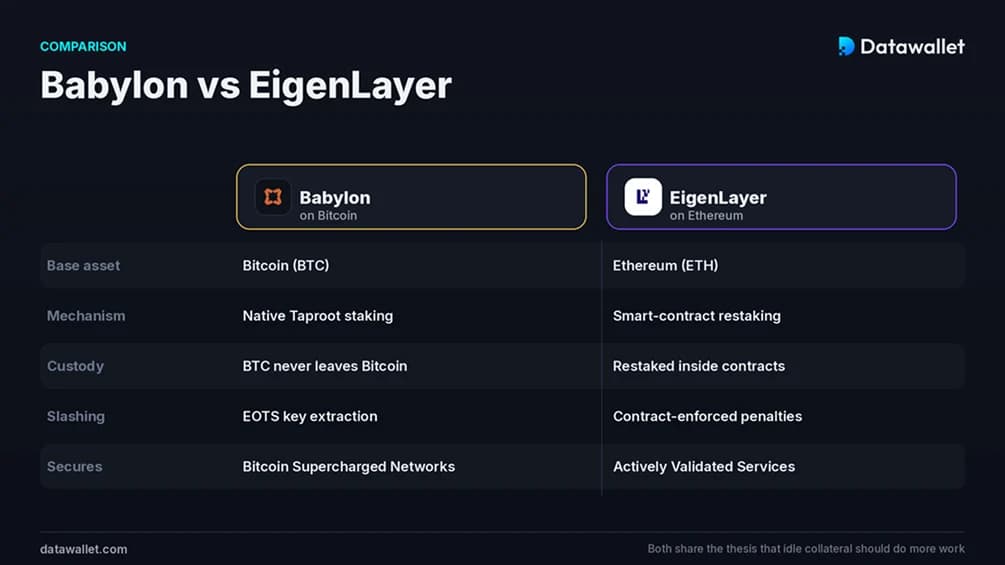
Babylon is often described as "EigenLayer for Bitcoin", and the comparison holds. Both re-use an existing asset to secure additional networks and pay the holder for it. The difference is the base layer. EigenLayer operates inside Ethereum's smart contract environment, restaking ETH and liquid staking tokens to secure additional services. Babylon works on Bitcoin's base layer, where there are no smart contracts, so it relies on Taproot scripts and EOTS to enforce slashing.
That constraint shapes everything. Bitcoin's limited scripting is harder to build on than the EVM, but it means staked BTC never leaves the most secure and liquid chain in crypto. The two are not direct rivals, since they target different assets, though they share the thesis that idle collateral should do more work.
Is Babylon Bitcoin Staking Safe?
The model is deliberately conservative, but it carries real risks that are easy to overlook:
- Slashing risk: Slashing is now live. If your chosen finality provider misbehaves, a portion of your delegated BTC can be burned. Spreading delegation across several reputable providers reduces this exposure.
- Finality provider concentration: Security depends on a healthy spread of operators. Concentration among a few large providers would weaken the network's decentralisation.
- TVL is volatile: Locked value swings sharply. After the April 2025 airdrop, a single migration by Lombard Finance unstaked around $1.2 billion of BTC in a day, cutting TVL by roughly a third before it recovered. Large stakers moving in and out can shift the picture quickly.
- Novel cryptography in the vaults: Trustless Bitcoin Vaults and the Aave spoke introduce new settlement, liquidation, and proof-verification surfaces that have not been tested at scale. Audits are ongoing, but the technology is young.
- Token and yield reality: BABY rewards are modest and the token is volatile, trading well below its pre-launch valuation. Anyone staking for income rather than airdrop exposure should size expectations accordingly.
None of these are unique to Babylon, but native Bitcoin staking is still young. Understand the finality provider you delegate to before committing size.
Who Founded Babylon and How Much Did It Raise?
Babylon was founded in 2022 by David Tse, a Stanford professor known for the proportional-fair scheduling algorithm used in wireless networks, and Fisher Yu, a researcher focused on blockchain security and cryptography. They built the protocol around one idea: Bitcoin's economic weight could secure other chains without ever leaving its own network.
The project has raised more than $96 million. The largest round, $70 million led by Paradigm in 2024, valued Babylon at around $800 million and drew participation from Polychain, Hashkey, and others. Binance Labs invested earlier in 2024, and a16z crypto returned in January 2026 with $15 million earmarked for the Bitcoin vault work. We have watched several of Tse's talks on bridging Bitcoin and proof-of-stake, and the thesis has stayed consistent across each funding round.
Bottom Line
Babylon set out to answer a question that has followed Bitcoin for years: can it do anything productive without giving up what makes it valuable? With more than 56,000 BTC staked natively, a live token, and slashing enforced on-chain, the staking side of that answer now operates rather than sits in a whitepaper.
The harder test is ahead. Multi-staking has to scale across many BSNs, the Aave integration has to prove that native Bitcoin collateral holds up under real liquidation pressure, and the BABY token has to find a value that reflects the billions it helps secure. We think Babylon has built the most credible version of Bitcoin staking so far, and the next year of BTCFi will show how much of the broader vision holds.

.webp)