



What is Pump.fun?
Pump.fun is a memecoin launchpad on Solana that removes every technical barrier to issuing a token. A user uploads an image, picks a name and ticker, and the coin is live within a minute. No code, presale, or liquidity seeding is required, because an automated bonding curve prices every trade from the first buy.
The platform launched on 19 January 2024 under Baton Corporation Ltd, a UK-registered company whose directors and co-founders are Alon Cohen, Noah Tweedale, and Dylan Kerler. A viral experiment quickly became the engine of Solana's memecoin economy, at times accounting for the majority of new token mints on the network.
More than 12 million tokens have been created on the platform, and in March this year Pump.fun crossed $1 billion in cumulative revenue, a first for any Solana application. It remained Solana's highest-earning app through the second quarter even as activity cooled.
That cooling matters. Daily fees sit well below their early-year peak as speculative capital rotated toward perpetuals venues like Hyperliquid, and the token graduation rate dropped to fractions of a percent. Pump.fun remains the dominant launchpad, just a smaller version of the machine it was at the cycle top.
How Does Pump.fun Work?
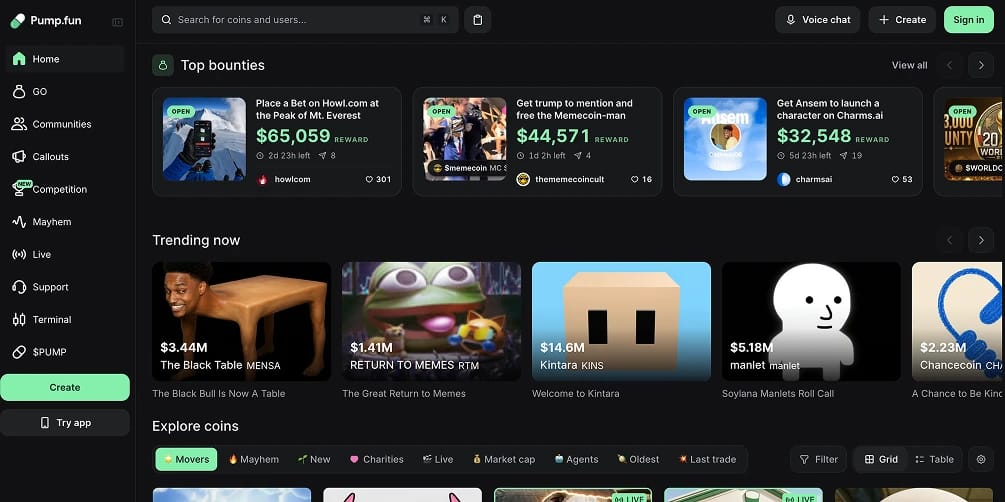
Every Pump.fun token follows the same lifecycle from creation to open trading:
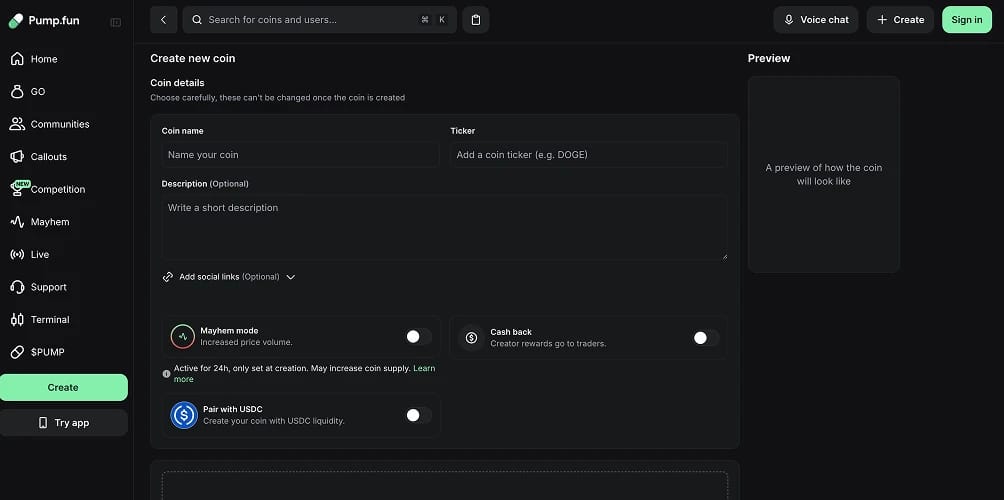
- Creation: Anyone connects a Solana wallet, uploads an image, and sets a name and ticker. Every token launches with a standard 1 billion supply and no presale, so all buyers enter through the same curve.
- Bonding curve: Early trading happens against a pricing formula instead of an order book. Purchases push the price up the curve and sales push it down, so price is a direct function of the SOL committed.
- Graduation: When buying fills the curve, at roughly $69,000 in market cap or around 85 SOL, the token graduates. Fewer than 2% of tokens ever get there, and by mid-June the seven-day graduation rate had slid to about 0.26%.
- PumpSwap: The SOL raised on the curve seeds a pool on PumpSwap, Pump.fun's own AMM, and the LP tokens are burned so liquidity cannot be pulled. Migration has been instant and free since PumpSwap replaced Raydium as the graduation venue in March 2025.
Burned LP blocks the classic hard rug pull, where a deployer drains the pool. It does nothing to stop soft rugs, where creators and early wallets sell into demand, which is why checking holder concentration and bundled wallets remains essential before buying anything on the platform.
Pump.fun Fees
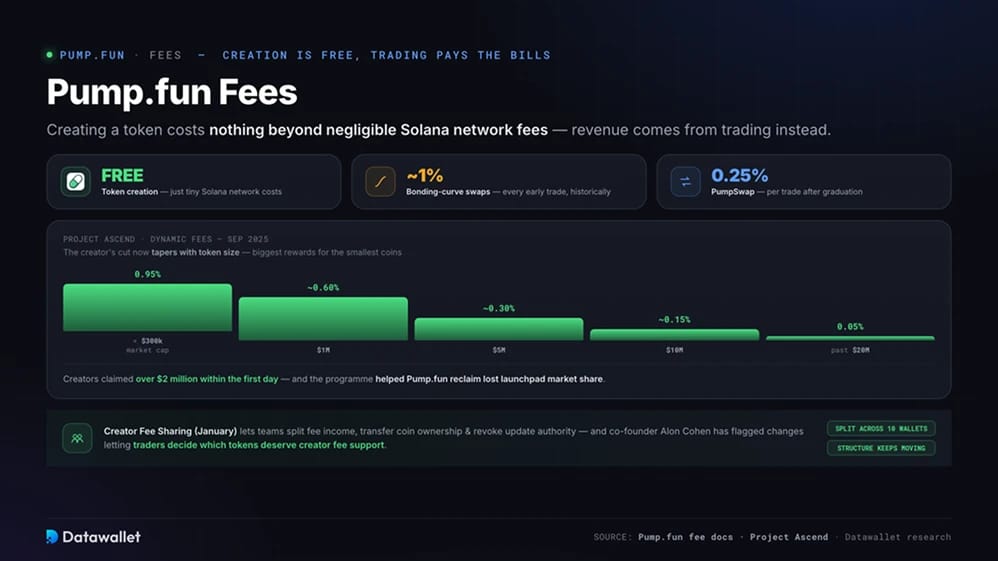
Creating a token costs nothing beyond negligible Solana network fees. Revenue comes from trading instead, historically a 1% fee on every bonding curve swap, with PumpSwap charging 0.25% per trade after graduation.
Project Ascend rebuilt the fee model in September 2025. Its Dynamic Fees system ties the creator's cut to token size, paying up to 0.95% per trade on coins below a $300,000 market cap and tapering to 0.05% past $20 million. Creators claimed over $2 million within the first day, and the programme helped Pump.fun reclaim lost launchpad market share.
A Creator Fee Sharing update followed in January this year, letting teams split fee income across up to 10 wallets, transfer coin ownership, and revoke update authority. Co-founder Alon Cohen has flagged further changes that would let traders decide which tokens deserve creator fee support, so the structure will keep moving.
PUMP Tokenomics
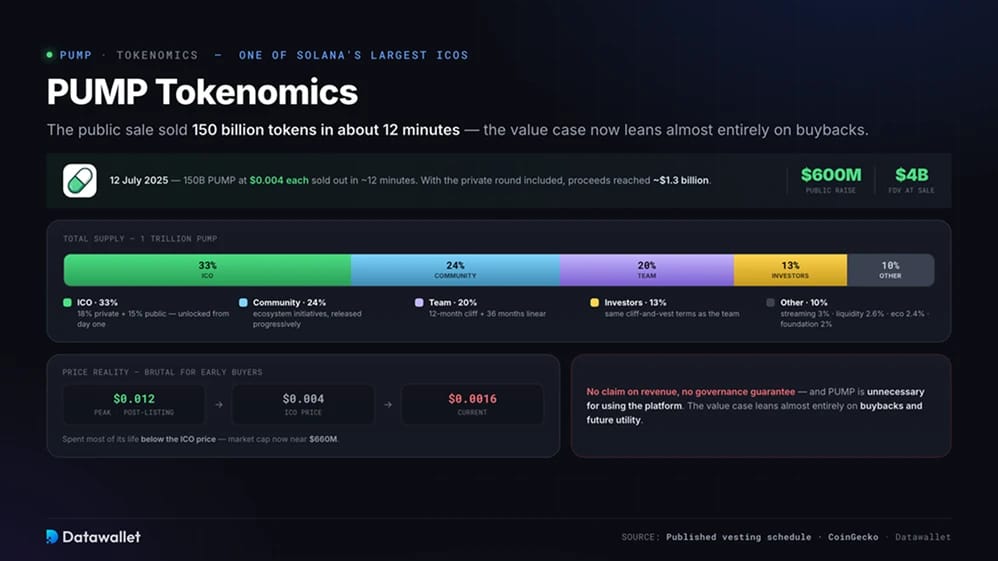
PUMP is the platform's native token, launched through one of the largest ICOs in Solana's history. The public sale on 12 July 2025 sold 150 billion tokens at $0.004 each in about 12 minutes, raising $600 million. With a private round included, total proceeds reached roughly $1.3 billion at a $4 billion fully diluted valuation.
The supply breaks down as follows, per the published vesting schedule:
- Total supply: 1 trillion PUMP, with 33% sold through the ICO (18% private, 15% public) and unlocked from day one.
- Community: 24% is reserved for community and ecosystem initiatives, released progressively.
- Team: 20% sits with the team behind a 12-month cliff followed by 36 months of linear vesting.
- Investors: 13% belongs to existing investors on the same cliff-and-vest terms as the team.
- Other: Livestreaming (3%), liquidity and exchanges (2.6%), an ecosystem fund (2.4%), and the foundation (2%) hold the remainder.
Price performance has been brutal for early buyers. PUMP peaked near $0.012 shortly after listing, spent most of its life below the ICO price, and currently trades around $0.0016 with a market cap near $660 million. The token confers no claim on revenue and is unnecessary for using the platform, so its value case leans almost entirely on buybacks and future utility.
PUMP Buybacks, Burns, and Token Unlocks
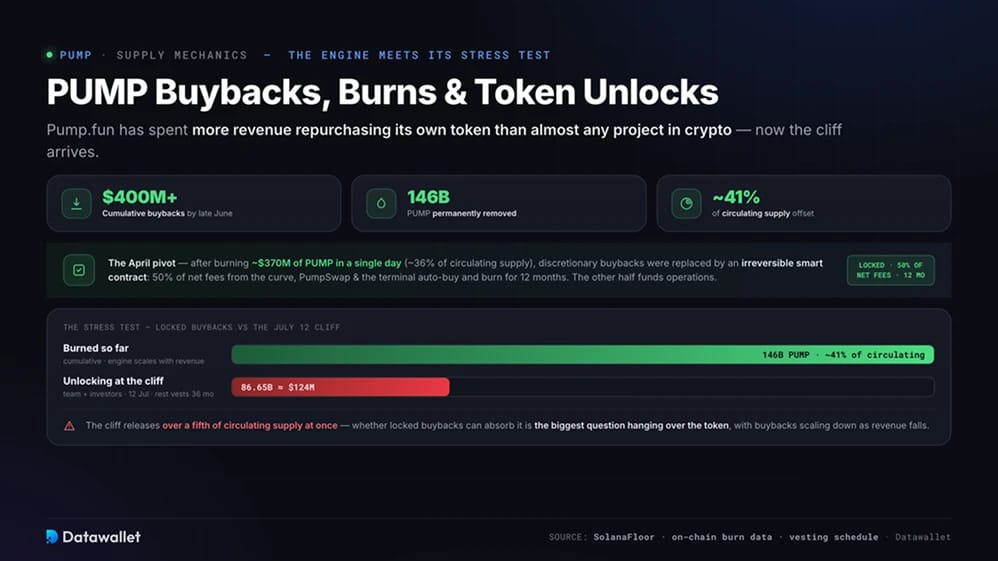
Pump.fun has spent more of its revenue repurchasing its own token than almost any project in crypto. Cumulative buybacks passed $400 million in late June, with 146 billion PUMP permanently removed, offsetting about 41% of circulating supply.
The programme changed shape in April. After burning roughly $370 million of PUMP in a day, around 36% of circulating supply, the team replaced discretionary buybacks with an irreversible smart contract committing 50% of net fees from the bonding curve, PumpSwap, and its trading terminal to automatic purchases and burns for 12 months. The other half funds operations and reinvestment.
The buyback engine now faces its first real stress test. On 12 July the team and investor cliff expires, unlocking roughly 86.65 billion PUMP at once, worth about $124 million and over a fifth of circulating supply, with the rest vesting across 36 months. Whether locked buybacks can absorb that supply is the biggest question hanging over the token.
Livestreaming and Creator Rewards
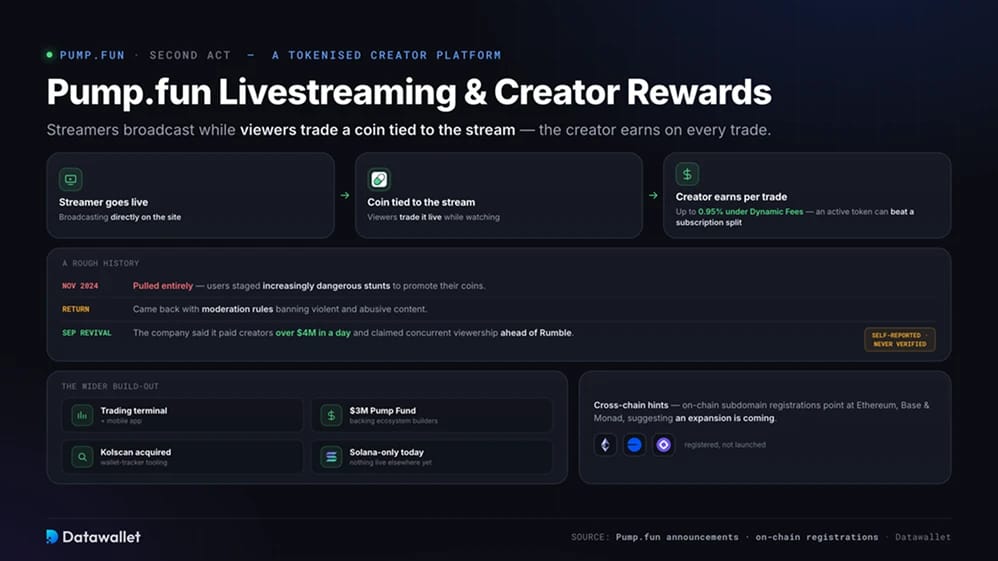
Pump.fun's second act is a tokenised creator platform. Streamers broadcast on the site while viewers trade a coin tied to the stream, and the creator earns a cut of every trade under the Dynamic Fees scale. For a small streamer, fee income on an active token can beat a conventional subscription split.
The feature has a rough history. Livestreaming was pulled in November 2024 after users staged dangerous stunts to promote their coins, then returned under a moderation policy banning violent and abusive content. During the September revival the company said it paid creators over $4 million in a day and claimed concurrent viewership ahead of Rumble, figures Pump.fun published itself with no third-party verification.
The company also runs a trading terminal, a mobile app, and the $3 million Pump Fund for ecosystem builders, and has acquired the wallet tracker Kolscan. On-chain subdomain registrations pointing at Ethereum, Base, and Monad hint at a cross-chain expansion, though nothing has launched outside Solana yet.
Pump.fun Lawsuits and Regulation
Pump.fun's largest threat is legal. A consolidated class action, Aguilar v. Baton Corporation, is proceeding in the Southern District of New York before Judge Colleen McMahon. Plaintiffs allege the platform sold unregistered securities and ran a racketeering scheme in which insiders used priority transaction ordering to buy new tokens first and exit onto retail buyers, seeking damages that could reach roughly $5.5 billion with trebling.
The case widened after a confidential informant supplied around 5,000 internal chat logs, and the second amended complaint filed in January this year names Solana Labs, the Solana Foundation, Jito Labs, and executives from each alongside Pump.fun's founders. Motions to dismiss were briefed through February and no trial date is set, so the overhang persists well into next year.
The defence has one substantial regulatory tailwind. In February 2025 the SEC's Division of Corporation Finance stated that transactions in typical memecoins do not involve the offer and sale of securities, a staff view with no legal force that still undercuts the securities claims at the heart of the suit. Access limits add another wrinkle, since the ICO excluded US and UK participants and the platform restricts users in several jurisdictions.
Pump.fun vs Other Solana Launchpads
Pump.fun's dominance has been contested more than once. LetsBonk briefly overtook it on graduations in July 2025 before Pump.fun regained the lead as top deployers migrated back. By January this year it controlled roughly three quarters of Solana memecoin launches.
Challengers keep arriving. Bags grew into a clear second place in the first quarter, Heaven pitches itself as a fairer launch venue, and Moonshot targets mobile-first buyers, while Base's Zora-powered token feed now mints more coins per day than Solana on some measures.
Pump.fun Risks
Pump.fun makes speculation frictionless, and that cuts both ways. These risks matter most before touching the platform or its token:
- Near-total failure rate: Fewer than 2% of tokens graduate and most go to zero. The class action alleges around 98.6% of launches ended as de facto rug pulls, with user losses estimated at $4 billion to $5.5 billion.
- Insider and bot dynamics: Snipers, bundlers, and priority-execution tools enter curves before ordinary buyers, so retail is structurally late even when a token succeeds.
- Soft rugs: Burned LP prevents pool drains, yet creators and early wallets can still dump on holders at any time, and no technical control stops it.
- Legal overhang: An adverse ruling in the SDNY case could reshape or cripple the business, and plaintiffs have asked the court to consider a receiver over Baton's operations.
- Revenue cyclicality: Platform activity has fallen roughly 80% from its cycle peak as traders rotated into perpetuals venues, and PUMP buybacks scale down with revenue.
- Dilution: The July cliff releases over a fifth of circulating supply, and team and investor allocations keep vesting for three more years afterwards.
- No holder rights: PUMP carries no revenue claim or governance guarantee, so buybacks are the only live value mechanism.
Final Thoughts
Pump.fun industrialised the memecoin. By collapsing token creation into a free 30-second action and standardising the path from bonding curve to DEX, it built the most profitable application Solana has produced and pulled an entire trading culture along with it.
The current chapter is harder. Activity sits well below peak, a federal lawsuit is probing the fairness of the launch machine itself, and PUMP is about to meet its largest supply event with buybacks running at half of reduced revenue.
For traders, the platform remains the deepest pool of early-stage speculation in crypto, and among the most dangerous. Treat every launch as likely to fail, verify holders before buying, and size positions accordingly. Our guide to the best meme coins covers the rare survivors.