



Who is Jeff Yan?
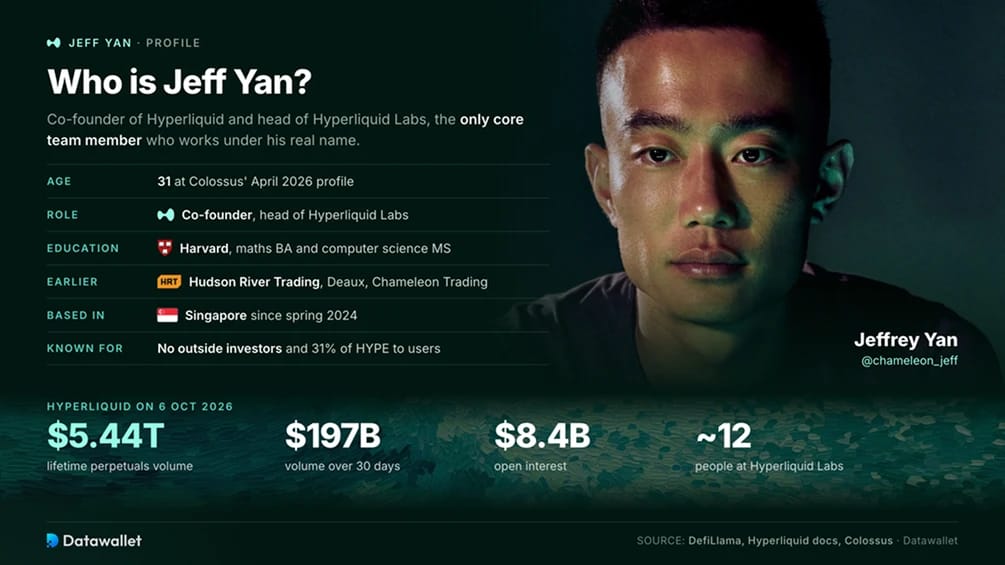
Jeff Yan, also written Jeffrey Yan, co-founded Hyperliquid and leads Hyperliquid Labs, the company of about a dozen people developing the network. He is the only core team member who works under his real name. According to Hyperliquid's documentation on its core contributors, his co-founder is a Harvard classmate known by the pseudonym iliensinc.
Hyperliquid is a blockchain with a built-in trading exchange. Its main product, perpetual futures, lets traders bet on asset prices with borrowed money through contracts that never expire. Users retain custody of their funds. Every order, trade and forced closure is recorded on a public ledger.
On October 6, 2026, DefiLlama's Hyperliquid dashboard showed $5.44 trillion in lifetime perpetual futures volume, including $197 billion over the previous 30 days. Open interest, the total value of positions still open, stood at $8.4 billion. These figures make Hyperliquid the benchmark for other decentralized perpetuals exchanges.
Key facts about Jeff Yan:
- Full Name: Jeffrey Yan
- Age: 31 at the time of Colossus magazine's April 2026 profile
- Role: Co-founder of Hyperliquid and head of Hyperliquid Labs
- Education: Bachelor's degree in mathematics and master's degree in computer science from Harvard University
- Earlier Career: Hudson River Trading, the prediction market Deaux and the market-making firm Chameleon Trading
- Based In: Singapore since spring 2024
- Known For: Building Hyperliquid without outside investors and giving 31% of the HYPE token to its users
Jeff Yan's Background
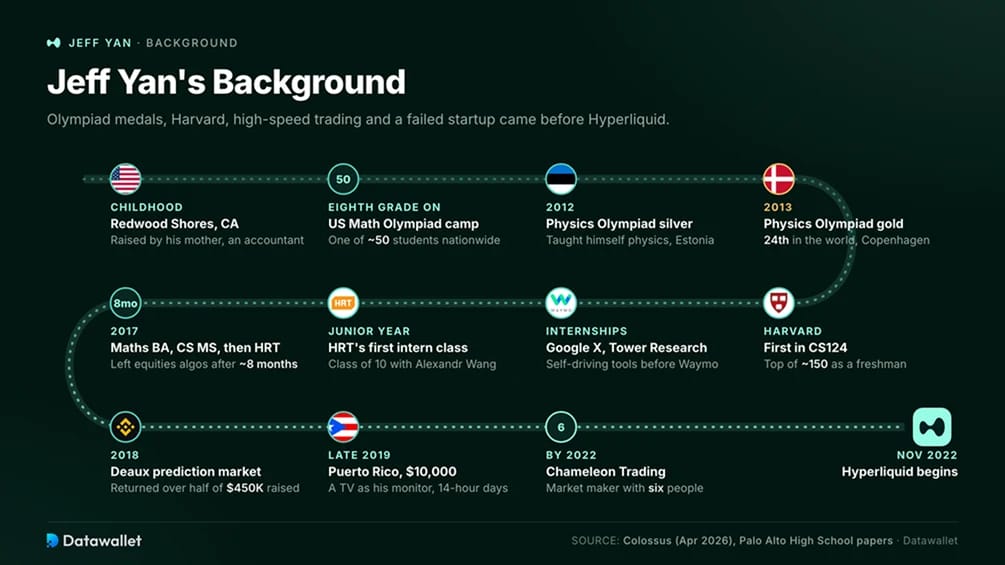
Before Hyperliquid, Yan competed in math and physics, worked in high-speed trading and founded a startup that failed. Colossus magazine's April 2026 profile supplies most of the detail below.
Early Life and the Physics Olympiad
Raised in Redwood Shores, California, between San Francisco and Palo Alto, Yan is the son of Chinese immigrants. His parents divorced when he was in third grade. His mother, an accountant, brought up him and his younger sister on her own.
In eighth grade, a friend took him to a math competition. That summer, he woke at five to work through old competition papers alone. Within a year, he qualified for the US Math Olympiad training camp, which admits about 50 high school students nationwide.
After failing to advance past a math qualifying round at 16, Yan taught himself physics using upperclassmen's textbooks and Richard Feynman's lectures. He won silver at the 2012 International Physics Olympiad in Estonia, followed by gold the following year in Copenhagen, where he ranked 24th in the world. Student newspapers at Palo Alto High School, where he studied, reported both results.
Harvard and Hudson River Trading
Harvard covered nearly all of Yan's tuition. During his freshman year, he took CS124, a data structures and algorithms course attended mostly by sophomores and juniors, and finished first among about 150 students. He graduated in 2017 with a bachelor's degree in mathematics and a master's degree in computer science.
His internships included building tools for Google X's self-driving car project before it became Waymo and working at Tower Research Capital. In his junior year, Yan joined Hudson River Trading's first intern class. The group of 10 also included Scott Wu, later co-founder of Cognition AI, and Alexandr Wang of Scale AI.
In late 2017, Yan joined Hudson River Trading full time on its US equities algorithms team. The firm specializes in high-frequency trading, using software to place and cancel orders in fractions of a second. About eight months later, he left. He told Colossus he could not say what value he was adding.
Deaux and Chameleon Trading
Yan built his first company, the prediction market Deaux, with college roommate Brian Wong in 2018 through Binance Labs' first incubation program. Users could bet on elections, sports or the weather. The product attracted about 100 sign-ups before closing, and Yan returned more than half of the $450,000 it had raised.
Deaux arrived early. A year later, Tarek Mansour co-founded Kalshi. Shayne Coplan launched Polymarket in 2020 on the same thesis.
Once his Hudson River Trading non-compete expired in late 2019, Yan moved to Puerto Rico with $10,000 in savings. Using a television as his monitor, he wrote trading algorithms and worked at least 14 hours a day. The operation became Chameleon Trading, a market maker that continuously quotes buy and sell prices so other traders have someone to deal with. By 2022, the firm employed six people.
How Did Jeff Yan Build Hyperliquid?
Yan turned his own trading firm into Hyperliquid, rejecting the funding model used by most crypto projects.
From FTX's Collapse to a Custom Blockchain
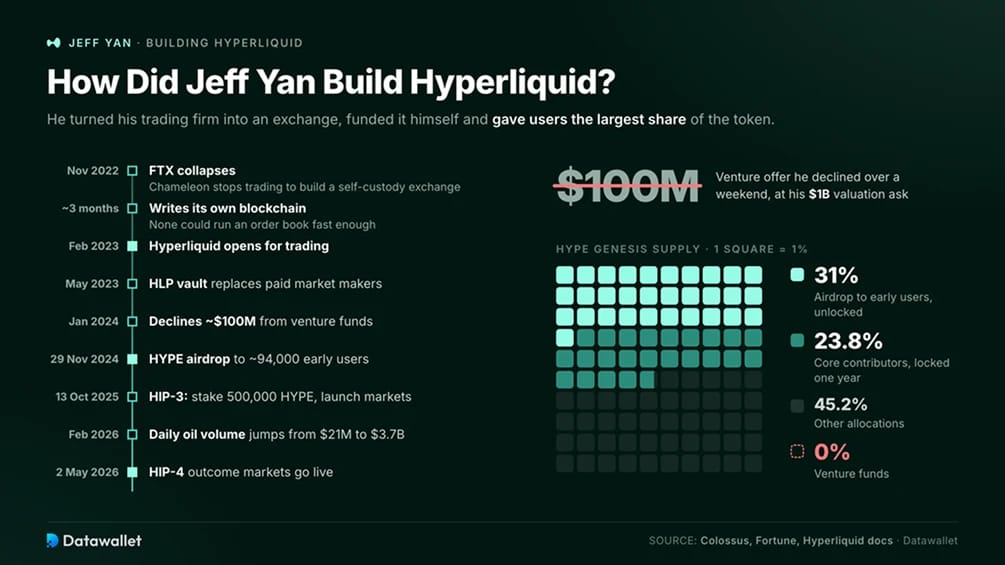
In November 2022, FTX, then the third-largest crypto exchange, failed after lending customer deposits to an affiliated trading firm. Yan halted Chameleon's trading and told the team they would build an exchange where customers held their own money. Several of its six members disagreed. Some left.
An order book is the live list of buy and sell orders used by most exchanges. No existing blockchain could run one at the speed traders expected, so the team wrote its own in about three months. Hyperliquid opened for trading at the end of February 2023.
New exchanges normally pay market makers to supply orders, but Yan refused. Instead, in May 2023, he put Chameleon's strategies into a public vault called HLP. Any user could deposit money and share in its profit or loss.
Turning Down $100 Million
Venture funds were visiting Yan in person by January 2024. One offered about $100 million at his required valuation of $1 billion. With the team spending hundreds of thousands of dollars from his savings each month, he considered the offer over a weekend, then declined.
Yan wanted neutrality. In a January 2026 interview with Fortune, he said a platform that other companies build on should have no insiders. His January 28, 2024, post stated that Hyperliquid had no investors or paid market makers, no fees going to the development team and no insiders.
The HYPE Airdrop
Hyperliquid distributed 31% of its 1 billion HYPE token supply to about 94,000 early users on November 29, 2024. The airdrop gave tokens free to people who had already used the product, with none locked. At the opening price, Colossus valued the distribution at more than $1 billion.
Core contributors received an allocation of 23.8% of supply, locked for a year. Venture funds received nothing and had to buy on the open market. Since May 2026, US investors have also been able to gain exposure through exchange-traded funds such as the Bitwise Hyperliquid ETF. Our Hyperliquid ETF tracker follows it alongside its competitors.
Opening Hyperliquid to Outside Builders
Letting other teams build the products was Yan's most consequential choice. The HIP-3 upgrade, introduced on October 13, 2025, allows anyone who stakes 500,000 HYPE as a locked bond to launch perpetual futures markets and keep up to half the fees.
TradeXYZ, the most active of these teams, lists contracts on oil, gold, stock indices and private companies. The Chicago Mercantile Exchange was closed when the US and Israel struck Iran on a Saturday in late February 2026. According to Colossus, daily crude oil volume on Hyperliquid rose from $21 million to $3.7 billion.
On May 2, 2026, a second upgrade, HIP-4, went live. It introduced outcome markets, where contracts are fully backed by traders' own money and pay out according to whether an event happens. Eight years after starting Deaux, Yan had a prediction market again.
Why Is Congress Asking Jeff Yan for Records?
A crypto wallet is all someone needs to trade on Hyperliquid. Users do not submit identity documents through the process regulators call know-your-customer (KYC) checks. That design has become Yan's largest political problem.
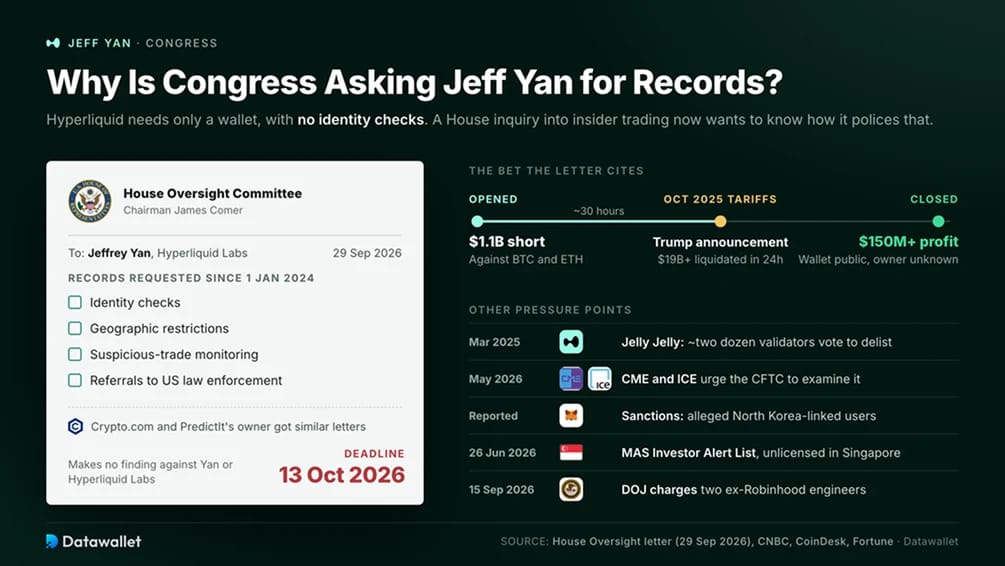
House Oversight Committee Chairman James Comer sent Yan a formal records request on September 29, 2026, as part of an inquiry into insider trading on prediction markets. The letter cites an analysis of a $1.1 billion bet against Bitcoin and Ether made with borrowed money. Opened about 30 hours before President Trump's October 2025 tariff announcement, the position closed for more than $150 million in profit.
Describing a platform with "apparently no identity verification," the committee requests documents dating back to January 1, 2024. It asks about identity checks and geographic restrictions, as well as suspicious-trade monitoring and any referrals to US law enforcement. The deadline is October 13, 2026.
The letter makes no finding against Yan or Hyperliquid Labs. Nor does it establish that the trader had inside information. CNBC reported that Comer sent similar requests to Crypto.com and PredictIt's owner that day. Hyperliquid's spokespeople did not immediately comment.
The tariff announcement triggered the October 10 crash. Across the industry, more than $19 billion in positions built on borrowed money were forcibly closed within 24 hours. Hyperliquid remained online throughout. Its public ledger makes the wallet behind the bet visible to everyone, although the person behind it is known to no one.
Other pressure points have built up around the same issue:
- Validator Intervention: In March 2025, a trader tried to push losses from a small token called Jelly Jelly onto the HLP vault. Roughly two dozen validators, the operators who verify transactions, voted within minutes to delist it and settle at an earlier price. Users were repaid. Critics questioned how decentralized a network could be if so few parties could override a market.
- Incumbent Exchanges: CME Group and Intercontinental Exchange urged the Commodity Futures Trading Commission to examine Hyperliquid, warning of manipulation and sanctions evasion in its oil markets.
- Sanctions Exposure: Fortune reported a MetaMask security researcher's allegation that users linked to North Korea had traded on the platform. A Hyperliquid Labs spokesperson said its website screens traders and enforces sanctions rules, blocking addresses confirmed as high risk.
- Singapore Warning: On June 26, 2026, the Monetary Authority of Singapore placed Hyperliquid on its Investor Alert List, publicly warning that the platform is unlicensed there. The warning carries no ban, though it came from the regulator in the city where Yan's team works.
- Insider Trading Cases: The Justice Department charged two former Robinhood engineers on September 15, 2026, with trading Hyperliquid perpetual futures using confidential listing information. Hyperliquid itself was not accused of wrongdoing.
Can Jeff Yan Bring Hyperliquid to the United States?
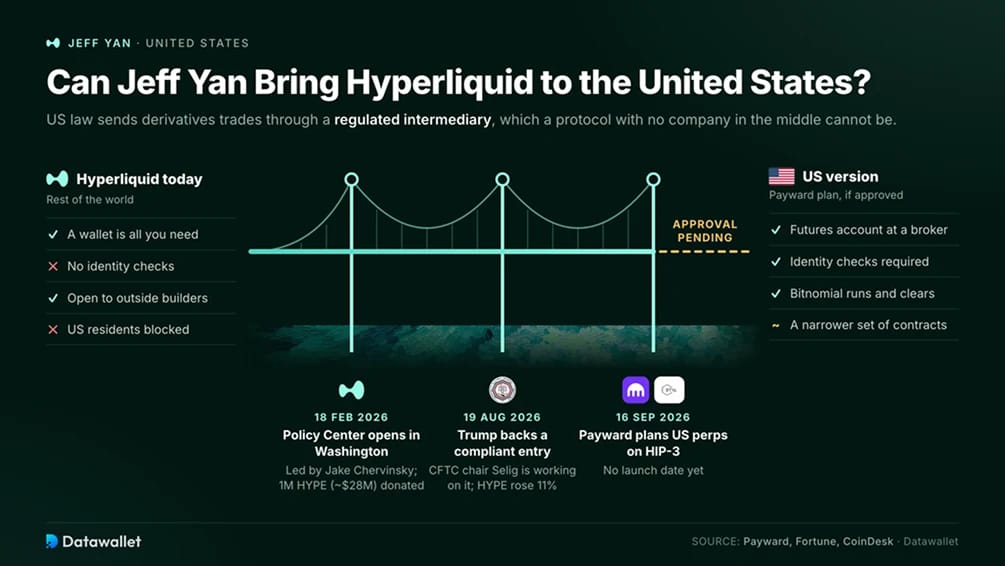
American residents remain blocked from the exchange, as our guide to whether Hyperliquid is available in the USA explains. US law requires derivatives trades to pass through a regulated intermediary. A protocol with no company in the middle has no way to comply.
Policy work has stayed separate from Yan's team. On February 18, 2026, the Hyperliquid Policy Center opened in Washington as an independent nonprofit led by crypto lawyer Jake Chervinsky. A foundation tied to Hyperliquid donated 1 million HYPE, then worth about $28 million.
Six months later, the effort reached the White House. President Trump said on August 19, 2026, that Commodity Futures Trading Commission (CFTC) chair Michael Selig was working to bring Hyperliquid into the country "in a fully compliant and legal fashion." HYPE jumped 11% on the remark.
Payward, the parent company of Kraken, announced plans to deploy perpetual futures for US clients on Hyperliquid's HIP-3 system on September 16, 2026. Bitnomial, its CFTC-regulated subsidiary, would operate and clear the markets. Clients would need a futures account with Payward's registered broker and would have to pass identity checks.
Regulatory approval is still pending, and there is no launch date. If approved, the plan would give Americans a regulated set of contracts on Hyperliquid's blockchain with identity checks. That is a narrower product than the open platform used by the rest of the world.
Jeff Yan's Net Worth
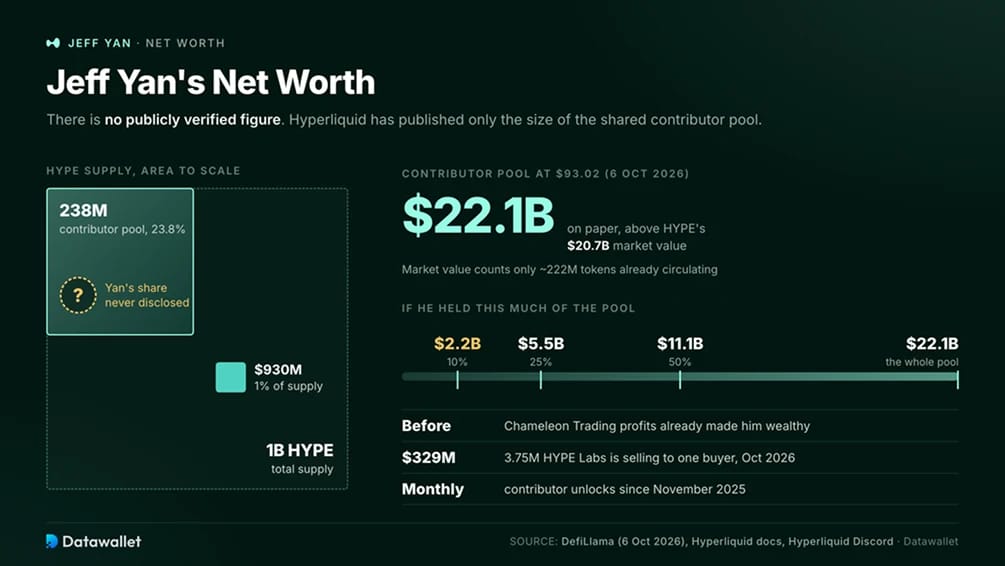
No publicly verified figure exists for Jeff Yan's net worth. He has not disclosed his HYPE holdings in the interviews, podcasts or profiles we reviewed for this article. Hyperliquid has published only the size of the shared team pool.
Reserved for current and future core contributors, that pool contains 238 million HYPE, or 23.8% of total supply. At the HYPE price of $93.02 shown by DefiLlama on October 6, 2026, its paper value was about $22.1 billion. HYPE's market value that day was lower, at $20.7 billion, because it counted only the roughly 222 million tokens already circulating.
Without knowing Yan's share, any estimate of his holdings is a guess. At that price, every 10 million HYPE, equal to 1% of total supply, was worth roughly $930 million. A founder with even one-tenth of the contributor pool would hold about $2.2 billion on paper.
Token allocations are far from cash. Contributors' tokens were locked for a year after launch, with monthly releases beginning in November 2025. For the October 2026 distribution, iliensinc said on the project's Discord that Hyperliquid Labs would sell 3.75 million HYPE, worth about $329 million, to one institutional buyer in a private sale.
Yan was already wealthy before HYPE existed. Chameleon Trading's profits funded Hyperliquid's development, and Colossus reported that he still pays many team costs himself. Public companies also hold large HYPE positions, ranked by holdings in our Hyperliquid treasury tracker.
What Jeff Yan Says Comes Next
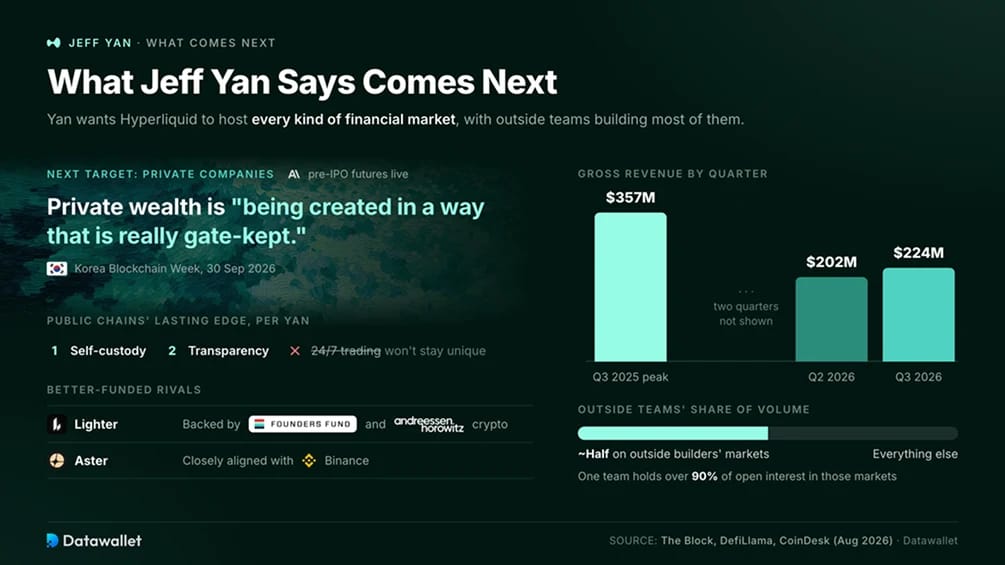
Yan wants Hyperliquid to host every kind of financial market. His newest target is private companies. At Korea Blockchain Week on September 30, 2026, he described private markets as a big opportunity because wealth there is "being created in a way that is really gate-kept." Outside teams already offer contracts on unlisted firms, including pre-IPO Anthropic futures.
During the same talk, he put self-custody, where users hold their own funds, and transparency about how the system works above round-the-clock trading as public blockchains' lasting advantages. Traditional exchanges are extending their hours, he noted. Weekend trading will not remain unique for long.
"We use crypto, but that doesn't define us," Yan told Colossus. He does not see Hyperliquid as a crypto company. His team develops the underlying system, while independent teams build most of what users interact with and earn fees for that work.
The model has a cost. DefiLlama data puts Hyperliquid's gross revenue peak at $357 million in the third quarter of 2025. Revenue fell to $202 million by the second quarter of 2026 before recovering to $224 million in the third. CoinDesk's analysis of the decline found that outside teams' markets had grown to about half of all volume. One team accounted for more than 90% of open interest in those markets.
Yan also faces rivals with more funding than he chose to accept. Founded by a fellow Harvard graduate, Lighter has backing from Founders Fund and a16z crypto. Aster is closely aligned with Binance. Our Hyperliquid statistics page tracks its market share against both.
Lesser-Known Facts About Jeff Yan
These details come from a handful of profiles, as Yan gives few interviews.
The details most often missed:
- Chameleon Handle: His X account, @chameleon_jeff, takes its name from the gaming handle he chose in middle school and later used for his trading firm.
- His Mother's Proverb: She often repeated a Chinese idiom meaning that beyond every person there are greater people, and beyond the sky there is more sky. The saying supplied the Colossus profile's title.
- One Outfit: Yan owns 15 pairs of identical Lululemon shorts and 10 of the same T-shirt in three colors. He also cuts his own hair to save time.
- Jazz Piano: He taught himself jazz on Harvard's common-room grand piano and spent hours playing chess, Go and poker with Scott Wu.
- Personal Security: A stranger followed him into his apartment elevator, prompting him to move to a safer building and hire a bodyguard. He travels with two security guards.
- Caution on AI: His engineers use separate laptops for AI models, limiting them to exploring ideas. Yan says the technology is not yet good enough to write important code.
- Bug Bounty: Hyperliquid has never paid a market maker. It will, however, pay up to $1 million for a single bug report.
- Industry Recognition: CoinDesk included Yan in its Most Influential 2025 list for building Hyperliquid while avoiding public attention.
- Chipotle Thursdays: With no Chipotle in Singapore, the team gave its chef the recipes to recreate the menu once a week.
Final Thoughts
Jeff Yan built Hyperliquid without investor money or paid market makers, declining to take a fee for his own team. Those choices produced a public trading network run by about a dozen people that now moves prices in oil and equities as well as crypto.
Politics will shape his next test. The congressional records deadline and pending CFTC decision on Payward's plan come as the fee model directs more revenue to outside builders. Together, these pressures will show whether an open, neutral platform can retain that character as regulators and rivals close in.