


Who is Vitalik Buterin?
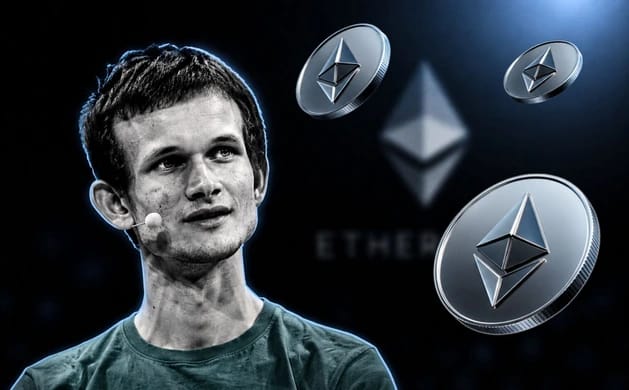
Vitalik Buterin is a Russian-Canadian programmer, writer, and crypto researcher best known as the co-founder of Ethereum. Born in 1994, he became involved with Bitcoin as a teenager before helping launch Bitcoin Magazine and later proposing Ethereum as a more flexible blockchain platform.
Unlike Bitcoin, Ethereum was designed to support smart contracts and decentralized applications, giving developers a programmable blockchain for finance, gaming, identity, governance, and other use cases. Buterin’s early whitepaper helped define Ethereum’s vision before the network launched and grew into one of crypto’s largest ecosystems.
Today, Buterin is less of a traditional CEO and more of a public intellectual, protocol researcher, and ecosystem guide. His influence comes from technical proposals, essays, conference talks, and public commentary on Ethereum’s roadmap, including decentralization, proof-of-stake, Layer 2 scaling, and long-term network resilience.
He remains active in Ethereum’s development, regularly publishing research on scaling, privacy, and cryptography at vitalik.eth.limo, and speaks at global conferences on the future of decentralized networks. His writing shows continued focus on making Ethereum more scalable, private, secure, and useful for everyday users.
Vitalik Buterin's Background
Vitalik Buterin’s background combines early mathematical talent, technical curiosity, and deep exposure to Bitcoin before Ethereum existed. His path moved from gifted student and crypto writer to one of blockchain’s most influential protocol designers.
Early Life and Education
Born in Russia and raised in Canada, Buterin’s early years shaped his interest in math, programming, economics, and decentralized technology long before Ethereum launched.
Key milestones from Buterin’s formative years include:
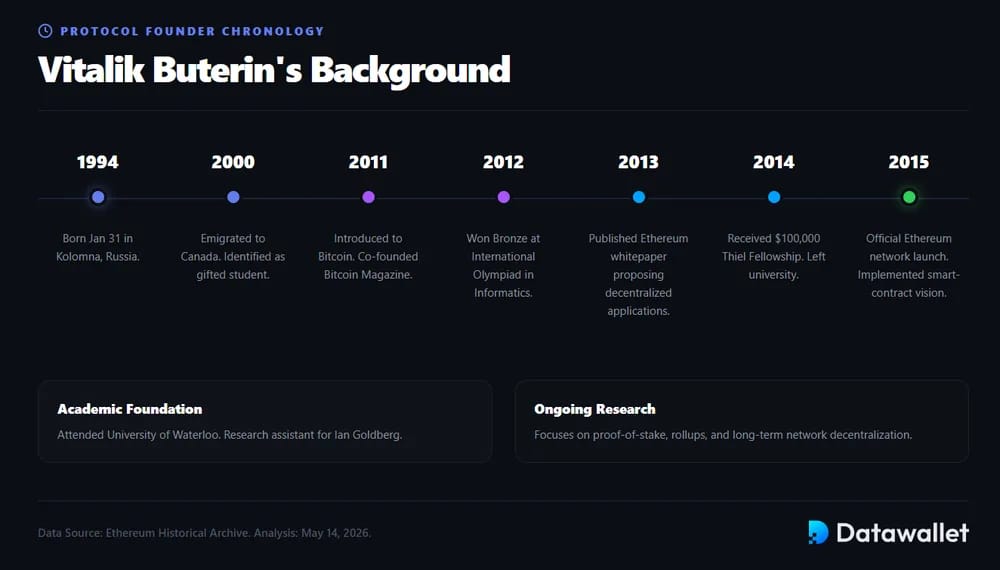
- Birth: Vitalik Buterin was born on January 31, 1994, in Kolomna, Russia, before moving to Canada with his family at age six.
- Family: His father, Dmitry Buterin, was a computer scientist who introduced him to Bitcoin in 2011, when Vitalik was around 17 years old.
- Canada: After emigrating, Buterin grew up in the Toronto area, where teachers noticed his unusual ability in mathematics, programming, and economics.
- Schooling: He attended The Abelard School, a private high school in Toronto, which he later credited as intellectually important for his development.
- Gifted: In grade three, Buterin was placed in a gifted program, where he became known for fast mental math and strong analytical thinking.
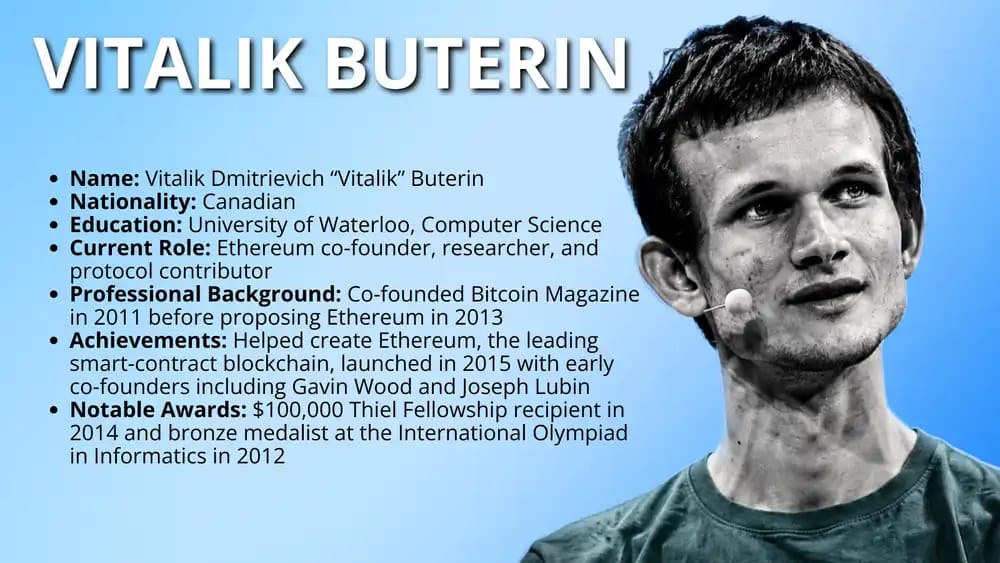
- Olympiad: In 2012, he won a bronze medal at the International Olympiad in Informatics, strengthening his reputation as a serious young programmer.
- University: Buterin enrolled at the University of Waterloo, taking advanced courses and working as a research assistant for cryptographer Ian Goldberg.
- Fellowship: In 2014, he received a $100,000 Thiel Fellowship, leaving university to focus full-time on Ethereum’s early development and ecosystem building.
Professional Career
Buterin’s professional career began with crypto writing, expanded through Bitcoin Magazine, and evolved into Ethereum, a general-purpose blockchain platform proposed in 2013 and launched in 2015.
Important career milestones and collaborations include:
- Writing: In 2011, Buterin began writing about Bitcoin online, reportedly earning bitcoin for articles while still a teenager.
- Magazine: Later, Mihai Alisie and Vitalik Buterin co-founded Bitcoin Magazine, one of the earliest serious publications focused on Bitcoin and digital currencies.
- Ripple: Buterin briefly explored working with Ripple and Jed McCaleb, but the opportunity reportedly fell through because of U.S. visa issues.
- Whitepaper: In 2013, Buterin published the Ethereum whitepaper, proposing a blockchain with a built-in programming language for decentralized applications.
- Announcement: On January 26, 2014, he publicly presented Ethereum at the North American Bitcoin Conference in Miami, helping attract early developer interest.
- Co-Founders: Ethereum’s early team included Gavin Wood, Charles Hoskinson, Anthony Di Iorio, Joseph Lubin, Mihai Alisie, Amir Chetrit, and Jeffrey Wilcke.
- Crowdfunding: In 2014, Ethereum raised funds through a public ether sale, helping finance development before the network’s official launch.
- Launch: Ethereum officially launched in 2015, turning Buterin’s smart-contract vision into a functioning blockchain used by developers, startups, and DeFi protocols.
- Research: Since launch, Buterin has focused on Ethereum’s roadmap, including proof-of-stake, rollups, privacy, account abstraction, cryptography, and long-term decentralization.
How Did Vitalik Create Ethereum?
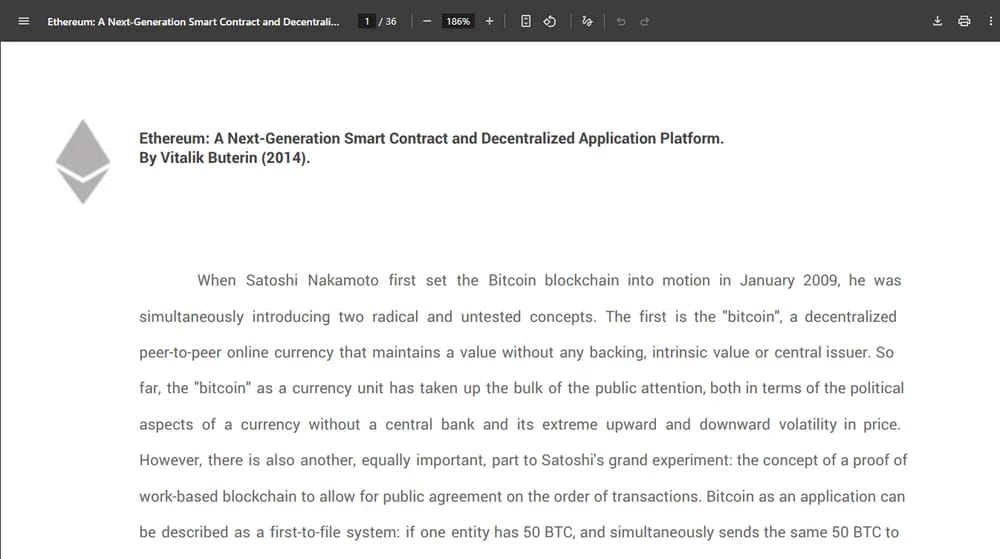
Vitalik Buterin created Ethereum after concluding that Bitcoin’s scripting system was too limited for broader blockchain applications. In the Ethereum whitepaper, first shared in 2013, he proposed a general-purpose blockchain where developers could build smart contracts, decentralized applications, digital assets, and autonomous organizations on one shared network.
The idea gained momentum in early 2014, when Buterin presented Ethereum at the North American Bitcoin Conference in Miami. Early collaborators, including Gavin Wood, Joseph Lubin, Anthony Di Iorio, Charles Hoskinson, Mihai Alisie, Amir Chetrit, and Jeffrey Wilcke, helped turn the concept into a technical and organizational project.
Development accelerated through the Ethereum Foundation and a 2014 public ether crowdsale, which funded early client teams and protocol work. Ethereum officially launched on July 30, 2015, with the Frontier release, introducing a live blockchain for programmable contracts and decentralized applications.
Vitalik Buterin Net Worth in 2026
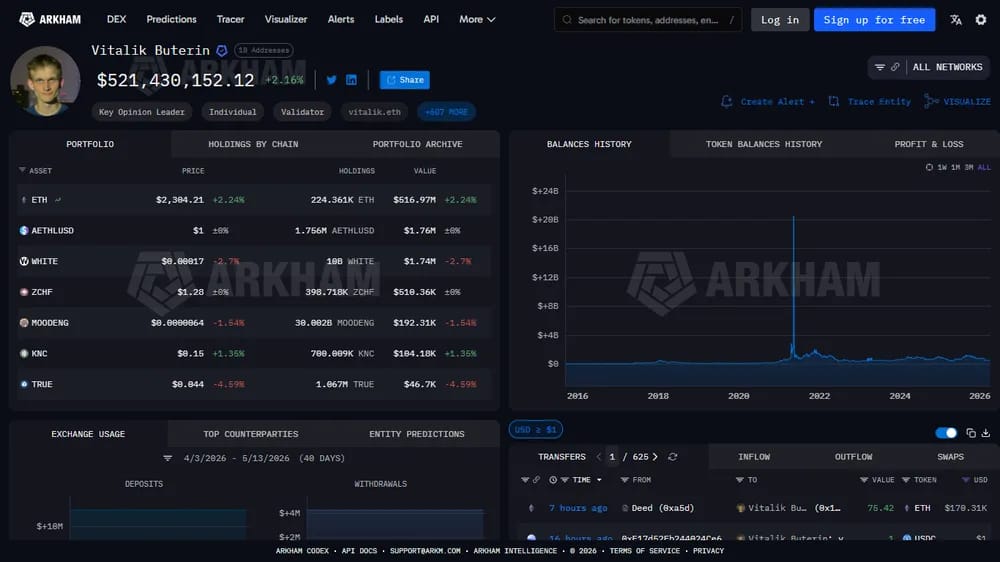
Vitalik Buterin’s net worth in 2026 is best estimated through his known onchain wallets rather than traditional billionaire lists. Arkham estimates his known crypto holdings at roughly $521 million, mostly from about 224,000 ETH, while noting undisclosed wallets or private investments could change the total.
Using the current ETH price of about $2,305, Buterin’s 224,000 ETH alone would be worth roughly $516 million. That aligns with Arkham’s broader estimate and shows why his net worth fluctuates heavily with ETH, which CoinMarketCap tracks as Ethereum’s native asset.
What Vitalik’s Net Worth Would Be If He Never Sold His ETH
According to Arkham’s historical balance table, Buterin’s known ETH holdings peaked around 662,810 ETH on December 31, 2015. At today’s ETH price of roughly $2,305, that amount would be worth about $1.53 billion; at ETH’s all-time high of $4,953.73 on August 24, 2025, it would have been worth around $3.28 billion.
That hypothetical is useful, but incomplete: Buterin’s ETH balance declined through donations, transfers, ecosystem support, and portfolio changes, not simply personal selling. Arkham also notes that his known crypto net worth briefly spiked far higher in May 2021 after he received large SHIB allocations, most of which he donated rather than kept.
Vitalik Buterin’s Onchain DeFi Positions
According to Arkham’s Vitalik Buterin entity page, his onchain portfolio is overwhelmingly ETH-based, with smaller DeFi, stablecoin, governance-token, and memecoin positions.
Token Holdings
His ten largest visible token holdings include:
- ETH: Buterin’s largest visible holding is 224.361K ETH, priced at $2,304.21, for an estimated $516.97 million in onchain value.
- AETHLUSD: His second-largest listed position is 1.756 million AETHLUSD, a Aave v3 LUSD position priced near $1 and valued around $1.76 million.
- WHITE: Buterin also holds 10 billion WHITE tokens from WhiteRock, priced at $0.00017 and worth approximately $1.74 million onchain.
- ZCHF: His Frankencoin exposure includes 398.718K ZCHF, priced at $1.28, giving the Swiss franc-linked position an estimated value of $510.36K.
- MOODENG: The wallet shows 30.002 billion MOODENG tokens, priced at $0.0000064, making this memecoin-style holding worth about $192.31K.
- KNC: Buterin holds 700.009K KNC from Kyber Network, priced at $0.15, with an estimated listed value of $104.18K.
- TRUE: His TRUE balance stands at 1.067 million tokens, priced at $0.044, giving the position a smaller but still visible value of $46.7K.
- REPV2: The wallet includes 45.105K REPV2 from Augur, priced at $1.01, with an estimated onchain value of $45.74K.
- ENS: Buterin holds 1.493K ENS from Ethereum Name Service, priced at $7.13, making the governance-token position worth about $10.65K.
- 0XBTC: His top-ten list ends with 210.157K 0XBTC, priced at $0.034, for an estimated position value of roughly $7.08K.
Borrowing and Lending Positions
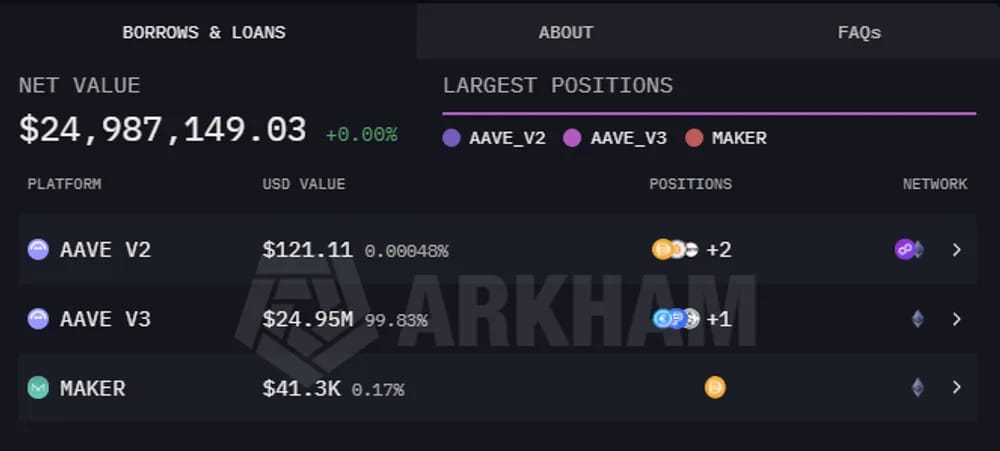
Arkham’s borrow-and-lend view shows about $24.99 million in visible DeFi net value across Aave and Maker. The largest position is Aave V3, followed by a small Maker position and a minimal Aave V2 balance; Aave is a decentralized lending protocol for borrowing and supplying crypto assets.
Key visible DeFi lending positions include:
- Aave V3: The largest visible lending position, worth about $24.95 million, making up almost all of the tracked borrow-and-loan value in the screenshot.
- Maker: Buterin’s Maker-linked position is much smaller, at about $41.3K, representing only a tiny share of the overall visible DeFi lending exposure.
- Aave V2: The Aave V2 position is minimal, at roughly $121, suggesting most of the visible lending activity has shifted to newer Aave infrastructure.
Vitalik Buterin’s Investments
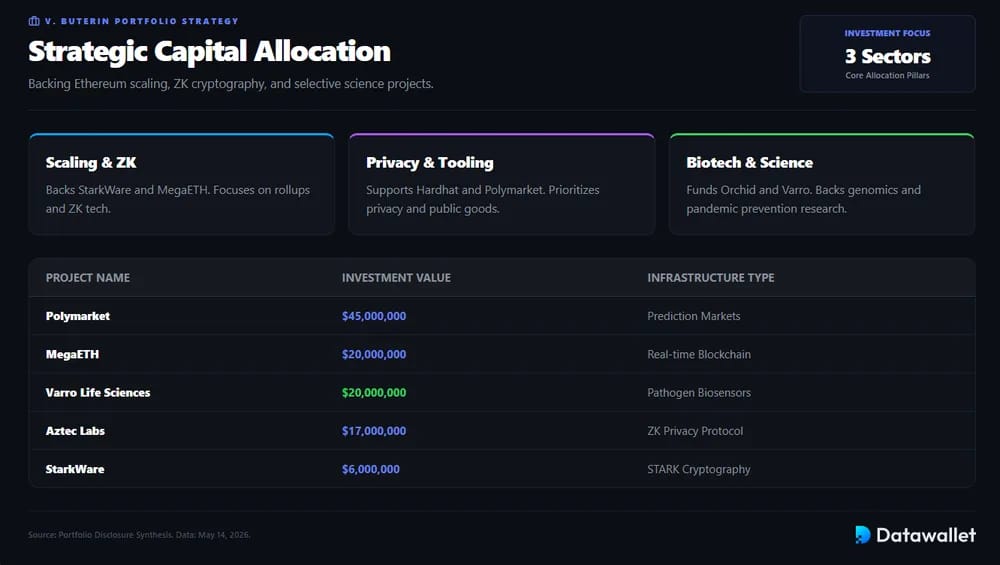
Vitalik Buterin’s investments go beyond simply holding ETH. His disclosed portfolio shows a pattern of backing Ethereum scaling, zero-knowledge cryptography, privacy infrastructure, developer tooling, prediction markets, and selective science or biotech projects.
1. Ethereum Scaling and Zero-Knowledge Infrastructure
Buterin’s most visible private investments are concentrated in Ethereum-aligned infrastructure, especially projects using zero-knowledge proofs, rollups, and faster execution layers.
Notable scaling and ZK-related investments include:
- StarkWare ($6M, May 2018): Seed investment in StarkWare, the STARK-based cryptography company behind StarkEx and Starknet, alongside Pantera, Polychain, Naval Ravikant, and Zcash Co.
- Aztec Labs ($17M, Dec 2021): Series A investment in Aztec, a zero-knowledge privacy protocol for Ethereum, in a round led by Paradigm with Ethereal Ventures participating.
- Kakarot Labs (Undisclosed, Jun 2023): Pre-seed backing for Kakarot zkEVM, a Cairo-based EVM implementation designed to bring Solidity compatibility to the Starknet ecosystem.
- MegaETH ($20M, Jun 2024): Angel investment in MegaETH, an Ethereum-compatible “real-time blockchain” project backed by Dragonfly, Joseph Lubin, Sreeram Kannan, and other crypto investors.
- RISE Chain ($3.2M, Sep 2024): Angel investment in RISE Chain, a “Gigagas” Ethereum Layer 2 focused on high-throughput execution and real-time blockchain performance.
2. Privacy, Tooling, and Ethereum Public Goods
Buterin has also backed projects that improve Ethereum’s developer experience, privacy guarantees, and broader public-goods infrastructure rather than purely speculative token ecosystems.
Key privacy and public-goods investments include:
- Nomic Foundation ($15M, Feb 2022): Contributor to Nomic Foundation, the organization behind Hardhat, as part of secured donations from Ethereum Foundation, Coinbase, Consensys, and others.
- Nocturne Labs ($6M, Oct 2023): Seed investment in Nocturne Labs, a protocol focused on private Ethereum accounts, co-led by Bain Capital Crypto and Polychain Capital.
- 0xbow / Privacy Pools (Undisclosed, 2025): Backed or publicly supported 0xbow’s Privacy Pools, an Ethereum privacy tool inspired by research co-authored by Buterin.
- Polymarket ($45M, May 2024): Participated in Polymarket’s Series B, a prediction-market raise led by Peter Thiel’s Founders Fund with 1confirmation and ParaFi.
3. Science, Biotech, and Non-Crypto Bets
Outside core crypto infrastructure, Buterin has selectively funded science, health, longevity, and biosecurity projects, often in areas where open research or public-good impact matters.
Notable non-crypto investments and grants include:
- Orchid (Undisclosed, 2023): Reported investor in Orchid, a reproductive-genomics company offering whole-genome embryo reports and advanced genetic screening tools.
- Varro Life Sciences ($20M, Oct 2024): Personal grant to Varro Life Sciences, reportedly supporting pathogen biosensor hardware, infectious-disease assays, and pandemic-prevention technology.
Interesting Facts About Vitalik Buterin
Beyond Ethereum, Vitalik Buterin is known for unusual stories, experiments, donations, and philosophical ideas that have made him one of crypto’s most distinctive public figures.
Buterin once blamed a World of Warcraft update for helping shape his views on centralized power. After Blizzard weakened his character’s Siphon Life spell, he later said the experience made him more aware of how platforms can change rules without user consent.
In May 2021, Buterin received huge unsolicited memecoin allocations, including SHIB, from token creators trying to associate their projects with him. He donated around 50 trillion SHIB to India’s Crypto Covid Relief fund, creating one of crypto’s strangest and largest public donations.
Buterin has also experimented with real-world coordination projects. In 2023, he helped convene Zuzalu, a two-month “pop-up city” in Montenegro where roughly 200 residents explored longevity, crypto governance, network states, public goods, and temporary community design.
Another unusual part of Buterin’s public persona is his philosophy writing. In 2023, he introduced “d/acc,” short for defensive, decentralization, or differential acceleration, arguing that powerful technologies should be developed in ways that strengthen defense, democracy, privacy, and human agency.
Final Thoughts
Vitalik Buterin’s net worth offers a clear example of how founder wealth works in crypto. Most of his visible fortune comes from ETH, while Arkham’s tracking adds transparency that traditional private-company wealth usually lacks.
His influence reaches well beyond wallet balances and conferences.
Buterin’s public record also points toward a broader mission: scaling Ethereum, improving privacy, supporting public goods, and funding experiments in science and coordination. His essays at vitalik.eth.limo help explain those priorities directly.
For readers, the key takeaway is simple: Buterin’s wealth rises and falls with Ethereum, but his importance comes from ideas, research, and ecosystem-building rather than personal accumulation alone.