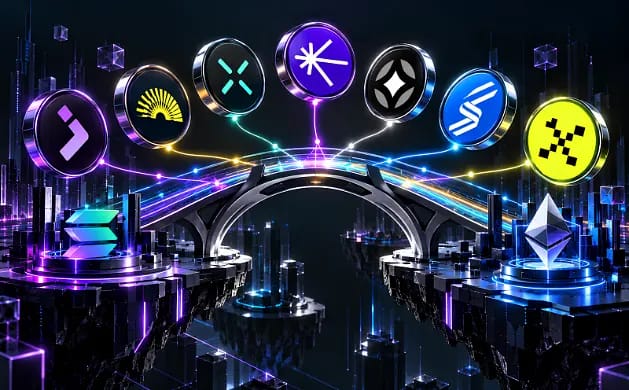




Compare the Top Crypto Bridges
1. Jumper Exchange
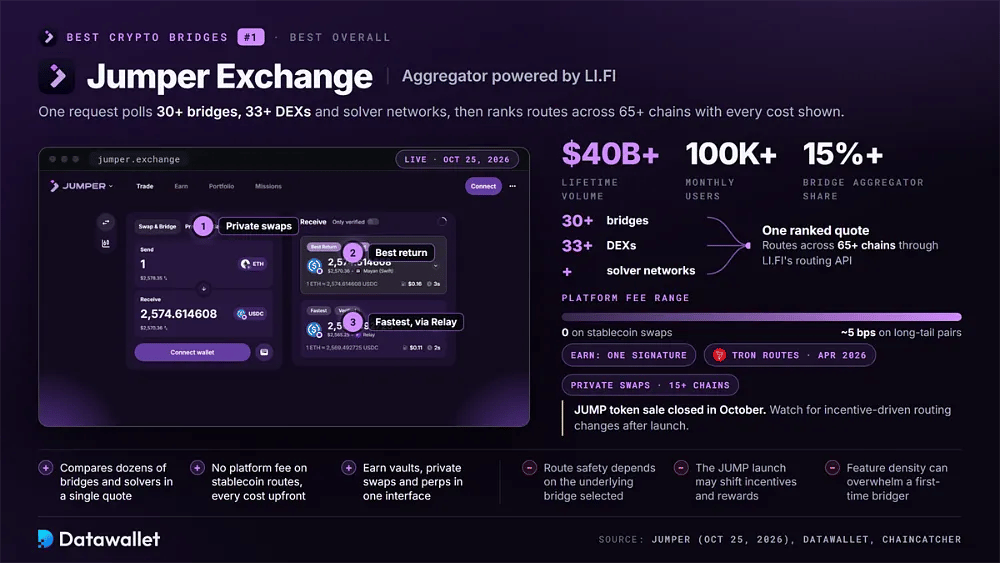
Jumper Exchange takes the top spot because it does the comparison shopping for you. One request polls 30+ bridges, 33+ DEXs and several solver networks through LI.FI's routing API, then returns ranked routes across 65+ chains with gas, fees and arrival time listed before you approve anything.
Scale backs the ranking. Jumper reported more than $40 billion in lifetime volume, over 100,000 monthly users and above 15% of bridge aggregator share when it spun out of LI.FI in September 2026. Platform fees run from zero on stablecoin swaps to roughly five basis points on long-tail pairs.
It has also grown well beyond bridging. Jumper Earn bundles a bridge, swap and vault deposit into one signature, Tron routes arrived in April 2026, and an optional private swap mode covers 15+ chains. The JUMP token sale closed in October, so watch for incentive-driven routing changes after launch.
Pros
- Compares dozens of bridges and solvers in a single quote.
- No platform fee on stablecoin routes, with every cost shown upfront.
- Earn vaults, private swaps and perps sit inside the same interface.
Cons
- Route safety still depends on the underlying bridge you select.
- The JUMP launch may shift incentives and reward mechanics.
- Feature density can overwhelm a first-time bridger.
2. deBridge
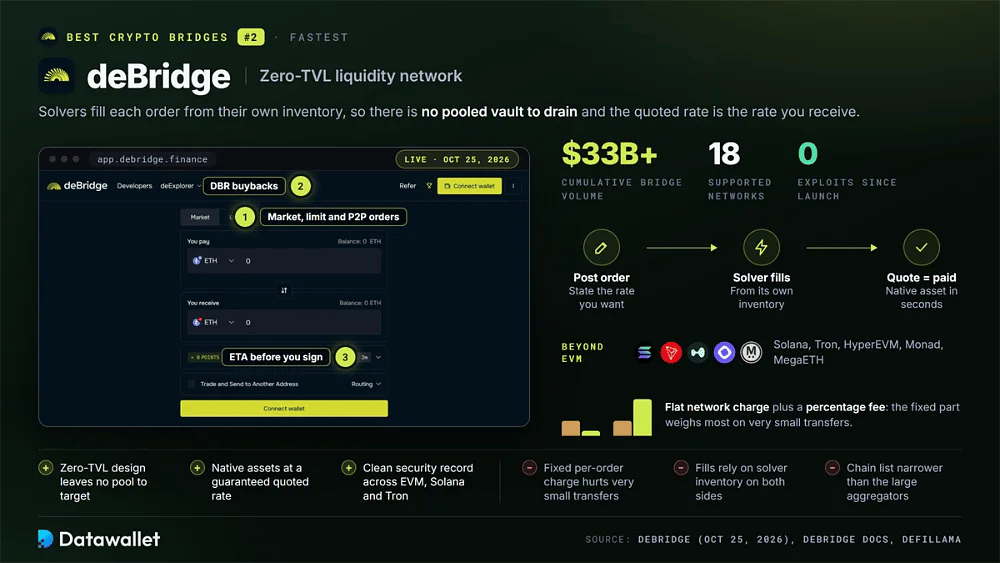
deBridge remains our benchmark for raw speed. Its Liquidity Network keeps no pooled capital, so an attacker has no vault to empty. You post an order, professional solvers fill it on the destination from their own inventory, and the quoted rate is the rate you receive, usually within seconds.
Coverage now reaches 18 networks in deBridge's chain documentation, including Solana, Tron, HyperEVM, Monad and MegaETH alongside the major EVM rollups. DefiLlama tracks more than $33 billion in cumulative bridge volume, and protocol revenue has funded DBR buybacks since June 2025.
The security record is the real draw. deBridge has avoided any exploit since launch, a rare claim in a year when eight major bridges were drained before summer. Expect a flat network charge on top of the percentage fee, which makes very small transfers less efficient than larger ones.
Pros
- Zero-TVL design leaves no pool for attackers to target.
- Delivers native assets at a guaranteed quoted rate.
- Clean security history across EVM chains, Solana and Tron.
Cons
- The fixed per-order charge hurts very small transfers.
- Fills rely on solvers holding inventory on both sides.
- Chain list is narrower than the large aggregators.
3. Across Protocol
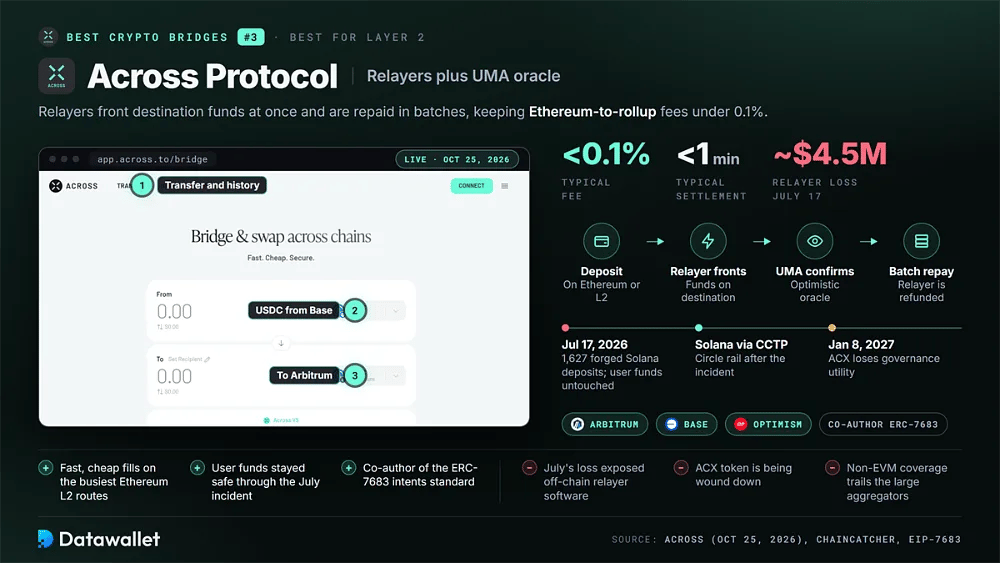
Across Protocol still dominates Ethereum-to-rollup traffic on Layer 2 networks like Arbitrum, Base and Optimism. Relayers front the destination funds immediately and are repaid in batches after UMA's optimistic oracle confirms the deposit, which keeps typical fees under a tenth of a percent and settlement under a minute.
2026 tested that model. On July 17 an attacker forged 1,627 Solana deposit events, and the Risk Labs relayer advanced about $4.5 million before Solana fills paused. Across's post-incident report says no user funds or contracts were touched, and Solana flow now routes through Circle's CCTP.
Governance is changing too. Risk Labs moved the protocol into Across, Inc., and ACX loses governance and economic utility after January 8, 2027. The bridge itself keeps running, and Across co-authored ERC-7683, the cross-chain order standard that other intent protocols now build against.
Pros
- Fast, cheap fills on the busiest Ethereum Layer 2 routes.
- User funds stayed safe through the July relayer incident.
- Co-author of the ERC-7683 cross-chain intents standard.
Cons
- July's loss showed off-chain relayer software is an attack surface.
- The ACX token is being wound down after the corporate shift.
- Non-EVM coverage still trails the large aggregators.
4. RocketX
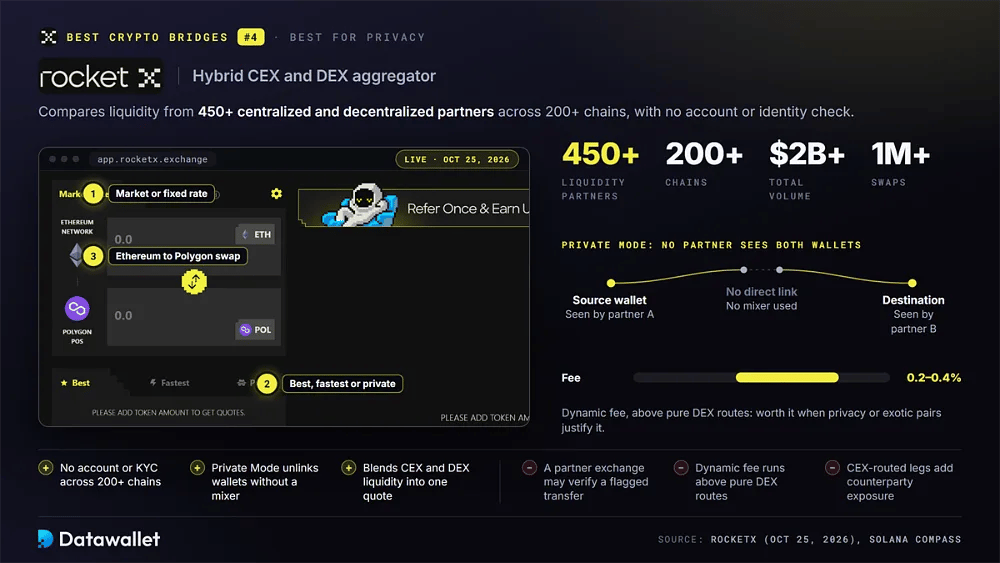
RocketX is our pick for privacy-minded users who still want aggregator pricing. Its hybrid engine compares liquidity from 450+ centralized and decentralized partners across 200+ chains, then ranks routes by price, gas and execution time, all without an account or identity check.
Privacy is the headline feature. Private Mode routes a swap so no single partner sees both your source and destination wallets, which breaks the direct onchain link without touching a sanctioned mixer. A separate Lightning Swaps path prioritizes speed over price when a trade is time-sensitive, useful during volatile market moves.
Custody never leaves your wallet, and RocketX reports more than $2 billion in total volume and over one million swaps, per its Solana ecosystem profile. The 0.2% to 0.4% dynamic fee is higher than pure DEX routes, so it makes most sense when privacy or exotic chain pairs justify the premium.
Pros
- No account or KYC needed to swap across 200+ chains.
- Private Mode unlinks source and destination wallets without a mixer.
- Blends CEX and DEX liquidity into one ranked quote.
Cons
- A partner exchange may request verification on a flagged transfer.
- The dynamic fee runs above pure DEX routes on small amounts.
- CEX-routed legs add counterparty exposure mid-transfer.
5. Relay
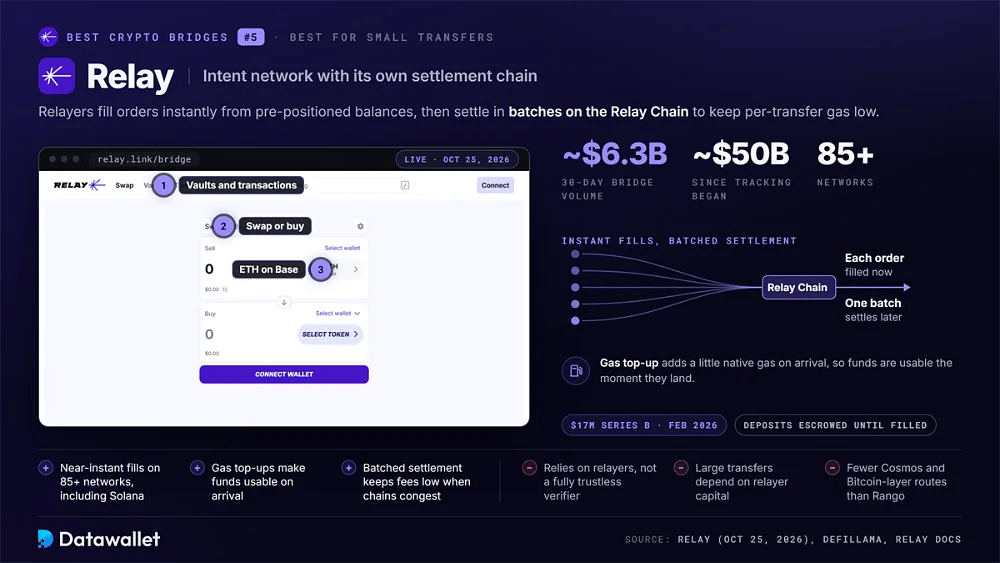
Relay has become one of the busiest intent networks in crypto. DefiLlama records roughly $6.3 billion in bridge volume over 30 days and nearly $50 billion since tracking began, driven by integrations inside major wallets and marketplaces as much as by its own interface.
The design suits small, frequent transfers. Relayers fill your order instantly from pre-positioned balances, then settle in batches on the Relay Chain, a dedicated settlement network unveiled alongside a $17 million Series B in February 2026. Batching keeps per-transfer gas low even when Ethereum or Base gets congested.
Relay also tackles the empty-wallet problem. Its app can top up a little native gas on the destination chain, so you can transact the moment funds land on any of its 85+ networks. The trade-off is reliance on relayers honoring each intent, though deposits stay escrowed until a fill completes.
Pros
- Near-instant fills on 85+ networks, including Solana.
- Gas top-ups make funds usable the moment they land.
- Batched settlement keeps fees low on congested chains.
Cons
- Relies on relayers rather than a fully trustless verifier.
- Large transfers depend on available relayer capital.
- Fewer Cosmos and Bitcoin-layer routes than Rango.
6. Stargate Finance
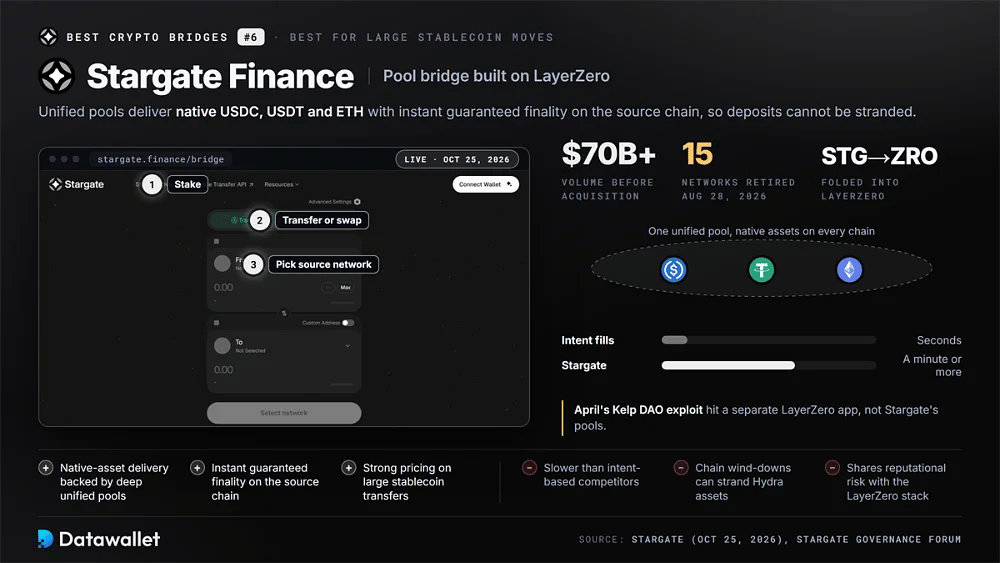
Stargate is the pool-based option for people who want native USDC, USDT or ETH with reliable depth. Built on LayerZero, it keeps unified liquidity across chains and guarantees instant finality on the source, so a confirmed deposit cannot be stranded by a destination pool running dry.
LayerZero Foundation acquired Stargate in 2025, folding STG into ZRO after the bridge had cleared more than $70 billion in volume. Its Hydra program extends liquidity to newer chains, though LayerZero ended support for 15 low-activity networks on August 28, 2026, so confirm your destination is still served.
April's Kelp DAO exploit hit a separately configured LayerZero app, not Stargate's pools, yet it pushed the whole ecosystem toward multi-verifier setups. Stargate stays slower than solver networks, usually a minute or more, but for large stablecoin moves its pool depth often beats intent fills on final price.
Pros
- Native-asset delivery backed by deep unified pools.
- Instant guaranteed finality on the source chain.
- Strong pricing on large stablecoin transfers.
Cons
- Settlement is slower than intent-based competitors.
- Chain wind-downs can strand Hydra assets on retired networks.
- Shares reputational risk with the wider LayerZero stack.
7. Rango Exchange
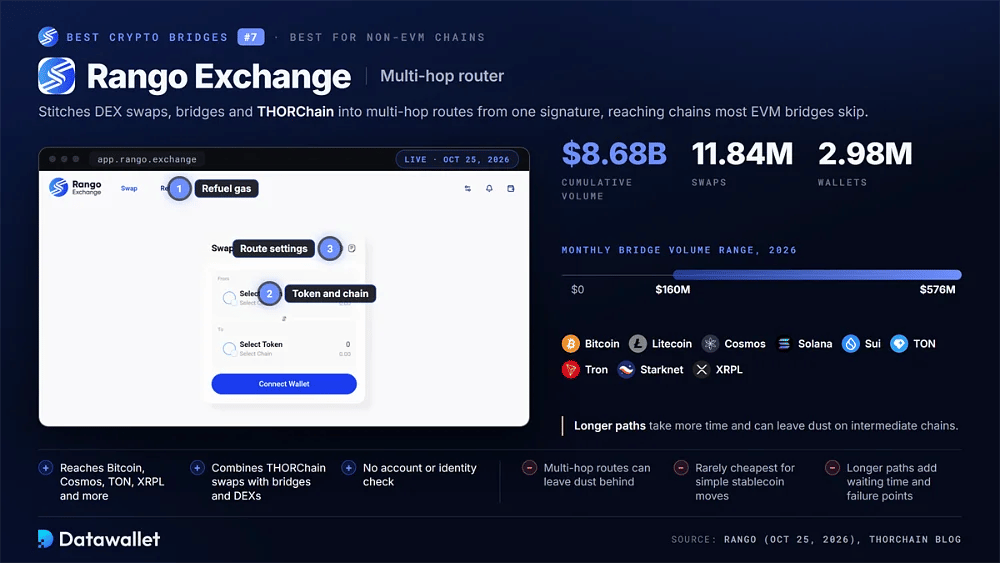
Rango Exchange is the router to open when one end of your transfer sits outside the EVM. Its engine supports Bitcoin and Litecoin, Cosmos zones, Solana, Sui, TON, Tron, Starknet and XRPL, stitching DEX swaps, bridges and THORChain into multi-hop routes from a single signature.
Usage keeps climbing. Rango's explorer showed $8.68 billion in cumulative volume across 11.84 million swaps and 2.98 million wallets, according to a THORChain protocol spotlight, with monthly bridge volume ranging from $160 million to $576 million through 2026. Tron's share of routed flow jumped sharply in Q2.
Rango stays KYC-free and powers cross-chain swaps inside several popular wallets, so many people use it without realizing. The cost of that reach is complexity: longer paths take more time, can strand small remnants on intermediate chains, and are rarely the cheapest option for a plain stablecoin hop.
Pros
- Reaches Bitcoin, Cosmos, TON, XRPL and other non-EVM chains.
- Combines THORChain native swaps with bridges and DEXs.
- No account or identity check required.
Cons
- Multi-hop routes can leave dust on intermediate chains.
- Rarely the cheapest for simple stablecoin moves.
- Longer paths add waiting time and failure points.
How Crypto Bridges Actually Work
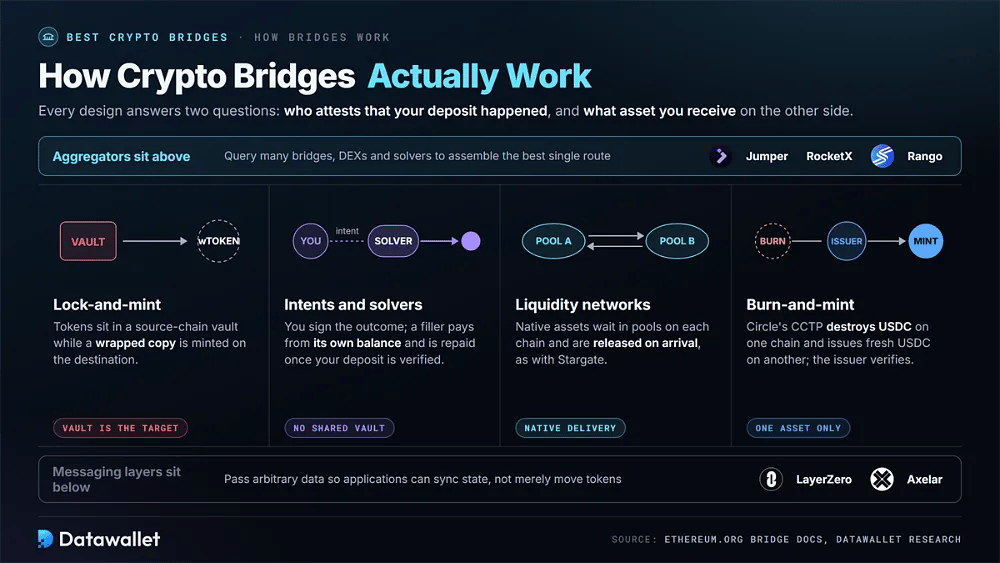
Blockchains are sealed ledgers. Ethereum cannot read Solana's state, and Solana cannot confirm what happened on Tron, so bridges exist to carry that proof between them. Every design answers the same two questions: who attests that your deposit happened, and what asset you receive on the other side.
Lock-and-mint is the oldest answer. Your token sits in a vault on the source chain while a wrapped copy is minted on the destination. It works, but the copy is only as good as the vault and its verifiers, which is why compromised vaults produced most of the largest losses in crypto history.
Intent and solver networks flip the model. You sign the outcome you want, and a professional filler delivers the destination asset from its own balance, collecting repayment once your deposit is verified. Because user funds never pool in a shared vault, the attack surface shifts to solver capital and off-chain software.
Liquidity networks such as Stargate hold native assets in pools on each chain and release them on arrival. Burn-and-mint rails like Circle's CCTP go further for a single asset, destroying USDC on one chain and issuing fresh USDC on another, with the issuer itself acting as the verifier.
Aggregators like Jumper, RocketX and Rango sit above all of these, querying many bridges, DEXs and solvers to assemble the best single route. Messaging layers such as LayerZero and Axelar sit below, passing arbitrary data so applications can sync state, not merely move tokens.
Why Intents Replaced Lock-and-Mint Bridges
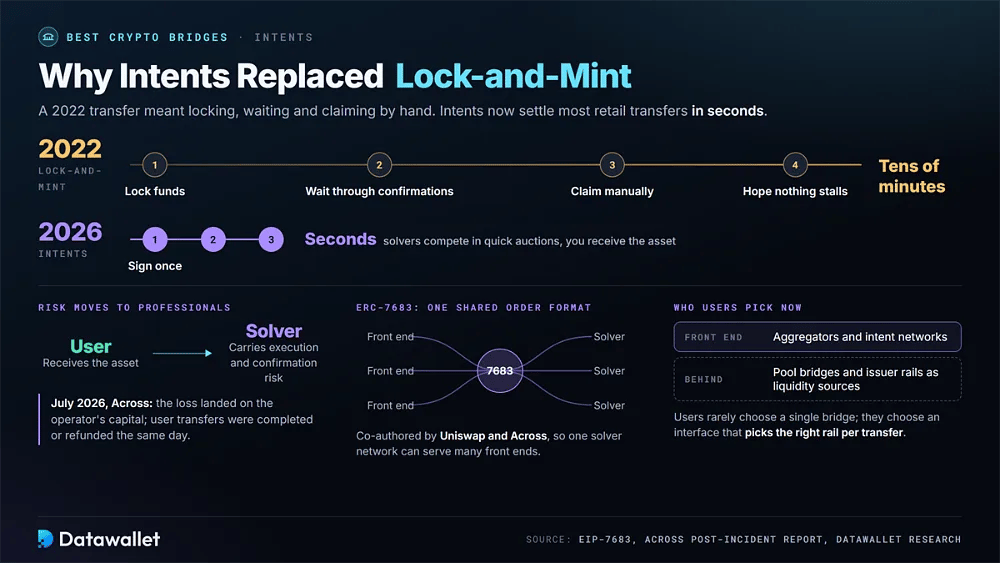
A 2022 bridge transfer meant locking funds, waiting through confirmations, claiming manually on the far side and hoping nothing stalled. Intents rebuilt that experience around a single signature, and by 2026 they settle most retail cross-chain transfers in seconds rather than tens of minutes.
The shift also moves risk to professionals. Solvers compete in quick auctions to fill your order, carrying execution and confirmation risk while you simply receive the asset. When Across's relayer software was tricked in July 2026, the loss landed on the operator's own capital, and user transfers were completed or refunded the same day.
Standards made the model scalable. ERC-7683, co-authored by Uniswap and Across, defines a shared cross-chain order format, so one solver network can serve many front ends. That shared plumbing deepens liquidity for every protocol that adopts it and lowers the cost of launching new routes.
The competitive question has changed as a result. Users rarely choose a single bridge anymore; they choose an interface that picks the right rail per transfer. Aggregators and intent networks now handle the front end, while pool bridges and issuer rails increasingly serve as liquidity sources behind them.
Native Stablecoin Rails Are Reshaping the Market
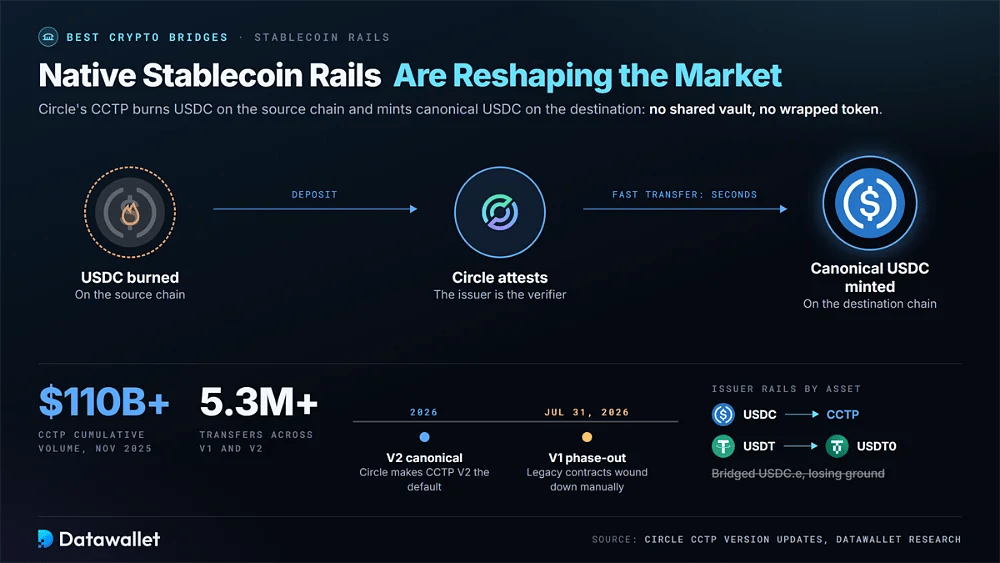
Stablecoins dominate cross-chain volume, and issuers now run their own rails. Circle's Cross-Chain Transfer Protocol burns USDC on the source chain and mints canonical USDC on the destination, removing both the shared vault and the wrapped token that caused most historic bridge losses.
Circle made CCTP V2 the canonical version in 2026, and the legacy V1 contracts began a manual phase-out on July 31, 2026. Across both versions, CCTP had processed over $110 billion in cumulative volume and more than 5.3 million transfers by November 2025, with Fast Transfer cutting settlement to seconds.
The ripple shows up everywhere. Across rerouted its Solana flow through CCTP after its July incident, aggregators default to CCTP whenever both chains support it, and Tether's own USDT0 standard plays a similar role for USDT. Bridged versions like USDC.e are steadily losing ground to native supply.
Issuer rails do not replace general bridges. CCTP only moves USDC, so ETH, long-tail tokens and many non-EVM destinations still need the platforms above. The practical rule: for native USDC between two supported chains, the issuer rail is usually cheapest, and a good aggregator will surface it automatically.
Ethereum's Plan to Make Bridging Invisible
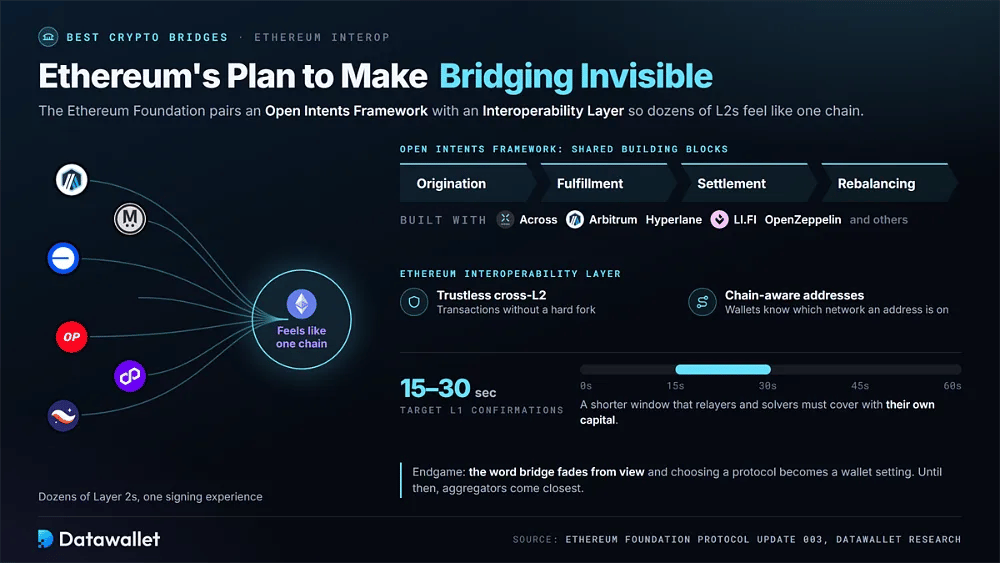
Ethereum's core developers now treat cross-rollup movement as a protocol problem. The Ethereum Foundation's interoperability roadmap pairs an Open Intents Framework with an Ethereum Interoperability Layer, aiming to make dozens of Layer 2 networks feel like one chain to the person signing.
The Open Intents Framework supplies shared building blocks for origination, fulfillment, settlement and rebalancing, built with contributors from Across, Arbitrum, Hyperlane, LI.FI, OpenZeppelin and others. Bridges that plug into it inherit common solver infrastructure instead of maintaining isolated systems, which should tighten spreads across every EVM-compatible chain.
The Interoperability Layer targets trustless cross-L2 transactions without a hard fork, paired with chain-aware address standards so wallets know which network an address belongs to. Faster Layer 1 confirmations, targeted at 15 to 30 seconds, also shrink the window that relayers and solvers must cover with their own capital.
For users, the endgame is that the word bridge fades from view. Wallets will route behind the scenes, and choosing a protocol becomes a wallet setting. Until those standards ship widely, aggregators remain the closest thing to that experience, which is why they lead this ranking.
Bridges Are Turning Into Onchain Super-Apps
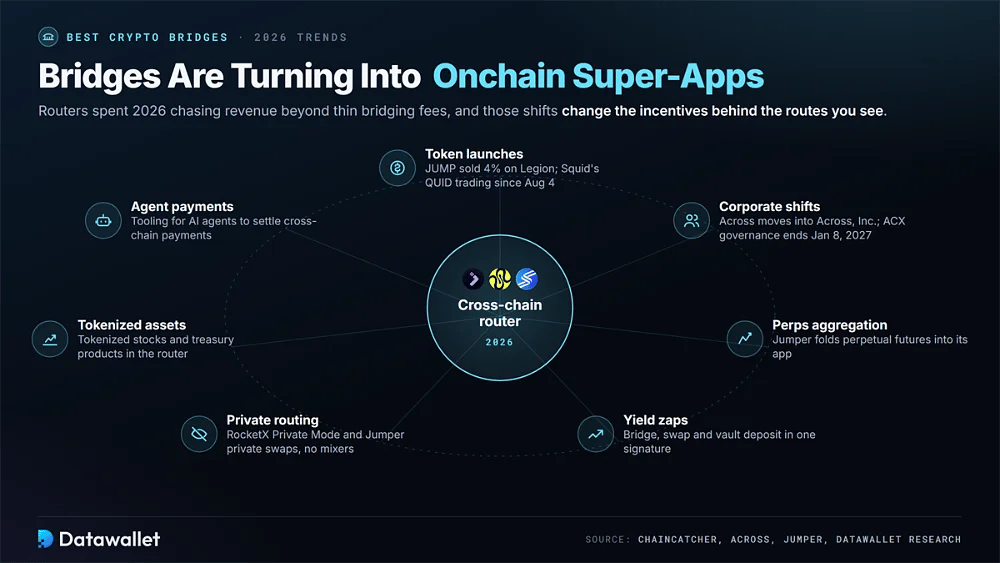
Cross-chain routers spent 2026 moving well beyond simple transfers. Token launches, corporate restructurings and new trading products show a sector chasing revenue beyond thin bridging fees, and those shifts affect the incentives behind the routes you see.
The main developments reshaping cross-chain platforms this year include:
- Token launches: Jumper sold 4% of its JUMP supply on Legion in October, while Squid's QUID began trading on August 4, tying router growth to token incentives and loyalty rewards.
- Corporate shifts: Across moved its protocol into Across, Inc. and set ACX to lose governance utility after January 8, 2027, choosing equity-style ownership over a token-run DAO model.
- Perps aggregation: Jumper is folding perpetual futures venues into its app, mirroring how decentralized perpetuals exchanges now compete for the same cross-chain users and deposits.
- Yield zaps: One-click flows now bridge, swap and deposit into vaults in a single signature, letting users chase yield on new chains without manual steps or idle balances.
- Private routing: RocketX Private Mode and Jumper's private swaps break the onchain link between wallets, answering demand for confidentiality without relying on sanctioned mixing services.
- Tokenized assets: Routers now surface tokenized stocks and treasury products, so a single bridge interface can move users from stablecoins into real-world assets across several networks.
- Agent payments: Squid and others ship tooling for AI agents and apps to settle cross-chain payments automatically, preparing for machine-driven volume that never touches a manual interface.
How to Choose a Crypto Bridge
Choosing a bridge comes down to matching the tool to the transfer, then confirming it can deliver safely before you commit real capital. Work through the four checks below in order, since each one narrows the options for the next.
Step 1: Confirm the Route Exists
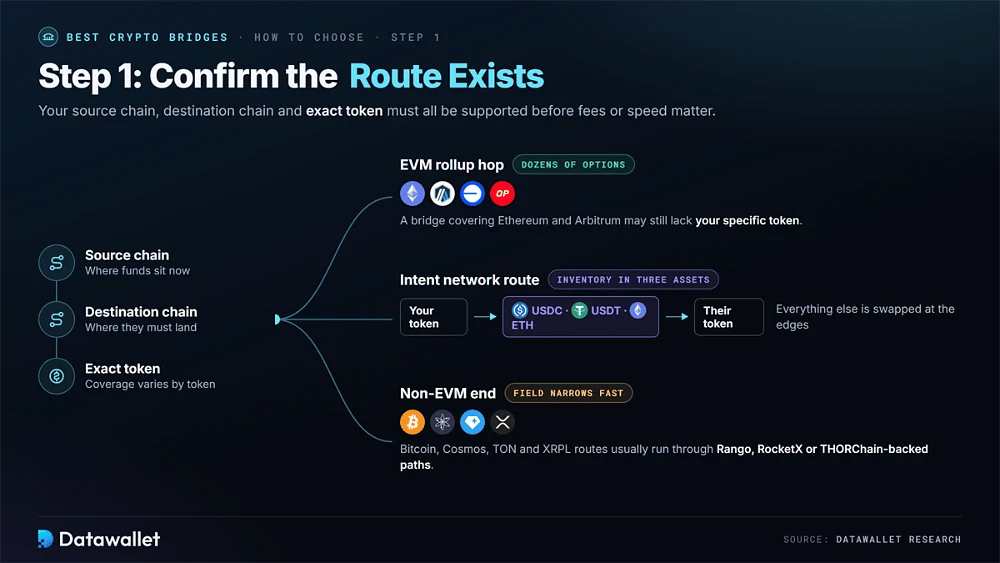
Start with the basics: your source chain, destination chain and exact token must all be supported. A bridge that covers Ethereum and Arbitrum may still lack your specific token, and many intent networks only hold inventory in USDC, USDT and ETH, swapping everything else at the edges.
Non-EVM transfers narrow the field quickly. Bitcoin, Cosmos, TON and XRPL routes usually run through Rango, RocketX or THORChain-backed paths, while EVM rollup hops have dozens of options. If you are unsure, enter the pair into an aggregator first and see which protocols actually return a quote.
Step 2: Vet the Security Model
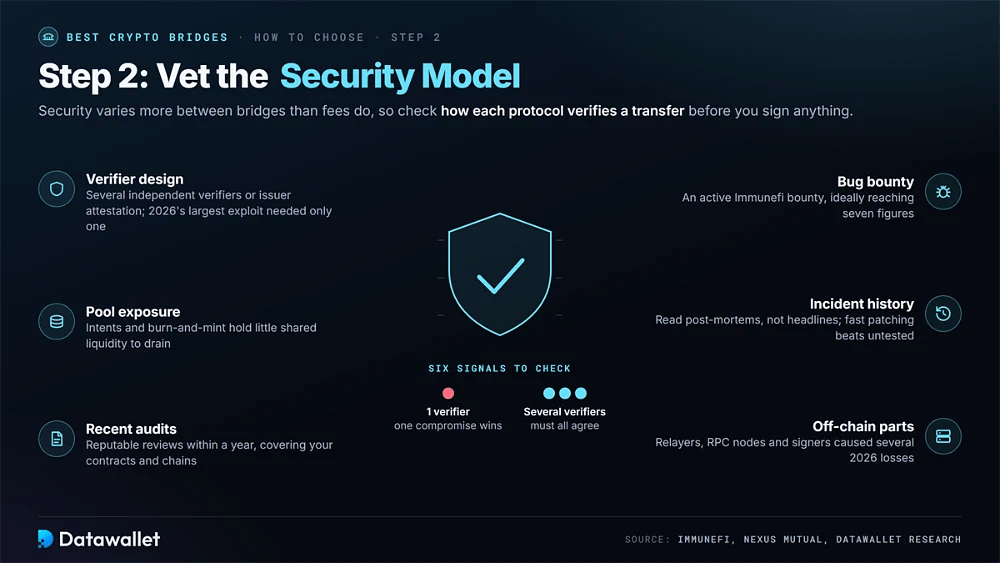
Security varies more between bridges than fees do, so look past the brand and check how each protocol verifies a transfer before you sign anything.
These are the security signals worth checking before any sizeable transfer:
- Verifier design: Prefer protocols using several independent verifiers or issuer attestation, since 2026's largest exploit succeeded because one compromised verifier could approve a forged message alone.
- Pool exposure: Intent networks and burn-and-mint rails hold little or no shared liquidity, which leaves attackers far less to drain than a large lock-and-mint vault.
- Recent audits: Look for reviews from reputable smart contract auditors within the last year, and confirm they covered the contracts and chains you will actually use.
- Bug bounty: An active bounty on Immunefi signals the team pays researchers to find flaws first, ideally with rewards reaching into the seven figures.
- Incident history: Read post-mortems, not headlines. A protocol that protected user funds and patched quickly may be safer than one that has simply never been tested.
- Off-chain components: Relayer software, RPC nodes and signer infrastructure caused several 2026 losses, so check whether the team discloses how those systems are hardened and monitored.
Step 3: Compare the True Cost
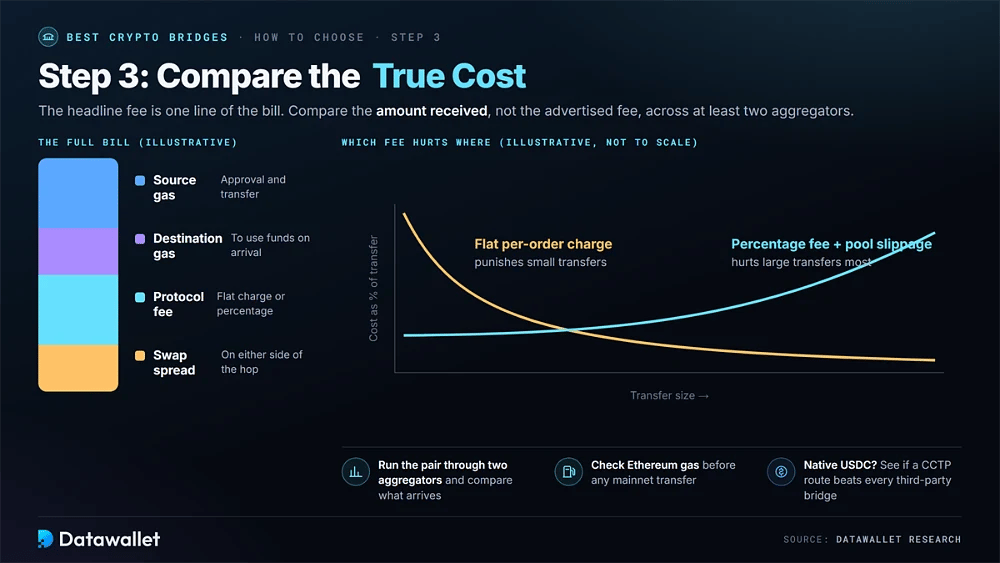
The headline fee is only one line of the bill. A full transfer cost combines source gas, destination gas, the protocol fee and any swap spread on either side. Flat per-order charges punish small transfers, while percentage fees and pool slippage hurt large ones the most.
Run the same pair through two aggregators and compare the received amount, not the advertised fee. Check the Ethereum gas price before mainnet transfers, and for native USDC, see whether a CCTP route beats every third-party bridge on the final number.
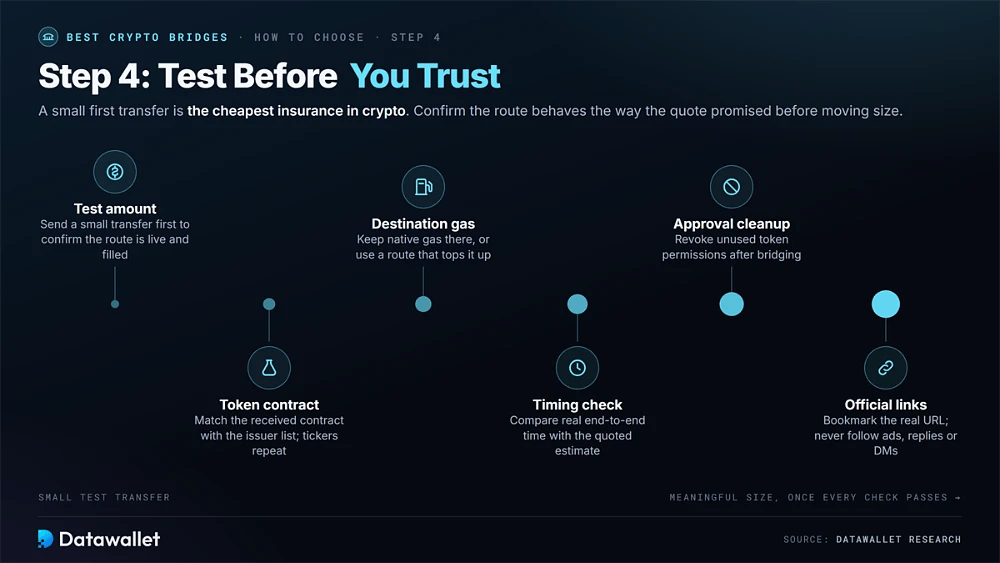
Step 4: Test Before You Trust
A small first transfer is the cheapest insurance in crypto. Before moving meaningful size, confirm the route behaves the way the quote promised.
Run through these checks on every new route or protocol:
- Test amount: Send a small transfer first to confirm the route is live, the solver fills it and the funds arrive where you expect them.
- Token contract: Compare the received token's contract address with the issuer's official listing, because wrapped and bridged versions often share the same ticker symbol.
- Destination gas: Keep a little native gas on the destination chain, or use a route that tops it up, so you can move funds once they land.
- Timing check: Note how long the test took end to end, and compare it with the quoted estimate before trusting the route with larger or time-sensitive amounts.
- Approval cleanup: Revoke token permissions you no longer need after bridging, so an old unlimited approval cannot be abused if a contract is later compromised.
- Official links: Bookmark the protocol's real URL and reach it from official documentation, never from search ads, social replies or direct messages promising support.
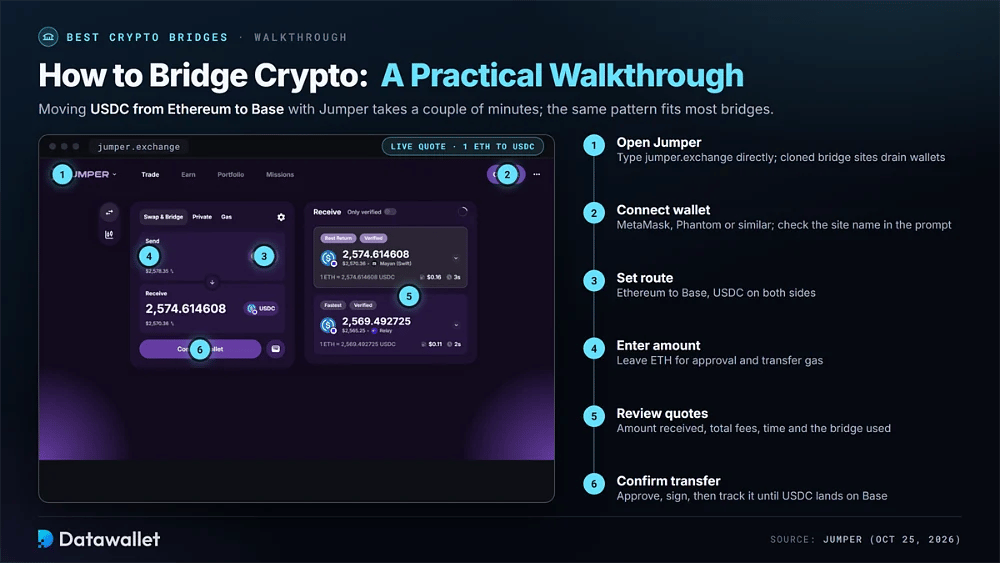
How to Bridge Crypto: A Practical Walkthrough
The steps below use Jumper to move USDC from Ethereum to Base, but the same pattern applies to almost any bridge or aggregator and usually takes only a couple of minutes once your wallet is connected.
Follow these steps to complete a typical cross-chain transfer:
- Open Jumper: Go to jumper.exchange directly and double-check the address, since cloned bridge interfaces are a common way attackers drain wallets during busy markets.
- Connect wallet: Link MetaMask, Phantom or another supported wallet, then approve the connection request in your extension after checking the site name shown in the prompt.
- Set route: Choose Ethereum as the source and Base as the destination, then select USDC on both sides so the router can compare native and bridged options.
- Enter amount: Type the amount you want to move, leaving enough ETH on Ethereum to cover the approval and transfer gas for the source-chain transaction.
- Review quotes: Compare the ranked routes by amount received, total fees and estimated time, and note which underlying bridge or solver each route will actually use.
- Confirm transfer: Approve the token spend and sign the transaction, then track progress in Jumper's explorer until the USDC appears in your wallet on Base.
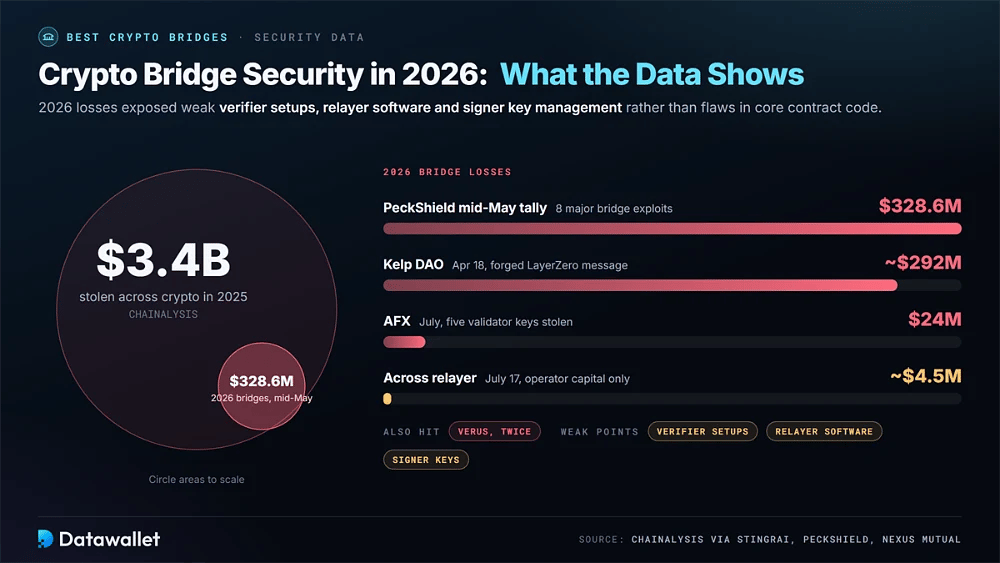
Crypto Bridge Security in 2026: What the Data Shows
Bridges remain the most targeted infrastructure in crypto. Chainalysis counted $3.4 billion stolen in 2025, and 2026 brought fresh bridge losses that exposed weaknesses in verifier setups, relayer software and signer key management rather than in core contract code.
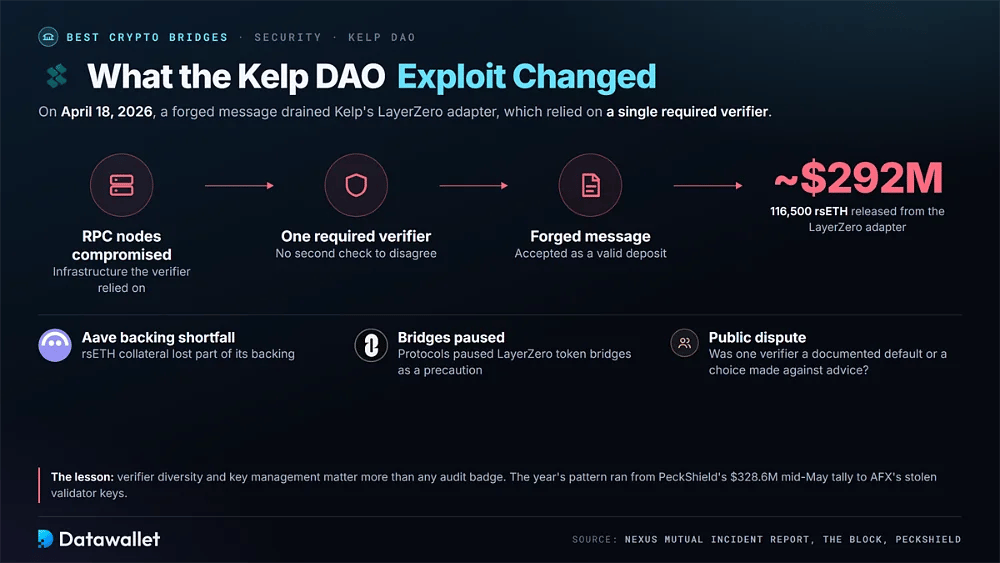
What the Kelp DAO Exploit Changed
On April 18, 2026, an attacker forged a cross-chain message and released 116,500 rsETH, about $292 million, from Kelp DAO's LayerZero adapter. The bridge relied on a single required verifier, and attackers had compromised RPC nodes that verifier depended on, according to Nexus Mutual's incident report.
The fallout spread well beyond Kelp. Aave faced a backing shortfall on rsETH collateral, protocols paused LayerZero token bridges as a precaution, and Kelp and LayerZero publicly disputed whether the one-verifier setup was a documented default or a choice made against advice.
The pattern continued all year. PeckShield's mid-May tally reached $328.6 million across eight major bridge exploits, AFX lost $24 million in July after five validator keys were stolen, and Verus was hit twice. The lesson is clear: verifier diversity and key management matter more than any audit badge.
Practical Steps to Bridge Safely
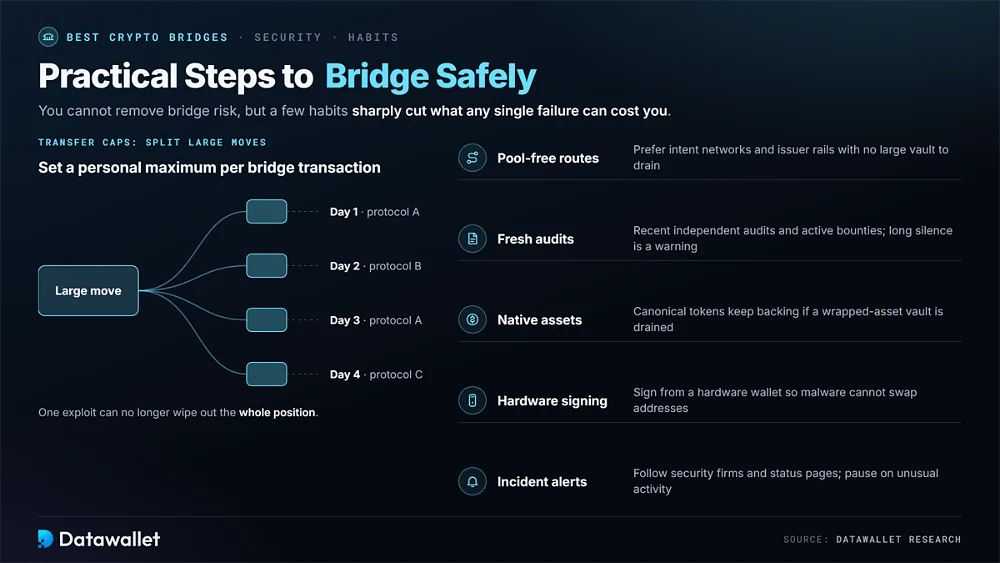
You cannot remove bridge risk entirely, but a few habits sharply reduce how much any single failure can cost you.
Apply these protective habits every time you move funds across chains:
- Pool-free routes: Favor intent networks and issuer rails where possible, since they give attackers no large shared vault to drain if verification fails.
- Transfer caps: Set a personal maximum per bridge transaction, splitting large moves across time or protocols so one exploit cannot wipe out your whole position.
- Fresh audits: Use protocols with recent independent audits and active bounties, and treat a long silence on security updates as a warning sign.
- Native assets: Prefer routes that deliver canonical tokens, because wrapped assets lose their backing if the vault behind them is drained during an exploit.
- Hardware signing: Approve bridge transactions from a hardware wallet where supported, reducing the risk that malware on your computer swaps addresses or approvals.
- Incident alerts: Follow security firms and protocol status pages, and pause transfers when a bridge you use reports unusual activity or a paused route.
Where Bridge Regulation Stands in 2026
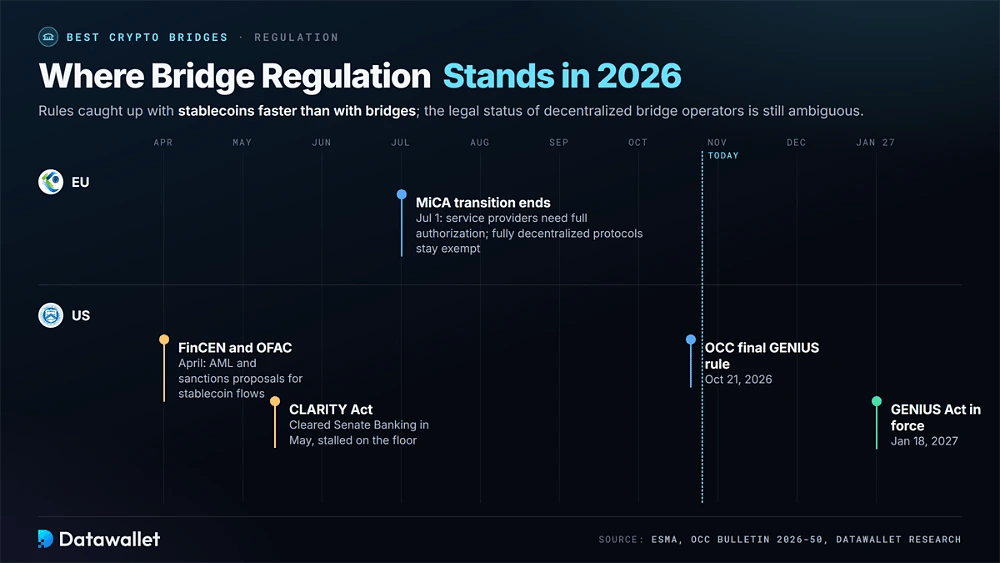
Regulation has caught up with stablecoins faster than with bridges. In the EU, MiCA's transitional period ended on July 1, 2026, so service providers now need full authorization. Fully decentralized protocols remain exempt, but bridges with identifiable operators or front ends face growing pressure to register through MiCA-licensed venues.
In the United States, the OCC issued its final GENIUS Act rule on October 21, 2026, and the GENIUS Act takes effect on January 18, 2027. Separate anti-money laundering and sanctions rules from FinCEN and OFAC, proposed in April, will shape how stablecoin flows across bridges are monitored.
Market structure remains unsettled. The CLARITY Act cleared the Senate Banking Committee in May 2026 but has stalled on the floor over ethics provisions, and forecasters have repeatedly cut their odds of passage this year. Until it moves, the legal status of decentralized bridge operators stays ambiguous.
Final Thoughts
Bridging in 2026 is faster and cheaper than ever, yet the year's exploits proved that verification design still decides who loses money when something breaks. The market has reorganized around aggregators, intent networks and issuer rails, so the best choice depends on the specific transfer rather than brand loyalty.
For everyday transfers across major chains, Jumper's breadth and transparent quotes make it our first stop, with deBridge and Across close behind when raw speed or cheap rollup hops matter most. RocketX suits privacy-minded users, while Rango covers the Bitcoin, Cosmos and other non-EVM routes others miss.
Whichever platform you pick, the safest routine stays the same: confirm the route, check the verifier setup and audits, cap your transfer size and send a test amount first. Strong protocols reduce risk, but careful habits are what keep a single exploit from becoming your loss.