Best Low-Fee Crypto Exchanges for 2026
Trading fees compound. A 0.05% taker fee on a 100x perpetual position is a 5% hit on collateral per round trip, before funding or slippage.
Most platforms hide their best rates behind VIP tiers, token holdings, or single-product promotions. To rank the genuinely cheapest venues, we tested funding paths, opened real positions, and audited every published fee schedule.
Lowest fees only count once you can fund the account and trust it with size. Several platforms with sub-zero maker rates have no fiat rails, no regulatory backing, or geographic restrictions that rule them out for most readers. The list below mixes raw-cost winners with the cheapest accessible options across major regions.
Our Picks: Lowest Fee Crypto Exchanges
- MEXC - Cheapest Centralized Exchange for Spot and Futures
- Hyperliquid - Best Onchain Perp DEX with Maker Rebates
- Lighter - True 0% Fee Perpetual DEX
- Binance - Cheapest Exchange for USDC Pairs and Deep Liquidity
- Bybit - Top USDC Discount Tiers Across Spot and Perps
- Bitget - Aggressive VIP Perp Fee Scaling with Copy Trading
- Kraken - Cheapest Regulated Exchange for US, UK, and Australia

Best Low-Fee Crypto Exchange - MEXC
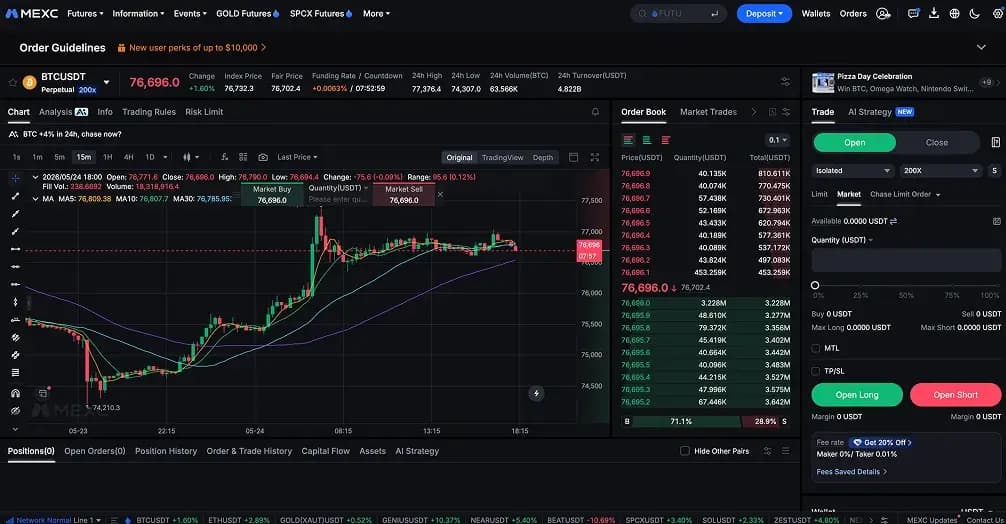
MEXC is the cheapest CEX to run an account on: 0% maker on spot and perpetuals for every user, plus rotating zero-fee promotions that frequently cover BTC, ETH, and the largest altcoin pairs.
Trading Fees
0% Maker, 0.05% Taker (Spot); 0% Maker, 0.02% Taker (Perps)
Max Leverage
Up to 500x on select perpetual pairs
Available Assets
2,600+ spot pairs, 1,400+ futures contracts
Compare Top Low-Fee Crypto Exchanges
1. MEXC - Cheapest Centralized Exchange for Spot and Futures
MEXC charges 0% maker on both spot and perpetuals for every account, with taker fees of 0.05% on spot and 0.02% on perps. The official MEXC fee schedule confirms these rates apply to all standard users with no VIP threshold or token holding requirement.
The extras add up. MEXC keeps a rotating list of zero-fee USDT spot pairs covering BTC, ETH, and mid-caps like WIF and POPCAT, and holding 500 MX applies an additional 50% discount on both books. When I funded a fresh MEXC account through USDT on TRC-20 last quarter, the deposit credited in under two minutes and my first taker fill on ETH/USDT cost about two cents on a $100 buy.
The trade-off is licensing. MEXC operates from the Seychelles with no major Western authorization, so US residents are blocked and fiat onramps elsewhere depend on third-party processors or P2P merchants. Most accounts are crypto-only for withdrawal, which makes MEXC a natural secondary venue funded from a regulated CEX or self-custody wallet.
Pros
- 0% maker on spot and perps without VIP requirements or token gating.
- Persistent zero-fee pair list covers BTC, ETH, and high-volume altcoins.
- 500 MX holding cuts both spot and futures fees by an additional 50%.
Cons
- No service for US residents and partial restrictions in several other markets.
- Fiat onramps depend on third-party processors and regional P2P merchants.
- Light KYC tightens for higher tiers and during fiat-side transactions.
2. Hyperliquid - Best Onchain Perp DEX with Maker Rebates
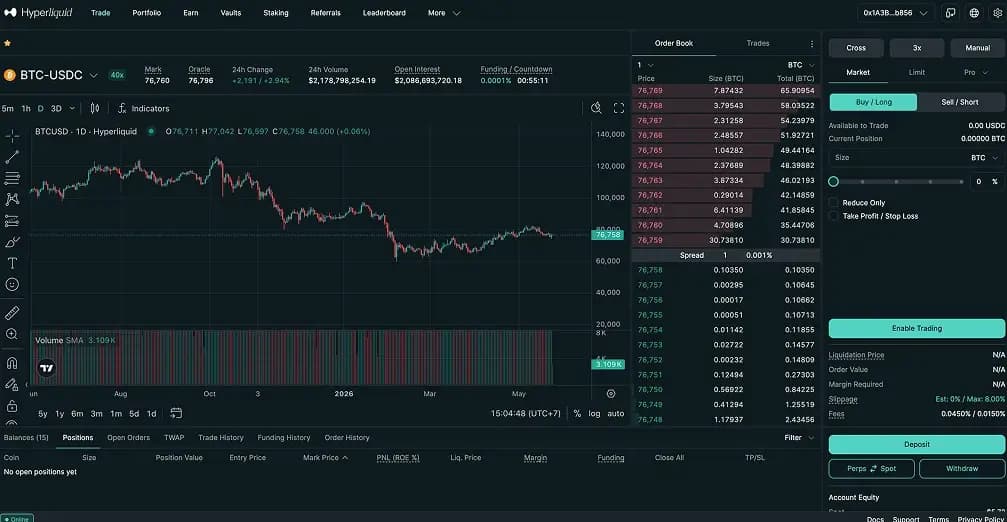
Hyperliquid charges 0.015% maker and 0.045% taker on perps at base tier, with volume tiers paying market makers a rebate of up to -0.003% per filled order. The official Hyperliquid fee documentation lists every tier, and spot volume counts at 2x weight toward the 14-day rolling calculation.
The scale story is now broader than crypto. Since HIP-3 launched in October 2025, builder-deployed equity, commodity, and FX perpetuals have grown to 27.4% of Hyperliquid's total open interest and 41.7% of 24-hour volume as of April 2026, per Hyperliquid Strategies' Q3 2026 disclosure. Trade.xyz, the dominant builder, runs 24/7 perpetuals for Tesla, Nvidia, Apple, oil, gold, and a synthetic S&P 500.
Funding works through the native Arbitrum bridge as USDC, with no KYC and EVM wallet sign-in. The standard risks apply: signing approvals, sequencer assumptions, and HIP-3 markets that can carry thinner books than the major BTC, ETH, and SOL pairs. Our Hyperliquid review covers the order-execution stack in more depth.
Pros
- Maker rebate tiers can flip net fees negative for serious quoters.
- Zero gas on Hyperliquid L1; only bridge fees apply to deposits and withdrawals.
- HIP-3 markets now span stocks, commodities, FX, and indices alongside crypto.
Cons
- Geo-restrictions exclude US residents and several other jurisdictions.
- USDC-only funding with no fiat onramps or card support.
- Newer HIP-3 markets can carry thinner books and higher liquidation risk.
3. Lighter - True 0% Fee Perpetual DEX
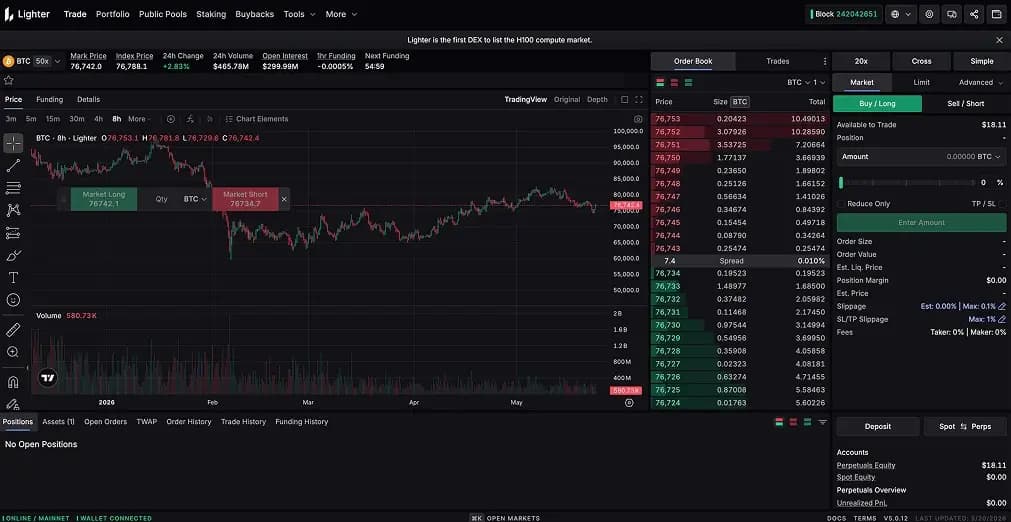
Lighter charges 0% maker and 0% taker on standard accounts across every perpetual market; the premium account tier pays 0.002% maker and 0.02% taker for faster matching priority. The exchange runs on its own zk-rollup, with cryptographic proofs covering both order matching and liquidations.
Scale already justifies inclusion. Lighter cleared roughly $254B in Q1 2026 perpetual volume per DefiLlama, making it the third-largest perp DEX behind Hyperliquid and Aster. The platform also leads the early RWA derivatives segment with ~$280M of open interest on tokenized stocks and FX as of December 2025, with a 2026 roadmap covering RWA spot, portfolio margin, and prediction markets.
Funding mirrors Hyperliquid: connect an EVM wallet, deposit USDC via the Ethereum L2 bridge, trade. There is no KYC and no fiat path. The honest caveat is that Lighter is newer than every other platform here, so size positions against the typical risks of an early-stage perp DEX: sequencer uptime, oracle integrity, and the pending LIT token generation event. Our Lighter explainer covers the architecture.
Pros
- True 0% maker and 0% taker fees on standard accounts across every market.
- ZK-proof execution covers order matching and liquidations onchain.
- Leads the RWA derivatives segment with $280M+ open interest.
Cons
- Shorter track record than Hyperliquid or major CEXs.
- USDC-only collateral with no fiat funding paths.
- Premium latency tier reintroduces a small maker and taker fee.
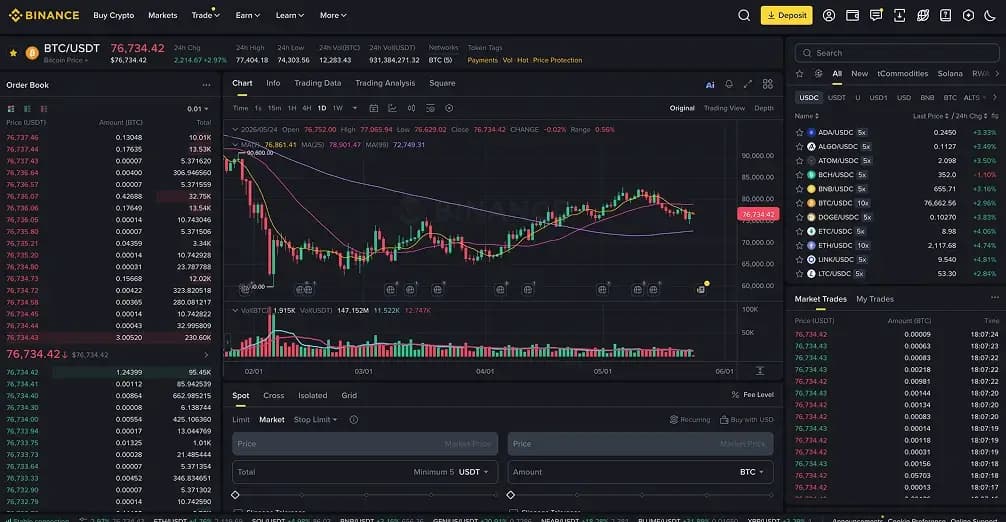
4. Binance - Cheapest Exchange for USDC Pairs and Deep Liquidity
Binance spot starts at 0.10% maker and taker, but the platform permanently lists multiple USDC pairs at 0% maker and 0% taker. The Binance futures fee schedule shows USD-M perpetuals at 0.02% maker and 0.05% taker at base tier, with a further 10% reduction when fees are paid in BNB.
Liquidity is the underrated cost saver. On BTC and ETH perpetuals, Binance's order book depth means realized slippage on a $100K market order is often a small fraction of the fee itself, so the all-in round-trip cost can sit well below platforms optimizing only the headline rate. VIP 9 reaches 0% maker and 0.017% taker on futures, though those volume requirements are institutional.
Regional access is the constraint. Binance.com excludes US residents, who use Binance.US (0% maker and 0.02% taker on all spot pairs since April 2026). EU users trade under MiCA via member-state CASPs; Australia operates as an AUSTRAC-registered DCEP; UK marketing has periodically faced FCA restrictions. SEPA, Faster Payments, OSKO/PayID, and stablecoin deposits all clear at low cost.
Pros
- Permanent zero-fee USDC spot pairs across BTC, ETH, and other majors.
- Deep liquidity keeps realized slippage low even at large order sizes.
- BNB-funded fees and VIP tiers compound into very low effective rates.
Cons
- US users cannot access Binance.com; Binance.US has narrower derivatives.
- Base 0.10% spot rate is uncompetitive without USDC pairs or BNB discounts.
- Meaningful VIP tiers start at six-figure monthly volume.
5. Bybit - Top USDC Discount Tiers Across Spot and Perps
Bybit charges 0.10% on spot and 0.02% maker / 0.055% taker on perpetual contracts at base tier, per Bybit's fee structure page. The March 2026 USDC ecosystem update halved taker fees across USDC spot and futures for eligible VIPs, with Supreme VIP rates from 0.0225%.
EU access runs through Bybit EU GmbH, which holds MiCA authorization granted by Austria's FMA under registration FN 636180i, with passporting across the EEA. The dedicated affiliate slug is /go/bybit-eu. The global Dubai entity operates under VARA and serves Australia, Asia, and Latin America. US users cannot fund accounts.
SEPA Instant deposits are free, USD wires settle within one business day, and OSKO/PayID rails work for Australian users through the Hong Kong settlement layer. The European service intentionally limits derivatives access, so EU users seeking perps default to the global entity (where MiCA protections no longer apply).
Pros
- MiCA-licensed Bybit EU GmbH covers the entire EEA market.
- USDC taker fees cut by up to 50% across spot and futures in March 2026.
- SEPA Instant, OSKO/PayID, and USD wires settle within one business day.
Cons
- Base 0.10% spot rate trails MEXC, Binance USDC pairs, and Bitget VIPs.
- No service for US-based users; geo-block applies at the funding layer.
- Bybit EU intentionally limits derivatives access for European users.
.webp)
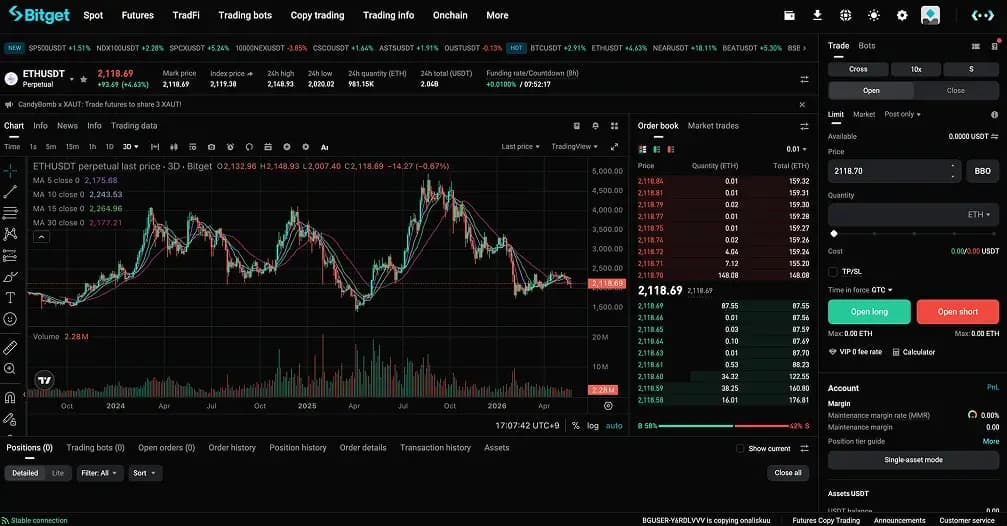
6. Bitget - Aggressive VIP Perp Fee Scaling with Copy Trading
Bitget charges 0.10% on spot and 0.02% maker / 0.06% taker on perpetual futures at base tier, with top-tier accounts reaching 0% maker / 0.02% taker on perps. Holding BGB stacks an additional 20% discount, and frequent zero-fee promotions on USDC and stablecoin pairs create effective free trading windows.
Regional licensing has expanded fast. Bitget runs a MiCA-licensed European entity covering the EEA, holds AUSTRAC registration in Australia, and operates a VARA-licensed Dubai office. The main global business remains based in the Seychelles, and US users cannot register.
Funding through USDT or USDC on TRC-20, ERC-20, or BSC is the cheapest path; SEPA card top-ups typically carry a 2% to 2.5% processor fee that erases the fee advantage on smaller orders. Copy trading is the platform's strongest secondary product, with leaderboards ranked by ROI, drawdown, and follower profitability.
Pros
- Top-tier perp fees drop to 0% maker and 0.02% taker through VIP discounts.
- MiCA-licensed Bitget EU entity covers the full EEA market.
- BGB token stacks an additional 20% discount on VIP rates.
Cons
- Base 0.10% spot fee is uncompetitive without BGB or VIP tier benefits.
- US users cannot register or fund accounts.
- Card top-up fees often exceed the savings from lower trading fees.
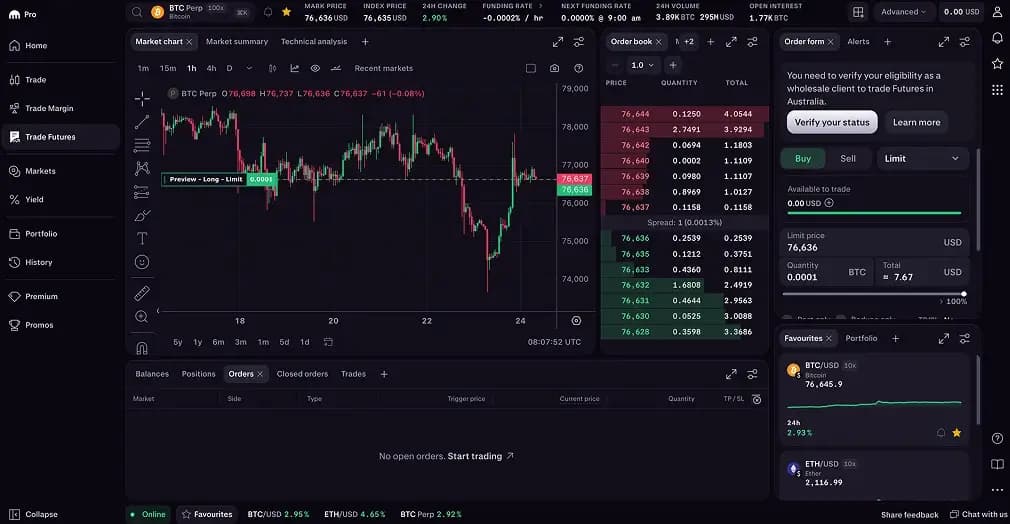
7. Kraken - Cheapest Regulated Exchange for US, UK, Canada and Australia
Kraken is the regulated low-fee option for US, UK, Canada, and Australia. The Kraken Pro fee schedule starts at 0.16% maker and 0.26% taker under $50K monthly volume, tapering to 0% maker and 0.10% taker beyond $10M. Kraken Futures is materially cheaper at 0.02% maker and 0.05% taker base.
The Kraken+ subscription is the standout for low-volume users: $10K of monthly spot trading at 0% fees plus doubled rewards on USDG holdings, the platform's regulated stablecoin. For traders treating Kraken as a primary CEX rather than a derivatives venue, that subscription offsets most of the higher base rates.
Regulatory coverage is the broadest on the page. Kraken operates as Payward Inc. in the US (FinCEN-registered with MTLs across most states), Bit Trade Pty Ltd in Australia (AUSTRAC, ACN 163 237 634), Payward Ltd. in the UK (FCA-registered cryptoasset business), and Payward Europe Digital Solutions Ltd. in Ireland under MiCA. ACH, FPS, OSKO/PayID, and SEPA Instant all clear within hours.
Pros
- Kraken+ subscription allows $10K of monthly spot trading at 0% fees.
- Regulated entities in the US, UK, Australia, Ireland, and Canada.
- Local fiat rails clear within hours at no cost across major regions.
Cons
- Kraken Pro base spot fees exceed most platforms on this list.
- Maker fees exceed taker fees at the entry tier, an unusual inverted structure.
- Kraken Futures is unavailable in several US states and most of Canada.
What Are Low-Fee Crypto Exchanges?
Low-fee crypto exchanges charge minimal maker and taker fees relative to industry averages. Across centralized venues, the typical baseline is roughly 0.10% spot and 0.02% to 0.05% on perpetuals; anything materially below that without token gating qualifies as genuine low-fee.
Onchain perpetual DEXs have shifted the benchmark further. Hyperliquid's maker rebates and Lighter's zero-fee standard accounts mean active onchain traders can pay nothing (or receive small payments) for providing liquidity. The trade-off is the loss of fiat rails and the burden of self-custody, including signing approvals, wallet hygiene, and bridge risk.
Realized cost matters more than the headline rate. A 0.04% taker fee paid twice on a 100x perp is an 8% hit on collateral per round trip; a thin order book that slips 5 basis points per fill can outweigh a perfectly zero fee. Our methodology favors platforms publishing fees transparently where realized round-trip cost (fees plus slippage plus funding) holds up across major pairs.
Hidden Crypto Exchange Costs to Consider
A 0% headline fee is meaningless if the platform recovers margin through other layers. The recurring traps we run into:
- Wide spreads on illiquid pairs: Some zero-fee promotions sit on pairs with bid-ask spreads of 20 to 50 basis points, which costs more than a 0.05% taker fee on a deep book.
- Funding rate drag: Even with zero trading fees, a 0.01% funding payment every 8 hours adds up to roughly 11% annualized on a one-sided directional position.
- Volume-gated VIP rates: The cheapest tiers on Binance, Bybit, and Kraken typically require six-figure monthly volume and are unrealistic for retail size.
- Token-staking requirements: MX, BNB, BGB, and similar tokens unlock real discounts but tie capital to a volatile asset.
- Card and SEPA processor fees: SEPA card deposits typically cost 2% to 2.5%, which erases hundreds of basis points of trading fee savings on small first deposits.
- Withdrawal network fees: A flat $1 to $5 withdrawal cost is a meaningful percentage hit on small balances; TRC-20 USDT is usually cheapest.
- Slippage on perp DEXs: Onchain perps without zero gas can pay $0.50 to $5 per trade in network fees, on top of the trading commission.
.webp)
How Fees Compare Across Regions
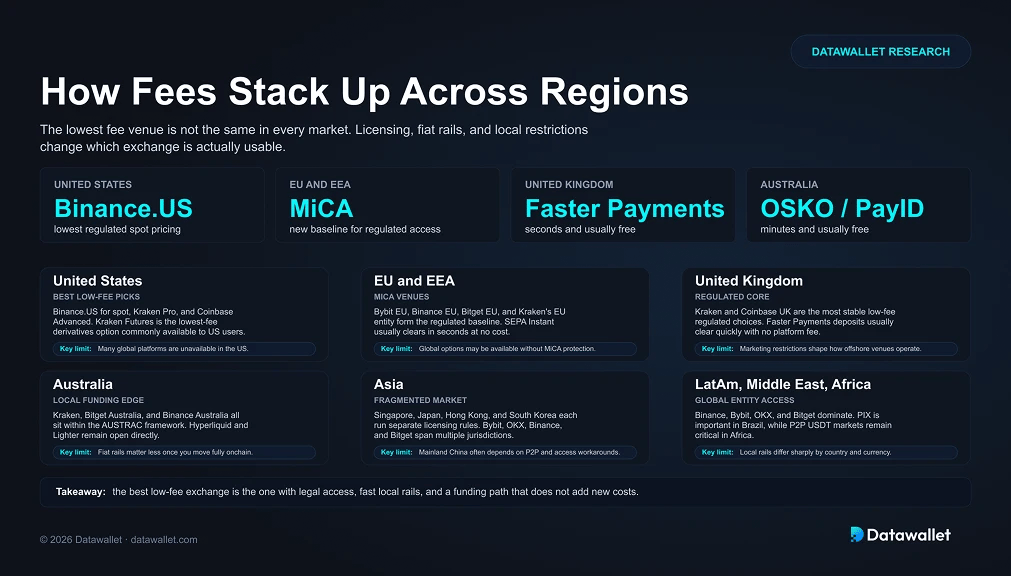
The lowest fees only matter if you can actually fund the account. Regional licensing, payment rails, and fee structures change the optimal pick enough that it varies meaningfully by country.
United States
US residents are excluded from Hyperliquid, Lighter, Binance.com, MEXC, Bybit, and Bitget. The realistic low-fee options are Binance.US (0% maker and 0.02% taker spot since April 2026), Kraken Pro, and Coinbase Advanced. Binance.US offers the lowest spot fees among regulated US venues; Kraken Futures is the cheapest US-accessible derivatives product with an MTL footprint across most states.
European Union and EEA
MiCA authorization is now the baseline for serving EU residents. Bybit EU GmbH (Austria's FMA, FN 636180i), Binance's various member-state CASPs, Bitget's EU entity, and Kraken's Payward Europe Digital Solutions Ltd. are all MiCA-authorized. Bybit EU and Binance EU lead on regulated spot fees, while MEXC and Hyperliquid remain available through their global offerings without MiCA protections. SEPA Instant clears in seconds at no cost on every MiCA venue tested.
United Kingdom
The FCA maintains a register of cryptoasset businesses cleared for AML compliance. Kraken (Payward Ltd.) and Coinbase UK are the two most stable low-fee regulated options; Bybit and Bitget operate under the global entity with marketing restrictions. Faster Payments deposits typically clear within seconds at no fee across the regulated venues.
Australia
AUSTRAC registration as a Digital Currency Exchange Provider is the local baseline. Kraken (Bit Trade Pty Ltd, ACN 163 237 634) is the lowest-fee regulated CEX for Australian users, with Bitget Australia and Binance Australia also AUSTRAC-registered. Hyperliquid and Lighter are accessible directly with no geographic restriction. OSKO/PayID deposits clear within minutes at no cost.
Asia
Singapore (MAS), Japan (FSA), Hong Kong (SFC), and South Korea (FSC) each run their own licensing regimes. Bybit, OKX, Binance, and Bitget hold licensing or registrations across multiple Asian markets; MEXC operates through the Seychelles global entity, with VPN access typically required inside mainland China. Our best crypto exchanges in China guide covers the CNY P2P specifics through Alipay and WeChat Pay.
Latin America, Middle East, and Africa
Regional users typically access Binance, Bybit, OKX, and Bitget through the global entity. Brazilian users have local PIX rails on Binance and Bitget; UAE and Saudi traders benefit from VARA-licensed Dubai entities for Bybit, Bitget, and OKX. African traders in Nigeria, South Africa, and Kenya usually fund through P2P USDT markets, with most major exchanges supporting local currency offers.
How to Choose a Low-Fee Crypto Exchange
The right answer depends on what you trade and where you live. Use the following criteria before opening an account.
- Match the product to the cheapest tier: MEXC for spot maker orders and altcoin perps, Hyperliquid or Lighter for onchain perps, Binance for USDC pairs and BTC/ETH depth, Kraken for regulated spot in the US, UK, and AU.
- Confirm licensing for your jurisdiction: Bybit EU GmbH for MiCA-protected EU access, Kraken for FinCEN/FCA/AUSTRAC coverage, AUSTRAC-registered DCEPs for Australian users.
- Calculate the realized round trip: Fees plus average slippage plus funding cost over your typical hold time. Cheap fees on a thin book often lose to slightly higher fees on a deep one.
- Verify funding rails for your country: SEPA Instant in the EU, OSKO/PayID in Australia, ACH or FedNow in the US, Faster Payments in the UK, PIX in Brazil.
- Watch the discount stack: BNB, MX, and BGB stack on VIP tiers but require capital allocation; the break-even depends on volume.
- Check derivatives access in your region: Bybit EU, Coinbase, and Binance EU restrict derivatives for retail; Hyperliquid and Lighter restrict US.
- Test the deposit and withdrawal cycle first: A $50 test deposit and immediate withdrawal exposes any hidden processor fees, KYC friction, or hold periods before serious capital moves.
Risks of Chasing the Cheapest Trading Fees
Low fees can come with structural risks that materially exceed the savings, especially on newer or offshore venues.
- Counterparty risk: Offshore exchanges without insurance funds or proof-of-reserves can fail entirely; FTX showed this is not a hypothetical.
- Withdrawal freezes: Light-KYC platforms typically apply harder withdrawal limits or holds when usage patterns trigger AML review.
- Regulatory exits: US, UK, and EU enforcement has caused multiple platforms to exit specific markets at short notice, sometimes with funds locked during the process.
- Smart contract risk: Perpetual DEXs add oracle, bridge, sequencer, and ZK-prover risks on top of normal market risk.
- Token incentive cliffs: Native token discounts disappear when the token loses value, often during the moments traders need fee savings the most.
- Slippage on listing days: Promotional zero-fee periods often coincide with new listings where order book depth is thin and price impact is high.
- Self-custody errors: Onchain venues shift the loss surface to wallet hygiene, signing approvals, and bridge integrity.
Final Thoughts
Low fees compound in your favor over hundreds of trades; structural risk compounds against you when something breaks. The cleanest setup for most traders is a regulated low-fee CEX for primary capital (Binance EU, Bybit EU, Kraken, or Binance.US depending on country), with a cheaper secondary venue for perpetual trading once size and conviction justify it.
MEXC, Hyperliquid, Lighter, Binance, Bybit, Bitget, and Kraken each fit a different role. MEXC and Bitget reward active perpetual traders willing to use offshore venues. Hyperliquid and Lighter give onchain access with rebates, zero-fee economics, and growing RWA market depth. Binance, Bybit, and Kraken stay relevant because liquidity, licensing, and fiat rails matter more than basis points once positions get large.
Our Methodology
We evaluated more than 30 centralized and decentralized exchanges that publish maker-taker fee schedules, prioritizing platforms serving multiple regulated jurisdictions and producing meaningful daily trading volume.
Here is how we evaluated each exchange:
- Headline Fees: We compared base maker and taker fees for spot and perpetuals using each platform's published fee schedule, isolating the rates that apply without VIP tiers or token holdings.
- Discount Stack: We tested how VIP tiers, native token holdings, USDC pair promotions, BNB-style payment discounts, and subscription products like Kraken+ combine to lower the realized rate.
- Realized Round Trip: We placed test orders on every platform to measure fill cost (fees plus slippage) on major pairs at retail order size, then scaled the estimate to typical position sizes.
- Funding Mechanics: We checked perpetual funding cadence (4 to 8 hours on most CEXs, 1 hour on Hyperliquid and Lighter) and the implied annualized cost on persistent directional positions.
- Regional Licensing: We confirmed which legal entity serves users in the US, UK, EU/EEA, Australia, and Asia, and verified each license against the issuing regulator's public register.
- Funding Rails: We tested SEPA Instant, Faster Payments, OSKO/PayID, ACH, USD wires, and stablecoin deposits across TRC-20, ERC-20, BSC, Solana, and Arbitrum for speed, cost, and reliability.
- Withdrawal Costs: We checked withdrawal network fees, hold periods, and minimum amounts, as these costs disproportionately affect smaller balances.
- Transparency: We favored platforms with detailed public fee schedules, proof-of-reserves disclosures, and visible API documentation over those relying on vague marketing claims.
- Risk Profile: We weighted insurance funds, ADL ranking transparency, audit history, and prior incident response when comparing platforms with similar headline fees.

.webp)