
Bybit Futures Review: Fees, Leverage & Country Restrictions
Summary: Bybit Futures lists roughly 740 derivatives pairs on CoinGecko, with up to 100x standard leverage, 200x Smart Leverage, copy trading, bots, portfolio margin, and Proof of Reserves.
Its base futures fees are 0.0200% maker and 0.0550% taker, while funding rates update every minute and settle at contract-specific intervals, commonly every eight hours.

Bybit Futures Review
Bybit Futures combines broad derivatives coverage, competitive fees, advanced trading tools, demo access, Proof of Reserves, and regional compliance limits for active crypto traders.
Supported Contracts
740+ perpetual pairs (including TradFi), plus dated quarterly futures
Futures Trading Fees
0.020% maker, 0.055% taker, lower for some newer markets
Regulation and Licensing
KYC mandatory, licensed in Dubai and expanding in the EU
Bybit ranks as the second-largest crypto derivatives exchange by open interest with more than $11 billion in reported open interest. That scale makes it a top platform for traders seeking liquidity, execution depth, and advanced perpetual futures infrastructure.
Still, market size should be only one part of the decision. Fees, leverage limits, funding mechanics, security controls, supported contracts, mobile tools, demo trading, and regional restrictions can matter just as much as trading volume.
Read our full review to see how the platform performs across fees, contracts, leverage, tools, security, regulations, and user experience. 👇
What Is Bybit Futures?
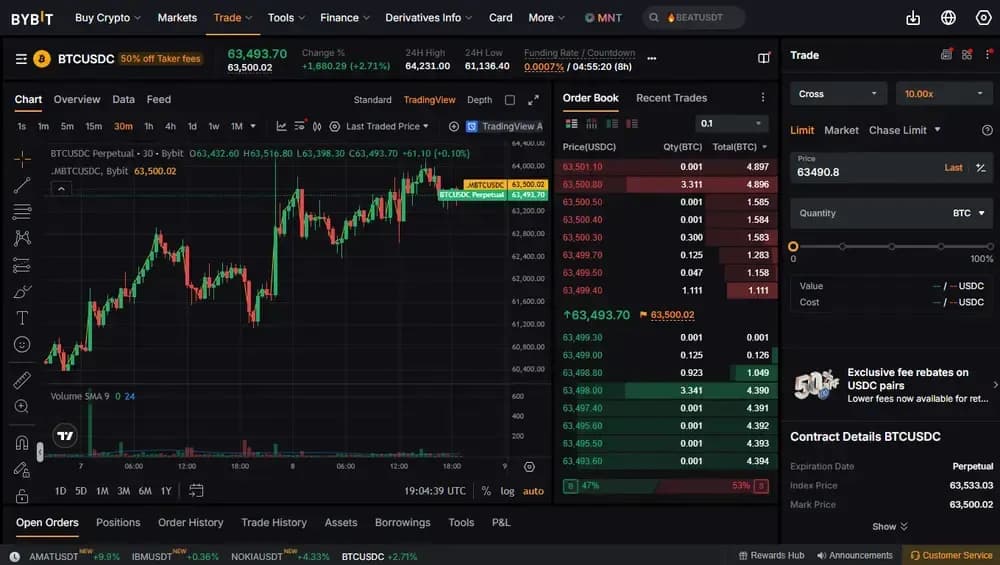
Bybit Futures is the exchange’s derivatives trading area for crypto contracts, built around perpetual and expiry markets rather than direct coin ownership. Traders can speculate on price movements, hedge spot holdings, or manage directional exposure through contracts margined and settled in USDT, USDC, or supported base assets.
The futures site supports long and short positioning, which means users can trade rising or falling markets without holding the underlying asset. Its main contract categories include USDT perpetuals, USDC perpetuals, inverse perpetuals, and expiry futures, giving traders different settlement currencies, margin structures, and risk profiles.
Perpetual contracts are central to Bybit Futures because they have no fixed expiry date and use funding payments to keep contract prices close to the underlying index. Expiry futures follow a set settlement schedule, making them more suitable for traders who want defined time horizons and clearer delivery-cycle planning.
Risk management is built into the perpetual futures interface through leverage controls, isolated margin, cross margin, portfolio margin, mark price, maintenance margin, and tiered risk limits. Maximum leverage depends on the contract and position size, while larger positions generally require more margin, helping reduce excessive concentration on a single market.
How to Use Bybit Futures
Using Bybit Futures starts with account setup, verified access, funded collateral, market selection, order configuration, margin control, and disciplined risk monitoring before active trading.
Follow these steps to trade futures on Bybit properly:
- Create Account: Register with an email address or mobile number, secure the login with two-factor authentication, and confirm that futures trading is available in your supported region.
- Verify KYC: Complete KYC identity verification with the required personal details and documents, since KYC status can affect account limits, withdrawals, deposits, and derivatives access.
- Deposit Funds: Add crypto or fiat through supported deposit methods, then check network selection, minimum deposit requirements, transaction confirmations, and wallet balance before trading.
- Transfer Collateral: Move funds into the Unified Trading Account or derivatives wallet, depending on account setup, so the balance can be used as futures margin.
- Choose Market: Select a futures contract such as BTCUSDT, ETHUSDT, USDC perpetuals, inverse perpetuals, or expiry futures based on liquidity, volatility, and settlement currency.
- Set Margin: Choose isolated, cross, or portfolio margin before opening a position, since each mode changes how collateral is allocated and how liquidation risk is managed.
- Adjust Leverage: Set leverage according to position size and risk tolerance, understanding that higher leverage reduces margin needs but increases liquidation sensitivity.
- Place Order: Enter a market, limit, or conditional order, then define direction, contract quantity, entry price, reduce-only settings, and execution preferences.
- Manage Risk: Add stop-loss and take-profit levels, monitor mark price, maintenance margin, liquidation price, funding fees, and avoid oversized positions during volatile sessions.
- Close Position: Exit manually, through preset TP/SL triggers, or with reduce-only orders, then review realized PnL, trading fees, funding costs, and order history.
Types of Futures Contracts on Bybit
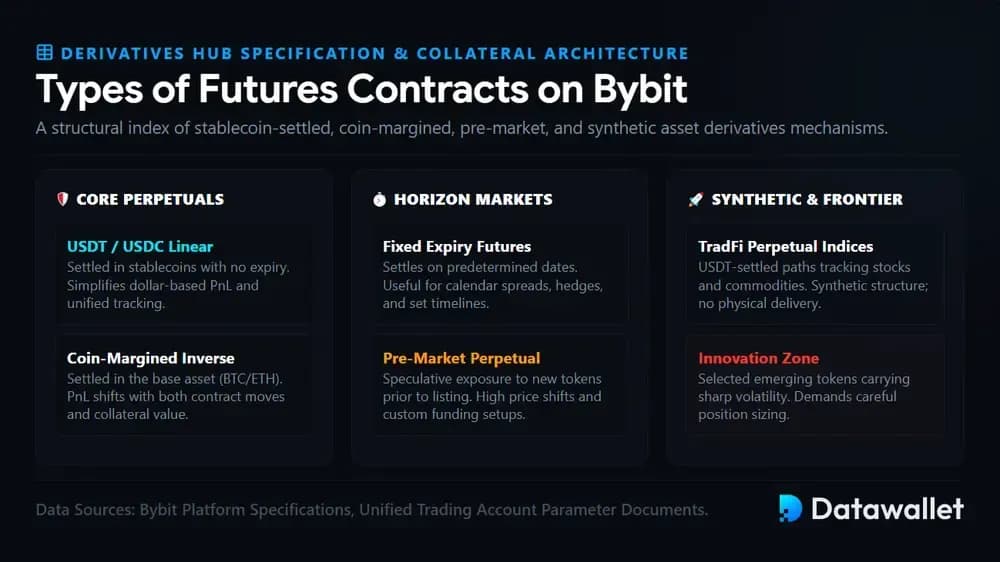
Bybit Futures includes stablecoin-settled, coin-margined, fixed-expiry, pre-market, TradFi, and higher-risk innovation contracts, giving traders multiple ways to manage exposure, collateral, and settlement preferences.
1. USDT and USDC Perpetual Contracts
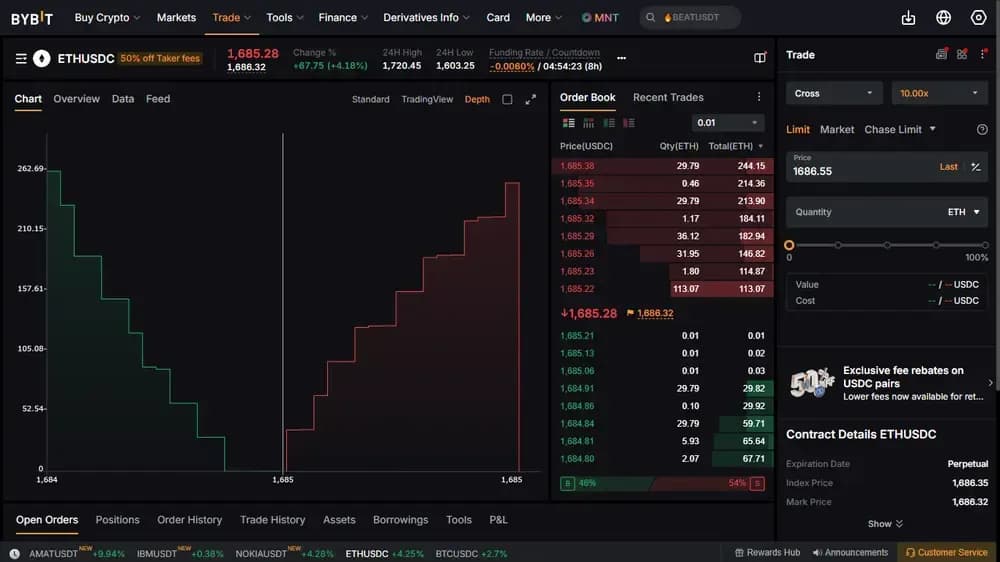
USDT and USDC perpetual contracts are stablecoin-settled derivatives with no fixed expiry date. Traders can open long or short positions, keep exposure as long as margin requirements are met, and calculate profit, loss, fees, and collateral needs in either USDT or USDC.
These contracts are popular because their stablecoin settlement makes performance easier to track against dollar-based account balances. USDT markets usually offer broad pair coverage, while USDC perpetuals can suit traders who prefer USDC settlement, Unified Trading Account support, and clearer stablecoin-denominated PnL tracking.
2. Inverse Perpetual Contracts
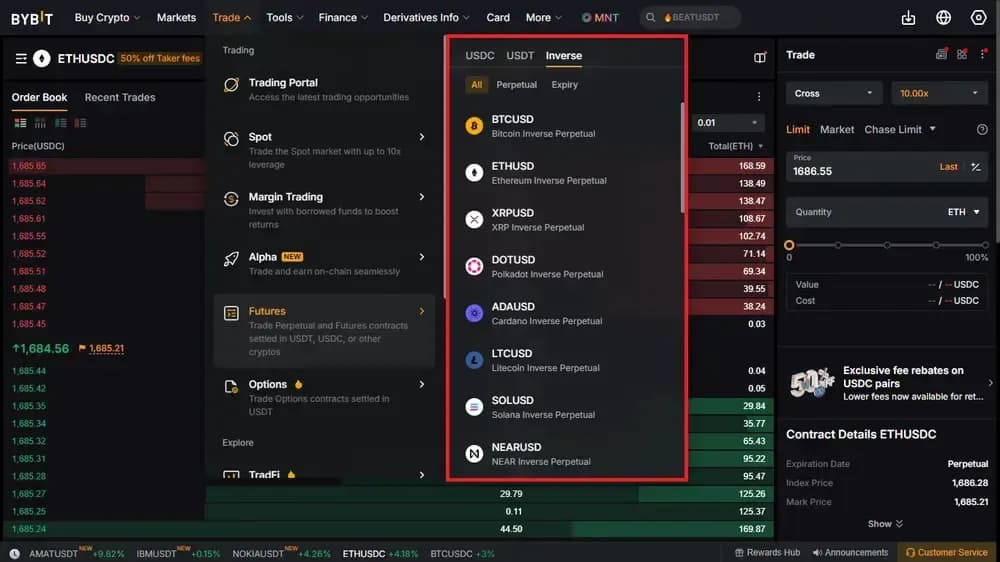
Inverse perpetual contracts are coin-margined derivatives settled in the underlying asset, such as BTC or ETH. They have no expiry date, and profit or loss is calculated in the base coin rather than a stablecoin.
This structure can appeal to traders who hold crypto long term and want futures exposure without converting collateral into USDT or USDC. It also changes risk, since collateral value moves with the underlying asset.
Key features traders should review before selecting inverse perpetuals:
- Uses underlying crypto as margin and settlement currency.
- No fixed expiry date for active positions.
- PnL changes with both contract and collateral value.
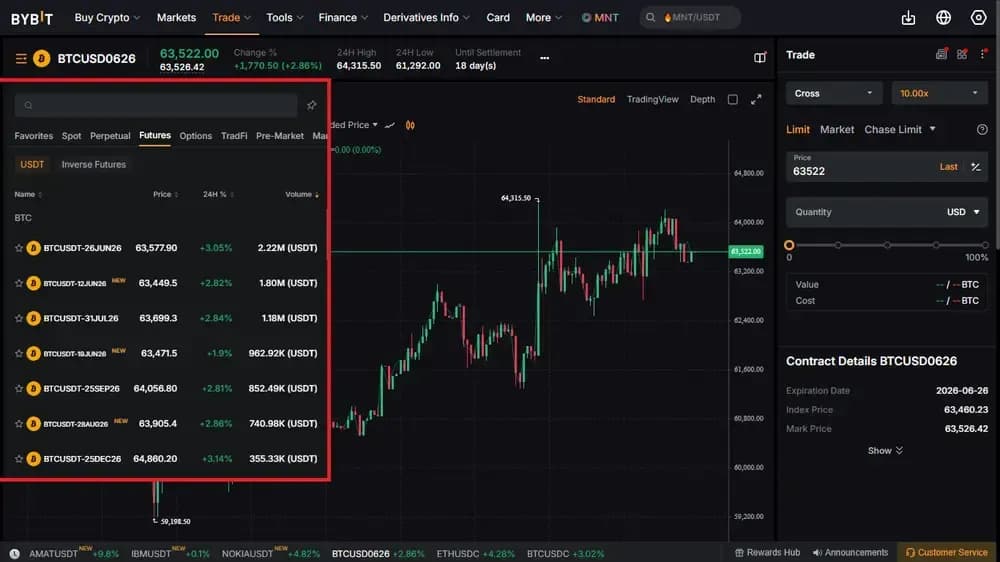
3. Expiry Futures Contracts
Expiry futures contracts have a fixed settlement date, meaning positions are closed or settled according to the contract schedule. Bybit supports expiry structures across selected USDT, USDC, and inverse markets, giving traders defined time horizons instead of open-ended perpetual exposure.
These contracts may fit strategies based on calendar spreads, directional views over a set period, or hedging around known market events. Since expiry futures settle at a predetermined time, traders must track settlement dates, liquidity changes, and position management before contract maturity.
4. Pre-Market Perpetual Contracts
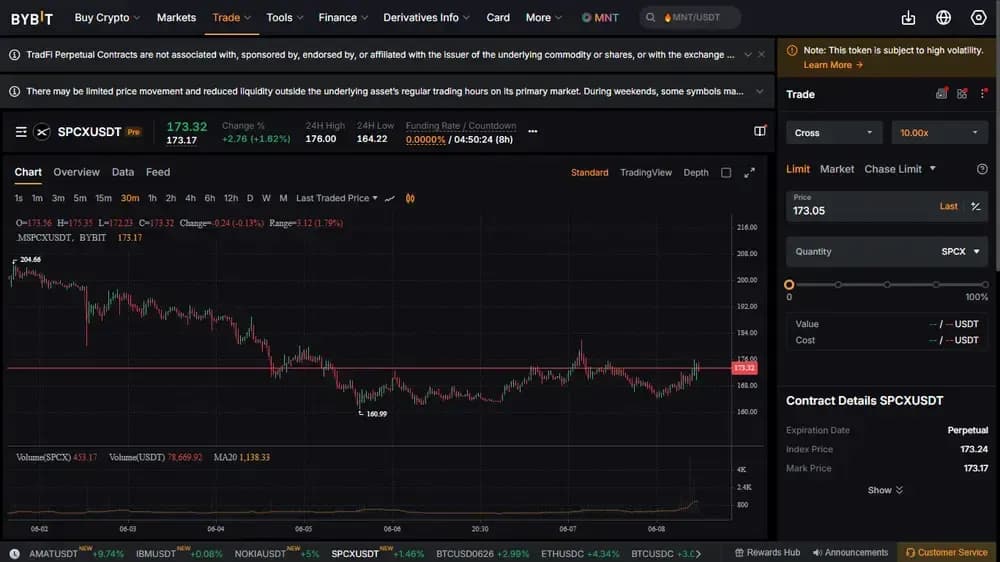
Pre-market perpetuals allow traders to speculate on selected new tokens before official Bybit spot or derivatives listings. They are designed for early price discovery, but liquidity, volatility, and contract rules can differ from standard perpetual markets.
Because these products involve assets before broader exchange availability, pricing can move sharply as expectations change. Traders should treat them as higher-risk contracts and review launch details, funding rules, and settlement conditions carefully.
Important points before trading pre-market perpetual contracts:
- Built for early exposure to selected upcoming tokens.
- Pricing can shift quickly before official listing events.
- Contract rules may differ from standard perpetual markets.
5. TradFi Perpetual Contracts
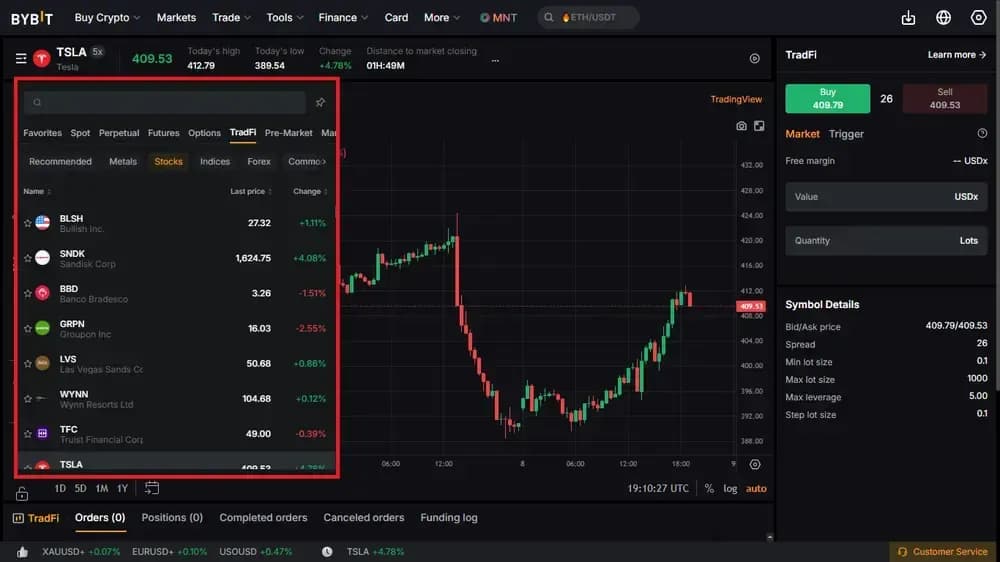
Bybit’s TradFi perpetual contracts are USDT-settled derivatives that track traditional financial assets, allowing crypto users to trade price exposure without holding the underlying stock, index, commodity, or related instrument. They follow perpetual-style mechanics, including margin, funding, mark price, and liquidation processes.
These contracts do not grant ownership rights, dividends, shareholder voting, or physical delivery of the tracked asset. They are better understood as synthetic price exposure inside Bybit’s derivatives platform, with contract parameters adjusted to reflect characteristics of traditional markets.
6. Perpetual Trading Innovation Zone
The Perpetual Trading Innovation Zone lists selected perpetual contracts connected to newer or higher-risk crypto projects. These markets can provide early derivatives exposure, but Bybit notes that they may carry higher volatility and stronger risk considerations.
Traders use this category when seeking exposure beyond major futures pairs, especially around emerging assets. Before entering, it is important to check liquidity, funding behavior, leverage limits, and whether the contract fits the trader’s risk plan.
Key checks before using Innovation Zone perpetual contracts:
- Focuses on selected emerging or higher-risk crypto projects.
- May involve stronger volatility than established futures markets.
- Requires stricter position sizing and active risk monitoring.
Bybit Supported Cryptocurrencies and Leverage
Bybit Futures supports a broad derivatives market across 2,800+ coins, altcoins, and newer listings. CoinGecko lists Bybit Futures at roughly 740 trading pairs, while Bybit’s spot market data shows hundreds of supported coins, giving futures traders wide coverage beyond BTC and ETH pairs.
Leverage varies by contract, asset, and risk tier. Bybit materials reference up to 125x leverage on BTCUSDT under the minimum risk limit, while selected USDT perpetual markets may offer lower caps, such as 10x on some new listings. Inverse BTCUSD contracts can also reach 100x.
Bybit’s Smart Leverage adds a separate structured-product format, with Bybit stating that users can take long or short exposure on selected tokens with up to 200x leverage. It reduces premature liquidation risk before settlement, but it is non-principal-protected, so losses remain possible.
Bybit Futures Fees and Funding Rates
Bybit Futures costs combine maker-taker trading fees, funding transfers, expiry settlement charges, delisting rules, and special-market pricing that varies by product, VIP tier, and account region.
These are the main costs futures traders should track:
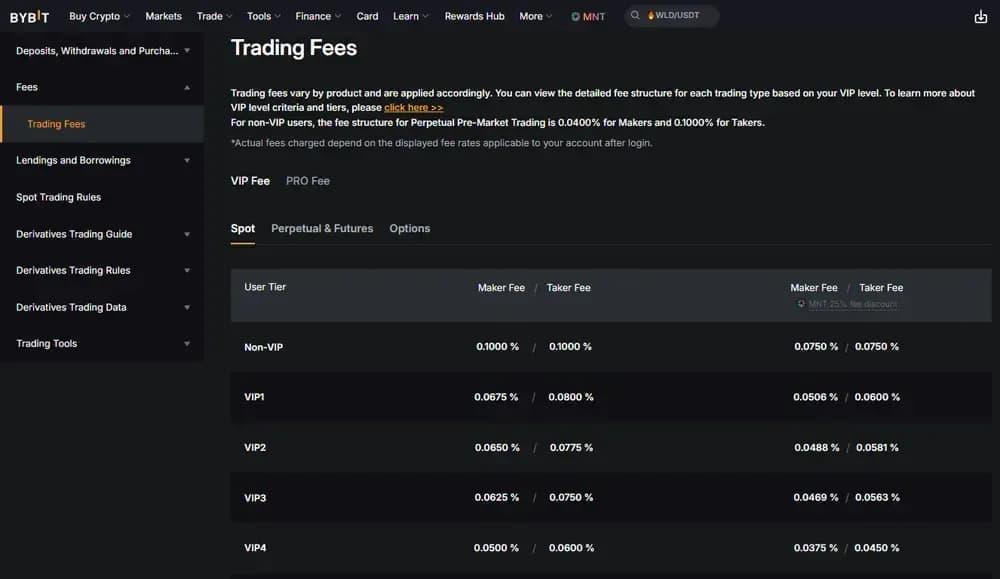
- Trading Fees: Standard non-VIP perpetual and futures trading uses 0.0550% taker and 0.0200% maker fee pricing, while VIP tiers reduce rates based on eligibility.
- VIP Discounts: The official fee table lowers derivatives fees progressively, reaching 0.0300% taker and 0.0000% maker for Supreme VIP accounts.
- USDT Fees: USDT perpetual and expiry fees use order value multiplied by fee rate, with order value calculated from quantity and executed price.
- USDC Fees: USDC perpetual contracts also list 0.055% taker and 0.02% maker fees, calculated from order quantity multiplied by executed price.
- Inverse Fees: Inverse perpetual and expiry contracts use the same standard rates, but order value is calculated as contract quantity divided by executed price.
- Funding Rates: Bybit perpetual funding is usually settled every 8 hours at 00:00, 08:00, and 16:00 UTC, though some contracts can shift to 1-hour or 4-hour intervals based on market conditions.
- Funding Direction: A positive funding rate means longs pay shorts, while a negative rate means shorts pay longs; Bybit can restore adjusted 1-hour funding after rates stay within ±0.025% for 16 periods.
- Funding Formula: USDT and USDC position value uses quantity multiplied by mark price, while inverse contracts use quantity divided by mark price.
- Settlement Fees: Inverse expiry contracts charge a fixed 0.05% settlement fee at expiration, while Bybit states USDT expiry contracts charge no settlement fee.
- Special Markets: Pre-market perpetuals charge 0.1000% taker and 0.0400% maker for VIP 0, while Innovation Zone takers start at 0.1100%.
Risk Management Tools on Bybit Futures
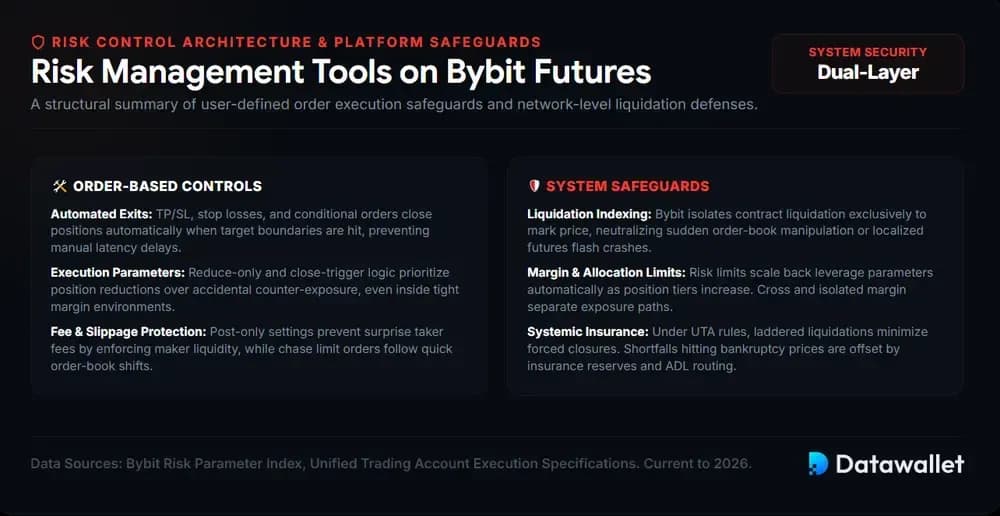
Bybit Futures combines trader-controlled order settings with platform-level protection systems, helping users define exits, reduce position mistakes, monitor liquidation risk, and understand what happens during extreme market moves.
Order-Based Risk Controls
Bybit lets traders manage risk before and after entry through TP/SL, conditional orders, closing settings, and execution controls that define when positions open or reduce.
These tools help traders automate exits and limit mistakes:
- Stop Loss: Stop-loss orders are designed to limit losses on open positions, with trigger settings available through Bybit’s TP/SL function for futures trades.
- Take Profit: Take-profit orders close positions when the selected profit target is reached, helping traders secure gains without manually watching every price movement.
- Conditional Orders: Conditional orders activate only after a trigger price is reached, allowing traders to plan entries or exits around predefined market levels.
- Chase Limit Orders: Special orders that automatically adjust bid or ask prices to follow market movement, reducing missed entries during rapid fluctuations.
- Reduce-Only: Reduce-only orders can decrease an existing position, but cannot increase exposure or accidentally open a larger position in the opposite direction.
- Close Trigger: Close on Trigger is used with conditional orders to prioritize position closing, helping execution even when available margin is limited.
- Post-Only: Post-only orders ensure limit orders enter the order book as maker orders, reducing unexpected taker execution and controlling trading-fee impact.
- Trigger Price: Bybit allows trigger-price selection for stop orders, but liquidation is based on mark price, so trigger settings must be checked carefully.
Platform-Level Protection Mechanisms
Beyond manual order settings, Bybit uses margin rules, mark price, liquidation processes, insurance reserves, and ADL to manage system risk during stressed futures markets.
These mechanisms shape liquidation exposure and exchange-side protection:
- Mark Price: Bybit uses mark price under its dual-price mechanism to reduce manipulation risk, and futures liquidation is triggered when mark price hits liquidation price.
- Maintenance Margin: Maintenance margin is the minimum required margin to keep a position open, and falling below this threshold can trigger liquidation procedures.
- Risk Limits: Risk limits cap exposure by position tier, adjusting margin requirements as position size increases and helping reduce concentrated leverage risk.
- Margin Modes: Isolated margin limits risk to a specific position, while cross margin shares available account equity across positions to support margin requirements.
- Laddered Liquidation: Under Unified Trading Account rules, Bybit can use a laddered process to reduce maintenance margin requirements before full liquidation occurs.
- Insurance Fund: The insurance fund covers losses when liquidation closes worse than bankruptcy price, helping prevent profitable counterparties from absorbing excessive shortfalls.
- Auto-Deleveraging: ADL can reduce opposing traders’ positions when the insurance fund cannot fully absorb losses, prioritizing accounts by profit and leverage ranking.
- Position Monitoring: Traders can track liquidation price, margin ratio, unrealized PnL, mark price, and position size directly from the futures position panel.
Bybit Futures Security and Regulations
Bybit Futures uses several account-level protections, including two-factor authentication, fund passwords, anti-phishing safeguards, withdrawal controls, and identity verification. Its security center also covers Google Authenticator, YubiKey support, mobile and email verification, and account recovery workflows, giving futures users multiple layers of access protection.
For asset protection, Bybit says user funds are stored offline in cold wallets and protected through multi-signature controls, Trusted Execution Environment technology, and Threshold Signature Schemes. These measures are designed to reduce unauthorized access risk while separating operational security from user-side trading risks.
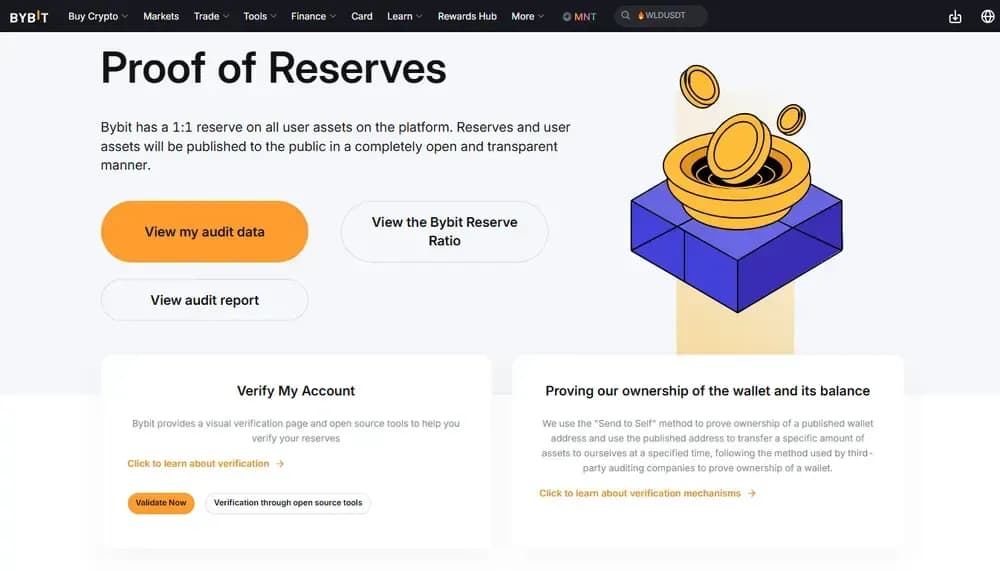
Bybit also publishes Proof of Reserves information, allowing users to verify supported asset balances through cryptographic reserve checks. Its PoR materials describe Merkle Tree verification and wallet-balance ownership processes, while public audit materials present reserves, liabilities, ownership, and assessment procedures for covered digital assets.
Regulatory access remains jurisdiction-dependent. Bybit restricts services for users in regions including the United States and the United Kingdom, while also highlighting work with international regulators, KYC controls, AML monitoring, and law-enforcement cooperation to strengthen platform oversight and user protection.
Pros and Cons of Bybit Futures
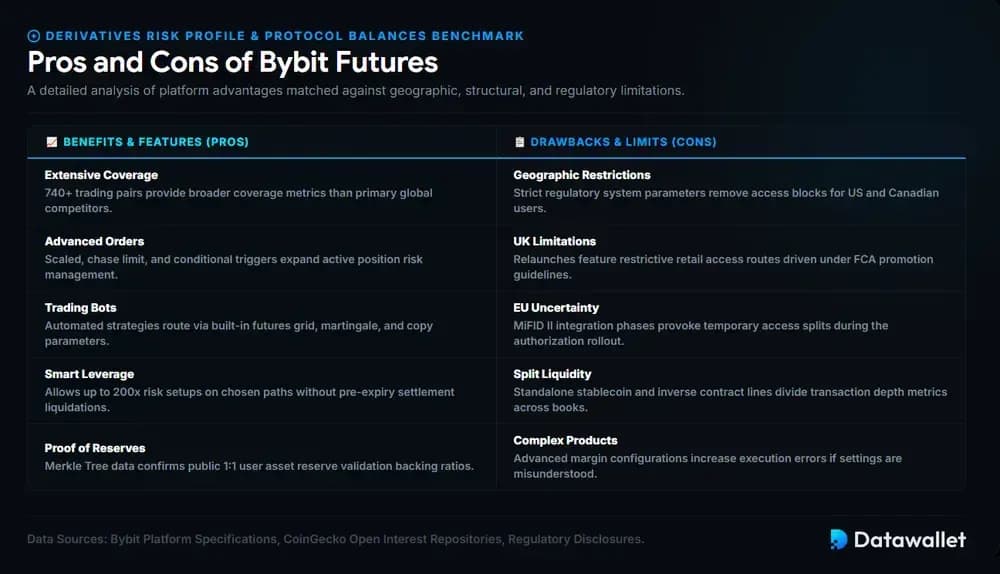
Bybit Futures offers broad market coverage, strong derivatives tooling, and transparent reserve reporting, but traders in 2026 must weigh product complexity, regional limits, and split liquidity carefully.
Benefits of Trading on Bybit Futures
Bybit’s strongest futures advantages come from market breadth, execution flexibility, automation tools, structured leverage products, and reserve transparency for active derivatives traders.
Key Bybit Futures pros include:
- Extensive Coverage: CoinGecko lists Bybit Futures at roughly 740 trading pairs, giving traders broader derivatives coverage than Binance Futures and OKX Futures by listed-pair count.
- Advanced Orders: Bybit supports scaled orders, chase limit orders, conditional orders, reduce-only execution, and TP/SL tools, giving active traders stronger control over entries and exits.
- Trading Bots: Futures grid bots, martingale bots, combo bots, and copy trading tools help automate strategies, though performance still depends on market conditions and user settings.
- Smart Leverage: Smart Leverage lets users take long or short exposure on selected contracts with up to 200x leverage and no liquidation before settlement.
- Proof of Reserves: Bybit publishes Proof of Reserves information, using Merkle Tree verification and public reserve ratios to show 1:1 backing for supported user assets.
Drawbacks of Using Bybit Futures
Bybit Futures also has limitations around jurisdiction access, regulatory structure, product complexity, liquidity distribution, and operational risk for traders using advanced margin features.
Main Bybit Futures cons include:
- Geographic Restrictions: Bybit restricts access in several jurisdictions, including the United States and Canada, which removes major markets from its global futures user base.
- UK Limitations: Bybit’s UK relaunch focuses on localized access under financial-promotion arrangements, while crypto derivatives remain heavily restricted for UK retail users under FCA rules.
- EU Uncertainty: Bybit EU has pursued MiFID II authorization for regulated derivatives, but access may differ from the global futures platform during licensing and rollout phases.
- Split Liquidity: Separate USDT, USDC, inverse, and expiry contracts can divide liquidity across markets, requiring traders to compare depth, spreads, and funding before execution.
- Complex Products: Smart Leverage, portfolio margin, pre-market perpetuals, and advanced order types can create operational mistakes when users misunderstand settlement, margin, or liquidation mechanics.
Bybit Futures Demo Trading and Mobile Experience
Bybit Demo Trading gives futures users a simulated environment with live market data and $1,000,000 in demo funds. Traders can test order types, leverage settings, TP/SL placement, and futures strategies before using real collateral, making it useful for beginners and experienced users testing new systems.
The Bybit mobile app supports derivatives trading alongside spot markets, copy trading, trading bots, portfolio access, alerts, and account management. Its futures interface is useful for monitoring open positions, adjusting margin, closing trades, and reacting quickly, although complex setups remain easier on desktop.
Binance Futures vs Competitors
Bybit competes with centralized leaders and decentralized perpetual exchanges across market breadth, leverage, fees, access rules, and execution design. The table below compares futures-focused platforms using current market-data pages, fee schedules, and official product documentation sources.
Final Thoughts
Bybit Futures is great for traders who want broad contract coverage, advanced order controls, automation tools, and competitive derivatives fees across stablecoin-settled and inverse markets.
Its main drawbacks are regional restrictions, product complexity, split liquidity across contract types, and the risks that come with leverage, funding payments, liquidation, and advanced margin settings.
Overall, Bybit Futures suits active crypto traders who understand derivatives risk and want a feature-rich platform, while beginners should start with demo trading and conservative position sizing.
Frequently asked questions

.webp)

.webp)
